Annual rents for single-family U.S. homes deteriorated across all price tiers in November as real estate investors continue to weather shifting post-pandemic market conditions.
“Rent growth slowed to its weakest pace in more than 15 years, signaling a broad-based cooling across the U.S. rental market as the market is adjusting after years of rapid increases,” said Molly Boesel, senior principal economist at real estate analytics firm Cotality, commenting on a newly released update to the company’s Single-Family Rental Index.
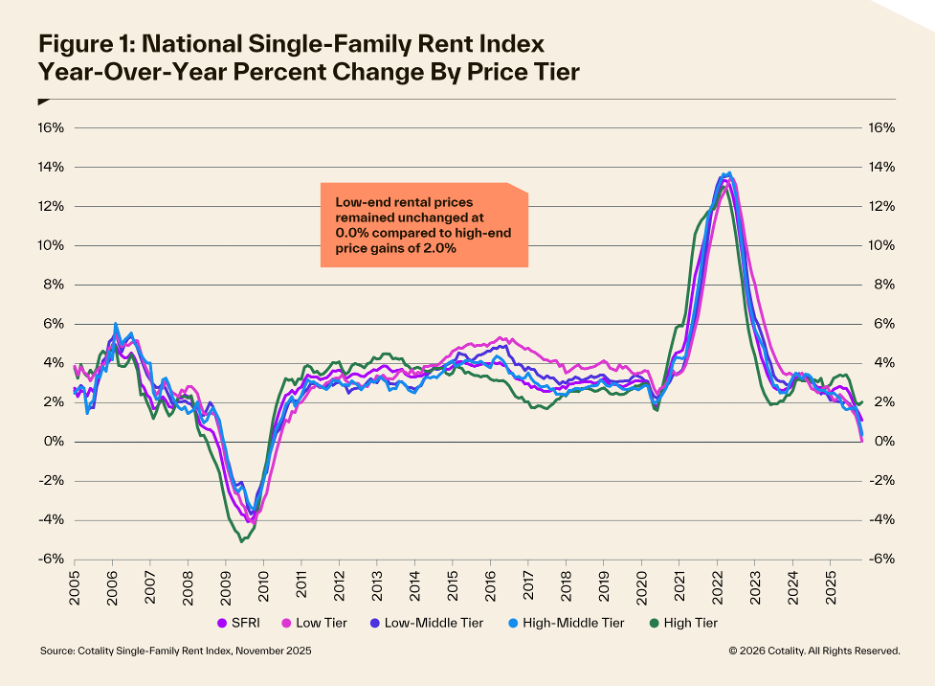
Prices rose just 1.1% annually in November, less than half the 2.5% rent growth registered from November 2023 to November 2024. November marked the fifth consecutive month that rent growth had slowed on an annual basis.

Lower-priced rentals are feeling the shock more than their luxury counterparts, however, posting no annual increase, down from 2.8% growth a year ago. High-end rentals increased 2% over the year, down from 2.7% growth a year ago.
Resilience at the pricier end of the single-family rental market will likely wane, said Boesel, noting that “even high-end rentals, which posted the strongest annual gains, show long-term growth converging across all price tiers, reflecting normalization across segments.”
Scotsman Guide reported last month that the double blow of stalling rents and climbing vacancies has led to rental investors “proceeding with a lot more caution and selectivity,” according to Charles Goodwin, who leads bridge loan and debt-service coverage ratio (DSCR) loan operations for Kiavi.
Price trends in November continued to vary notably across metro areas, with pockets of strength and weakness crisscrossing the country. Weakness dominated, however, as 43 of the 50 largest U.S. metros saw lower gains than a year ago, and 16 metros registered outright declines.
Midwest cities like Chicago and Detroit posted respective annual rent growth of 4.2% and 2.7% in November, while mid-Atlantic hubs Philadelphia, New York and Washington, D.C., observed gains of 2.8%, 2.3% and 1.8%.
After explosive growth during the pandemic, single-family rent growth in Southern cities continued months of accelerated softening.
Easing price gains of 1.2% and 1% in Atlanta in September and October fell to just 0.1% annual growth in November, while Miami, Houston and Dallas saw declines of 0.5%, 0.7% and 0.8%.