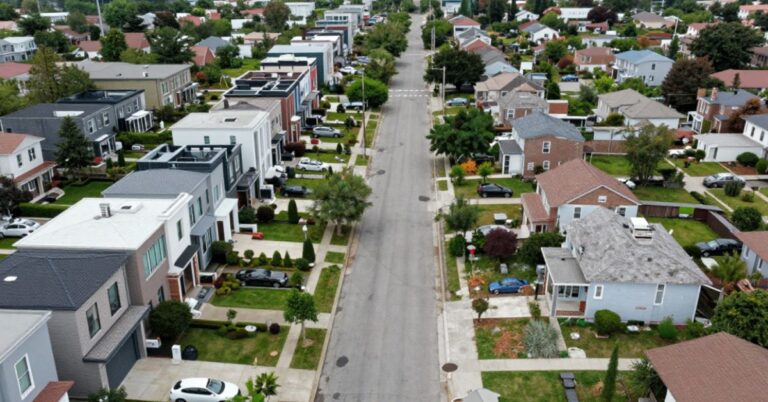

In an open letter to the housing sector published Monday, the CEO of Move Inc., owner of various listings platforms including Realtor.com, announced a resolution for 2026.
“Let’s recommit ourselves to a shared purpose that unites us — fighting for access for the American homeowner,” wrote Damian Eales, a former top executive at Move Inc.’s parent company, News Corp., owner of The Wall Street Journal’s publisher, Dow Jones & Co.
Citing a supply shortage that he assesses at 4 million homes, prices that he says have climbed 66% over the past decade and the rising age of first-time homebuyers, Eales called for the housing sector to throw its weight behind strategies for addressing housing supply.
About 1.3 million homes were built in 2024, according to Realtor.com data. New-home permits and starts have slowed in 2025, however, as builders lean on incentives to move completed inventory that is taking longer to sell amid affordability challenges and cautious buyer behavior.
“It is easier to promise cash than to pour concrete,” said Eales, noting how demand-side subsidies amid a supply shortage can worsen affordability by increasing competition for a limited number of existing homes. “Supply is the solution.”
The pandemic’s housing legacy
Many sectors of the U.S. economy buckled during the COVID-19 pandemic, beset by lockdowns and supply-chain disruptions.
The housing market boomed, however, amid a spike in housing demand and a once-in-a-lifetime opportunity for borrowers buying or refinancing to secure mortgage rates in the 2% to 3% range.
But in the post-pandemic recovery, sectors that stumbled righted themselves and housing turned for the worse — and has yet to recover.
Multiple years of double-digit home price appreciation, paired with a run-up in borrowing costs as the Federal Reserve combated runaway inflation, has made homebuying unaffordable for consumers across the U.S. First-time homebuyers have been particularly squeezed, with the median age for first-time buyers rising to 40 in 2025, according to the National Association of Realtors (NAR).
Existing-home sales in 2023, 2024 and 2025 have held near three-decade lows of just above 4 million units, per NAR data. Sales averaged 5.25 million units annually from 2013 to 2019.
With 80% of mortgaged homeowners now carrying sweetheart mortgage rates of 4% or lower, lock-in effects are keeping would-be movers anchored. The typical downpayment for a home purchase in the third quarter of 2025 was $30,400, according to Realtor.com, which is nearly 118% higher than the third quarter of 2019, when buyers typically put down $13,900.
With active inventory nationwide still 12% below pre-pandemic levels, the various constraints restricting housing access stand to worsen, Eales said, calling it “the cementing of a catastrophic and lasting economic divide.”
Legislation to build homes
A surge of new construction to close the housing supply gap would expand options for buyers and could exert downward pressure on existing-home prices as housing supply and demand come into greater balance.
In markets across the South and West, where new-home construction has surged in recent years, market power has shifted more quickly to buyers as expanding inventory has driven down home prices.
Eales says the “roadblocks to housing supply aren’t in Congress,” but instead in state legislatures, city councils and zoning meetings.
And yet, an omnibus housing bill passed unanimously by the U.S. Senate — and specifically designed to address the lack of housing supply and burdensome regulations — was recently dropped from a defense spending bill that passed the U.S. House of Representatives in early December.
The bill enjoyed broad support by housing, homebuilding and mortgage industry groups.
The House subsequently released its own package of housing legislation, dubbed the Housing for the 21st Century Act, with a supply-side and regulatory focus that parallels the Senate’s original Renewing Opportunity in the American Dream (ROAD) to Housing Act.
The House bill passed through the House Financial Services Committee in a 50-1 vote on Dec. 17 and awaits a full floor vote before being sent to the Senate for approval.
“Lobby for modernized zoning,” concluded Eales in his open letter. “Overcome NIMBYism. Advocate for the ‘missing middle.’”