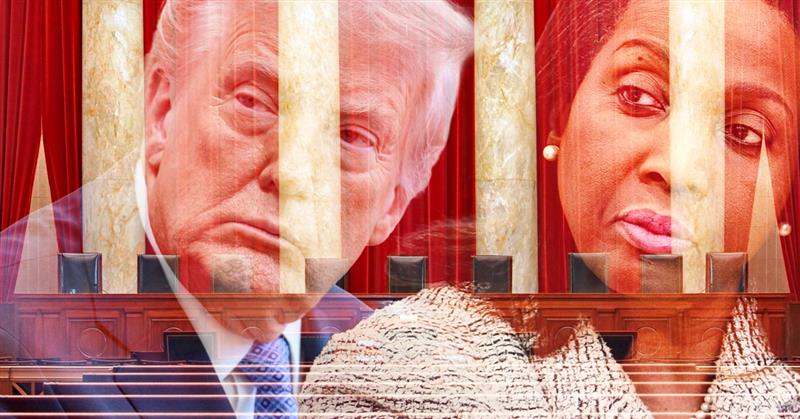
After months of legal escalation, the matter of mortgage fraud allegations against Federal Reserve Governor Lisa Cook has reached the highest legal forum.
The U.S. Supreme Court heard oral arguments Wednesday in Trump v. Cook, a case that potentially has far-reaching consequences for defining the independence of the quasi-governmental Federal Reserve and for determining how much discretion the president has for removing a central banker from office.
Though the court didn’t issue an opinion, the justices appeared uniformly skeptical of the legal basis for immediately removing Cook from office, with Justice Brett Kavanaugh, a Trump nominee, posing pointed questions about the importance of Fed independence.

U.S. Solicitor General D. John Sauer argued that President Donald Trump was justified when he moved to fire Cook on Aug. 25 based on allegations by Federal Housing Finance Agency Director Bill Pulte that Cook had committed mortgage fraud by claiming two homes as her primary residence to potentially receive more favorable loan terms.
“As President Trump stated in removing her, it is inconceivable that she was unaware of the first commitment when making the second, and it is impossible that she intended to honor both,” Sauer stated.
The solicitor general added: “Such behavior impugns Cook’s conduct, fitness, ability or competence to serve as a governor of the Federal Reserve. The American people should not have their interest rates determined by someone who was, at best, grossly negligent in obtaining favorable interest rates for herself.”
Paul Clement, an attorney representing Cook who served as U.S. solicitor general from 2005 to 2008, countered that the president rendered a prejudgment of Cook without giving her adequate means to dispute the allegations, thus compromising the “for cause” standards that dictate grounds for dismissal.
“The sum total of the solicitor general’s arguments would reduce the removal restriction in this unique institution to something that could only be recognized as at-will employment,” Clement said.
He characterized the government’s conception of cause as being “so capacious that apparent misconduct or gross negligence suffices.”
“That makes no sense” Clement added. “There’s no rational reason to go through all the trouble of creating this unique, quasi-private entity that is exempt from everything from the appropriations process to the civil service laws, just to give it a removal restriction that is as toothless as the president imagines.”
The emergency hearing was based on a governmental request that the Supreme Court overturn lower court rulings allowing Cook to remain in her role on the Fed’s board and its 12-member rate-setting committee while the underlying case proceeds.
Myriad questions from the justices during the nearly two-hour hearing centered on arcane legal concepts, though other inquiries focused more squarely on matters of Fed independence and the removal powers of the president.
“We know that the independence of the agency is very important, and that that independence is harmed if we decide these issues too quickly and with not due consideration,” Justice Sonia Sotomayor said at one juncture. “So waiting, to me, to have at least the lower courts look at these issues first makes the most sense to the public’s confidence and to the world’s confidence about the due process of law.”
Kavanaugh asked Sauer what, in his view, is the importance of Fed independence.
“It protects the governors for removal for policy disagreement or for no reason at all,” Sauer replied.
Kavanaugh continued to press on that question, discussing the “real-world downstream effects” of the potential removal of Cook from office.
“If this were set as precedent, it seems to me, just thinking big picture, what goes around comes around,” Kavanaugh said. “All the current president’s appointees would likely be removed for cause on Jan. 20, 2029, if there’s a Democratic president, or Jan. 20, 2033. Then, we’re really at at-will removal, so what are we doing here?”
Sauer responded that he “cannot predict what future presidents may or may not do.” He added that he disputed the characterization that the tools of removal power have been “unleashed” by Trump, stating that presidents have always had that tool at their disposal.
During Clement’s half of judicial questioning, Justice Elena Kagan asked, “Do you think that there is a way, at this posture, of dealing with this case so that we don’t have to confront the question of exactly what the ‘for cause’ standard means?”
Clement replied, “One way to come at it would be to say, at a minimum, ‘for cause’ doesn’t mean ‘apparent misconduct or gross negligence.’ And I think that would be sufficient to decide the case, at least at this juncture.”
In a statement provided to Scotsman Guide immediately following the hearing’s conclusion, Cook’s attorneys Abbe Lowell and Norm Eisen struck an optimistic tone, noting that “the Supreme Court has previously recognized the importance for the Fed to operate free from any political interference and we are hopeful it will do so again in this case.”
Cook, in a separate statement, characterized the case as being “about whether the Federal Reserve will set key interest rates guided by evidence and independent judgment or will succumb to political pressure.”
“Research and experience show that Federal Reserve independence is essential to fulfilling the congressional mandate of price stability and maximum employment,” Cook stated. “That is why Congress chose to insulate the Federal Reserve from political threats, while holding it accountable for delivering on that mandate.”
Cook concluded, “For as long as I serve at the Federal Reserve, I will uphold the principle of political independence in service to the American people.”