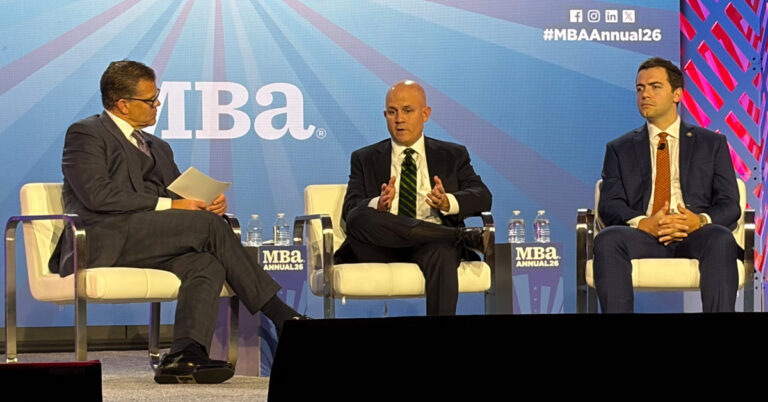
“I’m not sure why we’re still arguing about whether we need a tri-merge,” said Bob Broeksmit during a Thursday afternoon podcast appearance, addressing recent escalation in the debate over whether a single-bureau credit underwrite is wise for mortgage lending.
The president and CEO of the Mortgage Bankers Association (MBA) continued to voice strong support for his organization’s proposal, announced in December, that would allow mortgage lenders to submit loan files for underwriting by Fannie Mae and Freddie Mac with just one credit score if that score exceeds 700 or some other agreed upon baseline.
Answering a question on this week’s episode of “The Big Picture,” a mortgage podcast co-hosted by industry consultant Rich Swerbinsky and mortgage pundit Rob Chrisman, Broeksmit said he believes the Trump administration should “strike while the iron is hot,” with addressing housing affordability being a stated priority for President Donald Trump.

November’s fast-approaching midterm elections offer federal housing agencies all the incentive they should need, he believes, to take decisive action on one of a handful of “easy steps that the administration could take to affect affordability tomorrow,” which he outlined in a letter sent to the White House last month.
“Director [Bill] Pulte has the authority to make a call here,” Broeksmit said on Thursday, referring to the Federal Housing Finance Agency (FHFA) leader, while noting that the implementation of a single-bureau optional framework for Fannie Mae and Freddie Mac would simply require administrative action, not legislation.
Broeksmit said he was not surprised that Trump did not announce new proposals to address housing affordability in his recent speech at the World Economic Forum, though the president had said he intended to.
Instead, Broeksmit believes the State of the Union address — scheduled for Feb. 24 and delivered “from the well of the Congress” — would make a more appropriate venue to announce “some concrete ideas that will make things better.”
The MBA has faced staunch criticism from the Consumer Data Industry Association (CDIA) and Community Home Lenders Association (CHLA) for overlooking what they describe as risks to the broader mortgage ecosystem that an optional single-bureau policy could bring.
Those groups have concerns that market distortions leading to higher risk premiums could arise from the switch, pointing out that a large chunk of consumer data is not equally reported across the three main credit bureaus. For these reasons and others, CHLA and CDIA say that having the single-bureau option could raise tri-merge credit report costs for other lenders.
MBA has countered that the compounding inefficiencies of the tri-merge paradigm has inflated costs for the entire industry. Dismantling that paradigm through a gradual pivot to single-bureau underwrites would therefore help lower costs for all lenders over time, the association believes.
It remains unclear how investors, loan aggregators and correspondent lenders would smoothly adjust to such a shift, given disparities in the data sets underlying each bureau’s credit scores.
But a blockbuster development unfolded last week when the Housing Policy Council (HPC), an industry advocacy group led by Ed DeMarco, former director of the FHFA from 2009 to 2014, published findings on its website from an internal FHFA study obtained through a Freedom of Information Act (FOIA) request.
Among other revelations, the FHFA’s internal assessment of Fannie and Freddie loan data indicated that single-file credit pulls “showed a decrease in accuracy” compared to tri-merge and bi-merge alternatives. The data underlying these findings was obscured in the heavily redacted, 318-page FOIA response.
Broeksmit did not directly address the FOIA disclosure by the HPC on Thursday. He did, however, reference data published Thursday by the American Enterprise Institute (AEI), an economic research organization, concluding that “credit score performance is broadly similar across bureaus, with no meaningful differences in predicting loan outcomes.”
Substantial score variation exists between the three main credit bureaus — Experian, Equifax and TransUnion — and across the credit spectrum, the report says, with the high-low spread for credit scores at 700 or higher between the three averaging 26 points. The score-variation spread can reach 61 points in the 95th percentile of cross-bureau scores, according to the report.
These facts, says AEI, “could tilt customers to the bureau with the highest scores, and for other bureaus to increase their scores not to lose market share,” supporting fears of credit score inflation voiced by the CHLA and others.
Broeksmit also noted in the podcast appearance that Fannie and Freddie’s intention to purchase a combined $200 billion in mortgage-backed securities to lower mortgage rates makes their release from federal conservatorship, a separate policy goal of Trump’s, “probably not” a near-term priority.