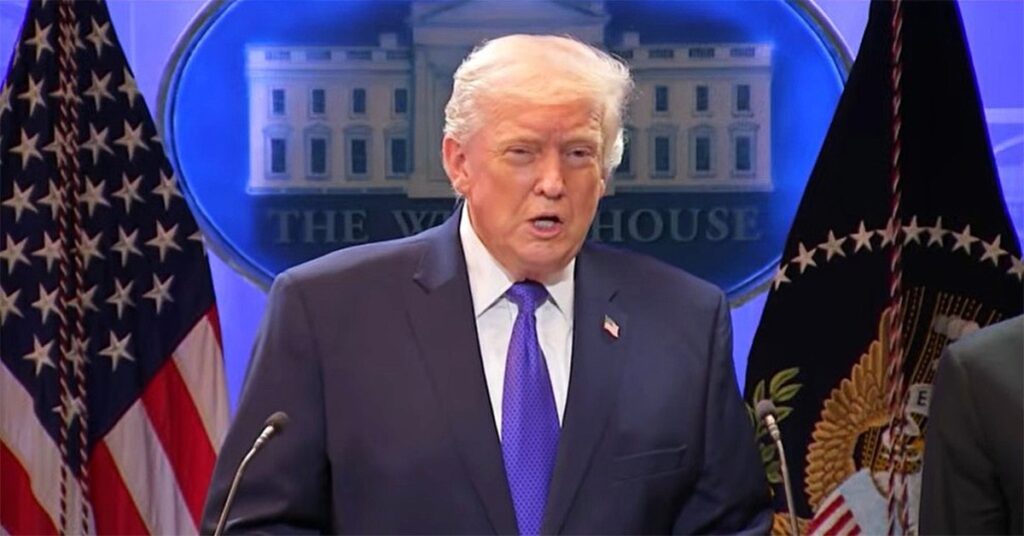
President Donald Trump blasted the Supreme Court’s decision to strike down his signature tariff policies on Friday, saying during a hastily arranged press conference that the decision was “deeply disappointing” and that he was “absolutely ashamed” of the six justices who ruled against him.
The president also pledged to push forward with alternate means to impose tariffs on global trading partners, saying he has “great alternatives” and he will now “go the way I should have gone originally.”
Trump also suggested that he may try to implement even higher tariffs moving forward, claiming that “in actuality, I was very modest in my ask of other countries and businesses” with the previous tariff measures.
“Today I will sign an order to impose a 10% global tariff under Section 122 over and above our normal tariffs already being charged, and we’re also initiating several Section 301 and other investigations to protect our country from unfair trading practices of other countries and companies,” Trump stated.
Section 122, part of the Trade Act of 1974, allows the president to impose tariffs of up to 15% for a maximum of 150 days on countries with which the U.S. has a significant trade deficit, unless Congress votes to extend them.
Section 301 is a provision of that same law allowing the government to impose tariffs based on unfair trade practices by a foreign country — but only after a determination is made by the official U.S. trade representative and the Commerce Department.
Trump’s defiant stance follows the Supreme Court’s 6-3 ruling, which found the president lacked the authority to impose sweeping tariffs on global trading partners under the International Emergency Economic Powers Act.
In his majority opinion, Chief Justice John Roberts wrote that by asserting “the extraordinary power to unilaterally impose tariffs of unlimited amount, duration, and scope,” Trump had an obligation to “identify clear congressional authorization to exercise it.”
In his dissent statement, Justice Brett Kavanagh said tariff power “falls squarely within the President’s wheelhouse,” and warned that the process of issuing tariff refunds could have “serious practical consequences in the near term.”
During the press conference, a reporter asked Trump if his administration will now have to refund hundreds of billions of dollars of tariff revenue collected over the past 11 months.
“They take months and months to write an opinion, and they don’t even discuss that part,” Trump responded, referring to the Supreme Court majority. He then added, “I guess it has to get litigated for the next two years.”
Trump first announced the tariff rollout on April 2, 2025, a day he dubbed “Liberation Day.” Since then, the actual tariff rates imposed on imports from individual countries have gone through myriad revisions as Trump’s economic threats have led to deals — and in some cases, additional tariffs following announced trade deals.
The constantly shifting effective tariff rate has presented challenges in formulating both U.S. fiscal and monetary policies, with Federal Reserve officials consistently citing tariff-related inflation uncertainty as justification for holding interest rates steady during its May, June and July policy meetings last year.
Asked by a reporter Friday if he would seek the input of Congress on future tariff measures, Trump replied: “I don’t have to. I have the right to do tariffs. And I’ve always had the right to do tariffs.”