How long does it take borrowers to achieve “very good” credit? And how much could borrowers save over the life of their loan?
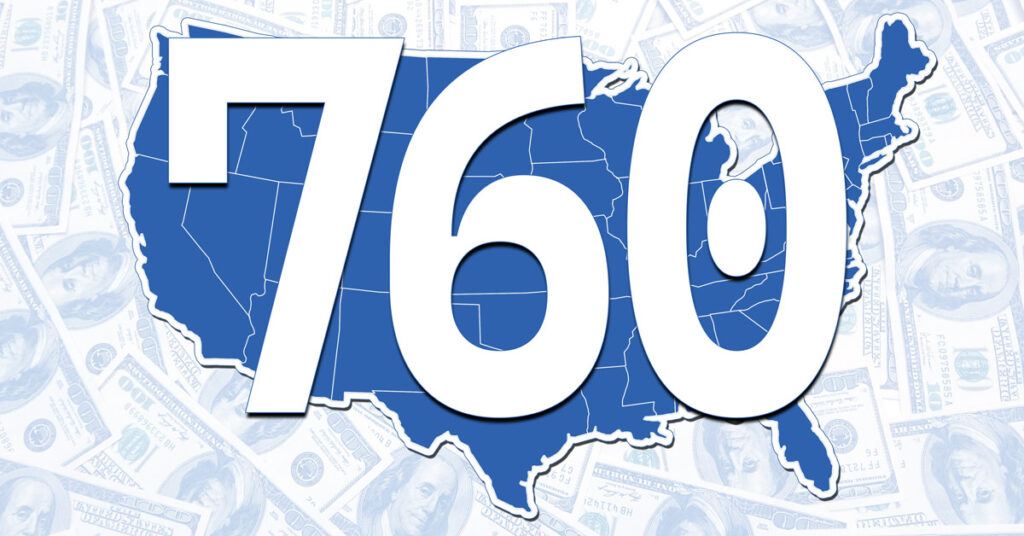
Those questions are the subject of a study released Thursday by AD Mortgage. The report from the Florida-based lender combines publicly available data with modeling scenarios to estimate how long it takes to improve credit to a 760 FICO score — Fair Isaac Corp.’s benchmark for “very good” credit, based on tiers used in the myFICO Loan Savings Calculator.
In most states, it requires between 18 months and three years to reach a 760 FICO score, the study found. The fastest states to reach 760 on average, based on AD Mortgage’s estimates, are Minnesota, Wisconsin and Vermont at 0.9, 1.1 and 1.15 years, respectively.

“These timelines suggest that in many states, borrowers are already close to excellent credit — and even modest improvements can unlock access to better mortgage rates quickly,” the report stated.
The slowest states to achieve the benchmark were Mississippi at 4.0 years and Louisiana at 3.5 years. Georgia, Texas and Arkansas all had averages of 3.25 years.
“This new data underscores just how critical credit education and early financial preparation are for today’s homebuyers,” stated Max Slyusarchuk, CEO of AD Mortgage, in the report. “A difference of 20 or 30 FICO points may seem small, but over the life of a mortgage, it can determine whether a borrower pays an extra $20,000 in unnecessary interest. Our goal with this report is to give lenders, brokers and consumers actionable insight into how credit impacts true buying power.”
States with high home prices and short improvement timelines like Washington, Colorado and Maine deliver the strongest return on credit improvement, the report found. States where improvement takes longer or savings are smaller provide fewer short-term benefits.
According to the report, savings resulting from reaching the higher credit score threshold range from about $9,500 to $46,000 over the life of the loan. The states with the largest benefits were Hawaii, California and Massachusetts, with average savings of $46,206, $42,753 and $36,022, respectively. The lowest average savings were $9,547 in West Virginia, $12,687 in Kentucky and $12,736 in Iowa.
The analysis used the average credit score as reported by Experian in September 2024. Calculations assumed a 30-year fixed-rate mortgage with a 15% downpayment — a national median figure AD Mortgage said was derived from the 2025 National Association of Realtors Home Buyers and Sellers Generational Trends Report.