Though frequently discussed, actually creating affordable housing usually takes a back seat to market-rate Class A multifamily rental projects that yield higher returns for developers and investors because of price maximization strategies.
To encourage expansion of the affordable housing stock in the U.S. that would not otherwise be built without public support, municipalities are increasingly incentivizing mixed-income properties. Municipalities will approve construction plans for market-rate apartments so long as a percentage of total project units meet affordable or workforce housing income requirements.
Developers are leveraging demand for affordable housing and new mixed-income property regulations to propose projects that may otherwise fail to earn approval. By including a percentage of affordable housing units in their multifamily projects, developers gain approval for the market-rate units that may not have been greenlit due to zoning restrictions or other permitting regulations at the municipal level.
Many tax abatement programs exist across the U.S. to reduce or eliminate taxes for individuals or businesses pursuing economic development in specific areas. The largest ones are in areas that face high affordability hurdles, such as New York City’s J-51 Property Tax Exemption and Abatement program and Florida’s Live Local Act. Program eligibility requirements vary widely and include provisions related to factors such as rent stabilization compliance, the duration that affordable units must be offered to would-be tenants, and the share of units requiring rent subsidies based on area median income metrics.
These considerations are designed to boost volumes of much-needed affordable and workforce housing units, as professionals in the fields of teaching, nursing and emergency response are increasingly being priced out of housing in the communities where they work.
Even with bipartisan legislative efforts to bolster affordable housing stock nationwide and alleviate housing cost pressure — particularly after vigorous house price appreciation during the COVID-19 pandemic exacerbated affordability issues — the development pipeline is starting to dwindle.
Approximately 45,000 affordable housing units were expected to be brought online across the U.S. in 2025, but only 17,000 were delivered through the first half of the year. Nearly 50,000 additional units are expected in 2026, based on projects in developers’ pipelines.
Once all approvals have been granted, an apartment construction project usually takes 18 to 24 months to complete, from breaking ground to receiving the certificate of occupancy.
Most of the projects set to be finished by 2027 are already under construction, with 12% fewer units expected to come online in 2027 than the average annual units added between 2020 and 2024. From 2028 onward, a rapid deceleration in the number of affordable units forecast for completion is expected, averaging less than 20,000 units per annum.
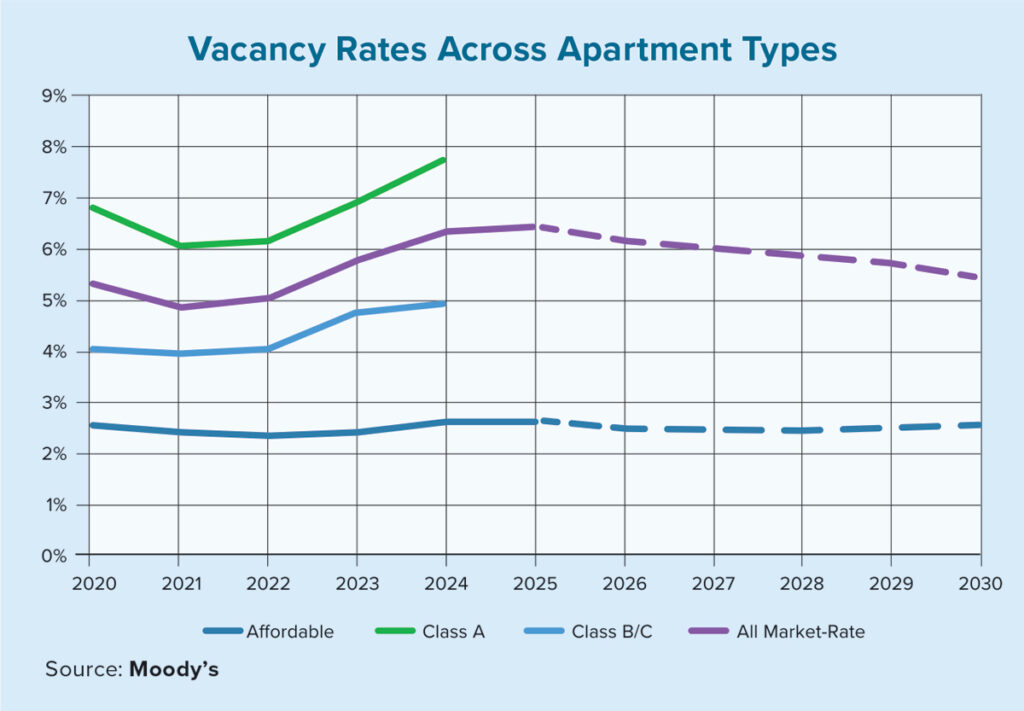
Supply tightness and strong demand mean the vacancy rate for affordable units is expected to end the year at 2.7% nationally. The vacancy rate for affordable units is generally frictional and has consistently hovered in the low- to mid-2% range for the past decade.
In areas with the starkest affordability issues, such as San Francisco and Orange County, Calif., and commuter submarkets outside New York City, Class B and C market-rate units also face frictional vacancy rates, as they often substitute for affordable housing.
Because of this, rent growth for affordable units has outpaced that of Class A units over the past two years amid softening demand for market-rate units. The lack of affordability in the broader housing market puts downward pressure on drivers of multifamily demand such as household formation.
Despite strong performance and financial enticements from municipalities, developers still prefer and prioritize market-rate projects over affordable housing projects because margins tend to be wider, especially in the face of higher construction and financing costs.
Nevertheless, construction of affordable units has outpaced that of Class B and C units over the past several years. This trend is expected to continue over the next few years, suggesting that public-private partnerships have proven beneficial in adding more affordable units to the overall housing stock.