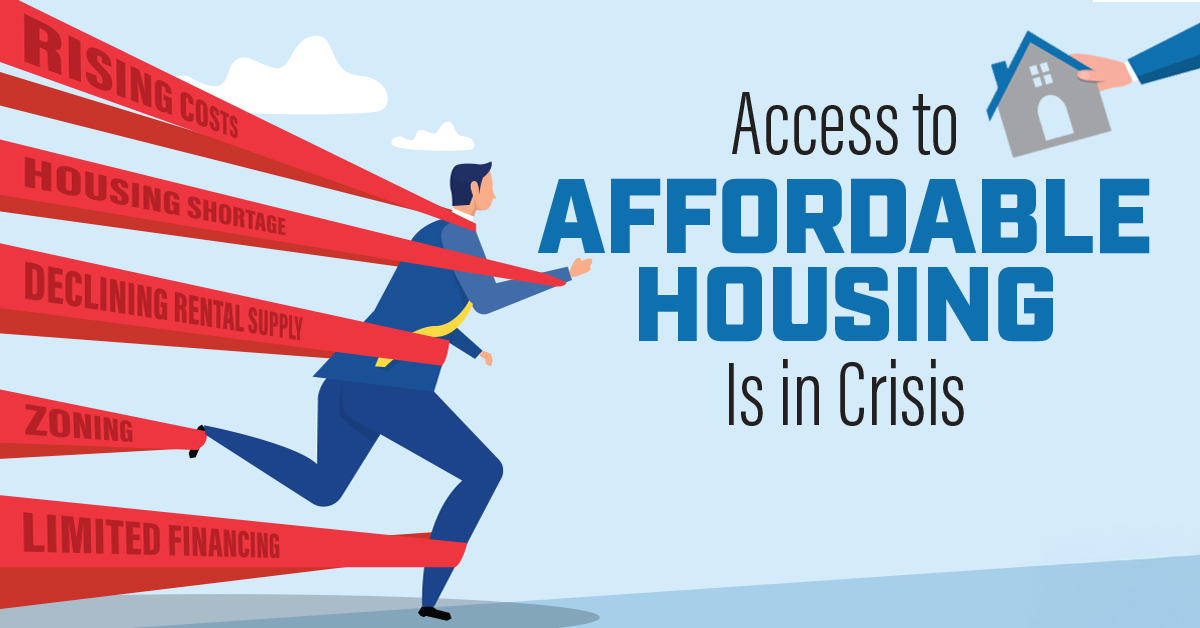
The lack of available affordable housing has hit a crisis point in the United States. A decade ago it was seen as a serious problem, but one largely confined to the country’s largest metro regions and expensive coastal communities.
Today, there is no region in the U.S. immune to the issue. Residents of all 50 states are impacted. The issue has become so prevalent that a wave of larger institutional investors is entering the sector to build, buy or preserve affordable apartment units.
Complications within the for-sale housing sector compound issues of supply and demand within the rental sector. When looking at affordable rental housing, many factors account for the current dearth of supply. The good news is there are financing programs available for this critical real estate asset class.
Challenges for homeownership, rentals
According to recent research from the Harvard Joint Center for Housing Studies, a first-time homebuyer must earn $126,700 annually to afford a median-priced home of $412,500, assuming a 31% debt-to-income ratio and 3.5% downpayment on a 30-year fixed-rate mortgage. Just 1 in 7 renter households in the U.S. can afford this, lengthening tenants’ rental occupancy timelines and thereby driving up demand for units.
Would-be homebuyers aren’t the only ones facing housing challenges. For three years in a row, the U.S. set records for cost-burdened renters. In 2023, half of all renters spent more than 30% of their income on housing, including 27% severely cost-burdened renters who allocated more than 50% of their incomes for housing.
The number of affordable apartment units has been declining in tandem. The number of apartments renting for under $600 per month decreased by 2.5 million units, or 28%, between 2013 and 2023. Five million units renting for $600-$999 (32% of this supply category) were lost over the past decade.
The country now lacks 7.1 million affordable and available apartments to meet current demand among Americans with extremely low incomes, or incomes at or below the federal poverty guideline (30% of the area median income, or AMI). This equates to a mere 35 affordable, available rentals for every 100 households living on extremely low incomes. Among the 50 states, the supply ranges from 17 (Nevada) to 62 (North Dakota) units available for every 100 households in need.
Essential next steps
It is exceedingly difficult to develop new affordable housing. Land is expensive, difficult to obtain and often comes wrapped in regulatory red tape due to zoning, entitlement and permitting requirements. In general, it is cheaper and easier to preserve existing rental housing. However, to successfully tackle the gap in available unit supply, the industry must both build new apartments and preserve those that already exist.
The availability of financing for either endeavor is critical. In late July, the Mortgage Bankers Association reported second-quarter origination of multifamily loans (all subcategories combined) had dropped 35% year over year from 2024 to 2025. However, multifamily lending through government-sponsored enterprises (GSEs) Fannie Mae and Freddie Mac accounted for much of the affordable and workforce multifamily financing, increasing 59% during that period.
It’s impossible to decouple lending and transaction trends from interest rates. Because rates have remained elevated since spring of 2022, many multifamily property owners can now no longer wait to refinance. Hard maturity dates, the tail end of bridge loan terms and a lack of options are forcing them to transact. This, in addition to rates reducing slightly, will likely contribute to the rise in loan volume.
The 2025 loan purchase caps for Fannie Mae and Freddie Mac are $73 billion each. These mandate a 50% mission-driven minimum percentage supporting affordable housing. The Federal Housing Finance Agency, which regulates the GSEs, allows the exclusion of loans for workforce rental housing from these caps with the goal of supporting preservation of existing affordable housing. Hence, there appears to be a demonstrated willingness from the GSEs in supporting market liquidity needed to hit the annual caps.
In 2024, the U.S. Department of Housing and Urban Development (HUD) expanded its 221(d)(4) loan program, which facilitates construction or rehabilitation of multifamily properties and has been traditionally associated with affordable housing. The expansion includes middle-income housing to serve households earning up to 120% of the AMI. The debt-service coverage ratio (DSCR) was lowered to 1.11x if at least half of the units are restricted to the AMI parameter via a regulatory agreement with a government entity.
Interest rates will inevitably impact the volume of deals closing through these agency loan programs. Any potential rate cuts made by the Federal Reserve will be heavily dependent on inflation, employment numbers and potential tariff impacts.
Considerations and solutions
Addressing the affordable housing crisis requires coordinated solutions from local, state and federal governments. The Low-Income Housing Tax Credit (LIHTC) is the primary financing vehicle for developing and preserving affordable apartments. Administered by the Internal Revenue Service and state housing finance agencies, LIHTC offers a 10-year annual tax credit based on either 9% or 4% of eligible costs. The 4% credit supports projects using tax-exempt bond financing, while the 9% credit is typically awarded competitively for conventionally financed projects.
Recent legislation reflects strong bipartisan support for LIHTC, including a permanent 12% increase in the per-capita allocation of the 9% tax credit. An adjustment was made to the 4% tax credit, lowering the required tax-exempt bond financing from 50% to 25% of eligible basis. This adjustment enables more projects to qualify, expanding the number of developments financed through a combination of tax-exempt bonds and the 4% credit. State agencies allocate bond volume caps for public-purpose projects, while housing finance agencies oversee the tax credits.
Additionally, the U.S. Senate Banking Committee unanimously approved legislation to enhance LIHTC’s impact. The bill would increase bank investment limits in LIHTC projects, direct HUD to establish zoning and land-use best practices and allow HUD to prioritize grant applicants serving Opportunity Zones. Though it awaits full approval by the Senate and U.S. House of Representatives, bipartisan backing improves its prospects.
Despite these advancements, preserving existing LIHTC units, especially those built in the 1990s, remains a concern. Many of these properties face expiring affordability requirements tied to their original financing. Without intervention, an estimated 350,000 units could transition to market-rate housing by 2030.
States offer incentives to support affordable housing, like tax abatement and exemption programs. Some states have created regulatory agreements for naturally occurring affordable rentals that encourage maintaining a portion of units as affordable. More than 30 state-specific programs exist, with varying effectiveness. Combining these with federal tools and agency loan programs can amplify efforts to preserve affordable housing supply.
The lack of affordable housing is a complex societal issue with many influencing factors. Affordability issues are likely to persist for years, but there is increasing political and societal momentum toward resolving the issue. Industry participants, government representatives and community advocates have expanded their focus to a variety of potential solutions. Some of those involve increasing financial resources, reducing regulatory hurdles, improving zoning and permitting processes and establishing tax incentives. By working together, positive improvements can be made.