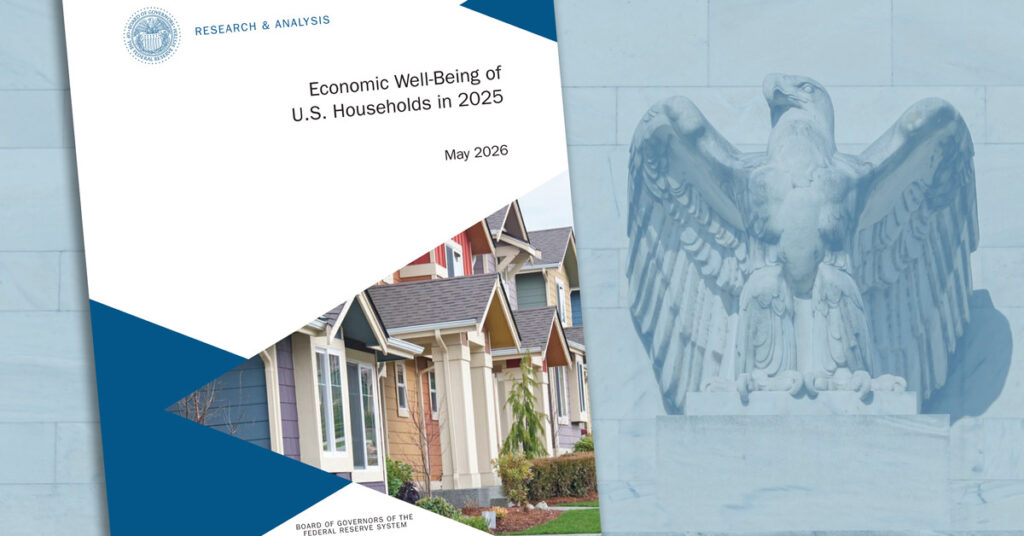
The Federal Reserve Board released its annual research looking at the economic well-being of U.S. households on Wednesday, showing little change in financial circumstances of U.S. adults and their families in 2025.
Basing its report on findings from the Survey of Household Economics and Decisionmaking (SHED), fielded in October 2025, it stated that 73% of adults identified as “doing okay financially” or “living comfortably” — the same percentage as 2024 and still below the high of 78% in 2021.
The report did note the role housing played for many, observing it “represents the largest expense for most families, and consequently, housing decisions have the potential to substantially affect economic outcomes.”

The Fed called housing costs and availability “a challenge for many adults, particularly those with low income.”
“While rental costs held steady over the prior year, renters were more likely to have fallen behind on rent in 2025,” the report stated in its section on housing. “Among homeowners, the cost of homeowners insurance contributed to some going without coverage entirely or having less coverage than they wanted. Many homeowners with insurance said that the costs have gone up by more than they were expecting in recent years.”
The Fed pointed out gaps in homeownership rates by demographic characteristics. Sorted by race, white adults have a 72% ownership rate and a 20% rental rate. Black adults (44% own, 43% rent); Hispanic adults (48% own, 41% rent); and Asian adults (66% own, 25% rent) made up the remaining racial demographics. The total shares do not add to 100% because some people live rent free in a house that neither they nor their spouse own.
The report indicated that consumer prices continued to be the most common concern, with 91% citing it as either a major or minor concern. However, the share who cited price increases as a “major concern” fell to 53%, down from 56% in 2024.
Those reporting they could “cover a $400 emergency expense using cash or its equivalent” also stayed at its 2024 level of 63%.
“As we work to support a strong and vibrant economy, it’s critical for the Federal Reserve to understand the economic experiences of families and communities,” Fed Governor Michael Barr commented. “The SHED provides valuable data on how households are dealing with evolving financial opportunities and challenges.”