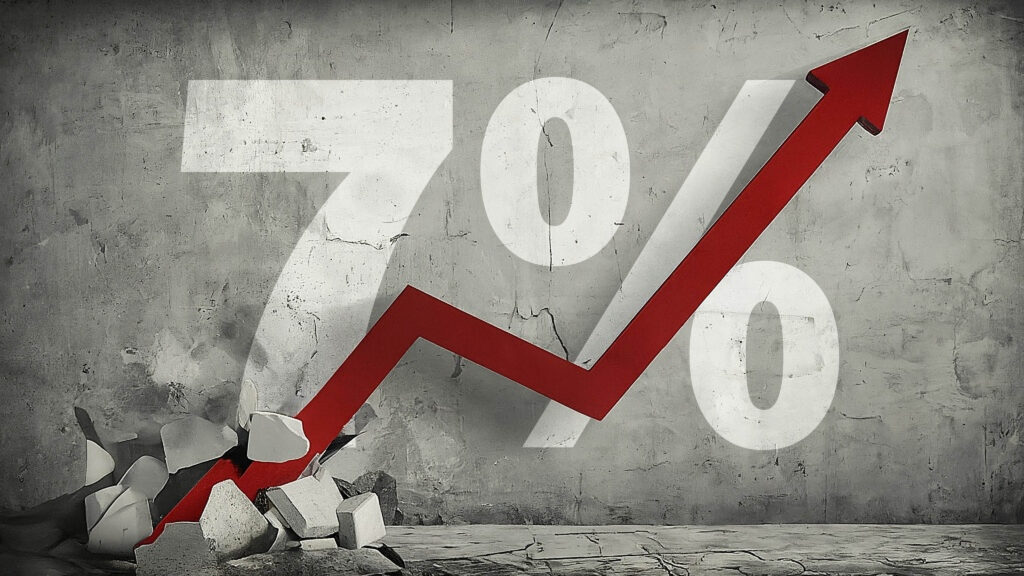
October is spooky season, but this is a sequel mortgage professionals were hoping not to see: The Return of the 7% Rate.
Redfin reported this week that the daily average 30-year fixed rate hit 7% on Oct. 28 — the first time mortgage rates have hit 7% since the start of summer. Mortgage Daily News, which tracks mortgage rates via its own daily survey, had rates pegged even higher on Oct. 29, reporting an average of 7.08% earlier in the day before settling on 7.03% in the afternoon.
Freddie Mac’s widely watched weekly interest survey was at 6.54% for a 30-year fixed-rate mortgage during the week ending Oct. 24.

The upturn of mortgage rates over the last month and a half has not been kind to potential homebuyers searching for affordability, according to a new report from Redfin. Crunching the numbers, the real estate brokerage has calculated that a homebuyer on a $3,000 monthly budget has lost $33,250 in purchasing power over the past six weeks.
With a 7% mortgage rate, the aforementioned homebuyer on a $3,000 monthly homebuying budget can currently afford a $442,500 home. Six weeks ago, when the rate was 6.11%, per Redfin’s data, the same buyer could afford a home priced at $475,750.
Put another way, the monthly mortgage payment on a $428,000 home — the current median price, according to Redfin — is $2,895 with a 7% mortgage rate. At 6.11%, it’s at $2,694, roughly $200 less.
So why have mortgage rates taken a sudden northward turn?
Mark Zandi, chief economist at Moody’s analytics, tweeted on Tuesday that it may be a cocktail of economic resilience with a dash of election prognostication.
“The mortgage rate is up despite the Fed’s decision to cut the federal funds rate by half a percentage point and signal that more cuts are coming,” Zandi wrote. “What’s going on? First, the strong economy is even stronger than anticipated, causing investors to re-think how quickly the Fed will cut rates.
“Equally important is investors’ rising expectation that former President Trump will win re-election (look at betting markets). Investors are taking Trump at his word and believe if he wins it will lead to … higher inflation and more government borrowing. The recent surge in mortgage rates is a clear indication what investors believe a Trump victory would mean for the economy and the nation’s fiscal outlook.”