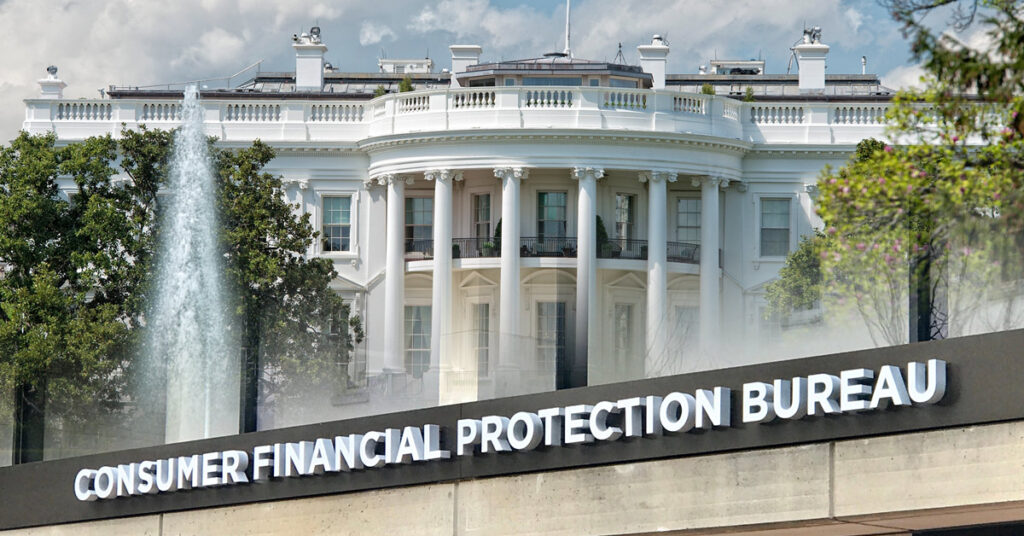
A report from the White House Council of Economic Advisers (CEA) estimates that the Consumer Financial Protection Bureau (CFPB) has cost U.S. consumers up to $369 billion since its inception in 2011, adding fuel to the ongoing political battle over the agency’s future.
The CEA report, released Feb. 17, argues that the CFPB’s regulatory and liability burdens have driven up the cost of credit across several key sectors, from mortgages to auto loans. According to the analysis, increased borrowing expenses account for $222 billion to $350 billion of the CFPB’s alleged negative economic impact.
Broken down by loan type, the report claims the CFPB’s rules have cost consumers $116 billion to $183 billion in higher mortgage costs, $32 billion to $51 billion for auto loans, and $74 billion to $116 billion for credit cards. The CEA asserts these costs significantly surpass the $21 billion that the CFPB reports having returned to consumers.
Prominent Republicans heralded the findings on social media. In an X post, Sen. Tim Scott, R-S.C., chairman of the Senate Banking Committee, wrote that the report “shows how the past misguided policies of the CFPB raised borrowing costs and made it harder for families to access mortgages, auto loans, and credit cards.”
The CEA analysis follows a Feb. 9 report prepared by Democratic minority staff members of the Senate Banking Committee, which claimed that Trump administration efforts to dismantle the CFPB have cost consumers an estimated $18.8 billion.
According to the minority staff’s calculations, that figure includes $15 billion from “since dismissed final rules”; $3.5 billion from dropped enforcement matters; $225 million from dropped or withdrawn settlements; and $40 million from the bureau’s “gutted complaint portal.”
In a press release announcing the report’s findings, Sen. Elizabeth Warren, the committee’s ranking Democratic member and the primary congressional architect behind the establishment of the CFPB, claimed that the Trump administration’s “attempt to sideline the CFPB has cost families billions of dollars over the last year alone.”
The CEA report drew immediate criticism this week from consumer advocacy groups, such as the National Consumer Law Center (NCLC), which slammed the document as a coordinated White House effort designed to dismantle the agency and give financial institutions a free pass to exploit borrowers.
In a press release, the NCLC argued the report was an “attack” on the CFPB and harmful to consumers.
“A functioning, effective Consumer Financial Protection Bureau is essential in safeguarding people from unscrupulous companies that prey on working families,” stated Diane Thompson, NCLC’s deputy director and chief advocacy officer.
The CFPB did not respond to a request for comment.
The mortgage industry response has been measured. In a statement provided to Scotsman Guide, a spokesperson for the Mortgage Bankers Association offered a nuanced view, saying, “We’re still reviewing the report and that while the rules may have been costly and in many cases overreaching, they were less costly than leaving mortgage lenders to comply with an unworkable statute.”
Meanwhile, a prominent academic sought to debunk the report’s underlying math and legal framing. In a blog post, Adam Levitin, a Georgetown law professor, argued that the CEA “discredits itself” with its methodology and conclusion.
Levitin framed the CEA’s mortgage-related analysis as “bizarre and contorted,” arguing that the CFPB “actually eased” the regulatory burden on homebuyers with its “safe harbor” policy.
Although Levitin agreed with the CEA’s finding that the CFPB’s regulations have raised costs by 16 basis points — saying he predicted a similar level (18 basis points) back in 2013 — he took issue with how the CEA extrapolated that data point across whole industries, resulting in a misleading cost calculation, in his view.
However, the CEA’s assessment of the CFPB’s cost to consumers is not without precedent. In a 2013 analysis, the Heritage Foundation, a think tank whose mission entails formulating and promoting “conservative public policies,” warned that the “CFPB’s paternalistic view of consumers also means fewer choices and higher costs for credit.”
The White House’s report arrives at a highly volatile moment for the CFPB, which has been under heavy scrutiny from the executive branch.
Over the past year, there have been ongoing legal battles over staffing cuts and the bureau’s funding mechanisms, with CFPB Acting Director Russell Vought — who also serves as director of the White House’s Office of Management and Budget — stating his intent to shutter the agency.
In January, Vought reluctantly complied with a court order, requesting $145 million from the Federal Reserve to fund continuing operations for the bureau through the second quarter.