For the second time in as many meetings, the Federal Reserve left interest rates unchanged Wednesday, judging that the current balance of monetary risks warrants a cautious approach.
The decision to hold means the benchmark federal funds rate will remain in a range of 3.5% to 3.75% for at least another month, giving the Federal Open Market Committee (FOMC) time to assess the economic and inflationary impacts of the war in Iran and whether the February labor market contraction was a momentary blip or the beginning of a long-term trend.
“Uncertainty about the economic outlook remains elevated. The implications of developments in the Middle East for the U.S. economy are uncertain,” the official Fed statement read. “The Committee is attentive to the risks to both sides of its dual mandate.”

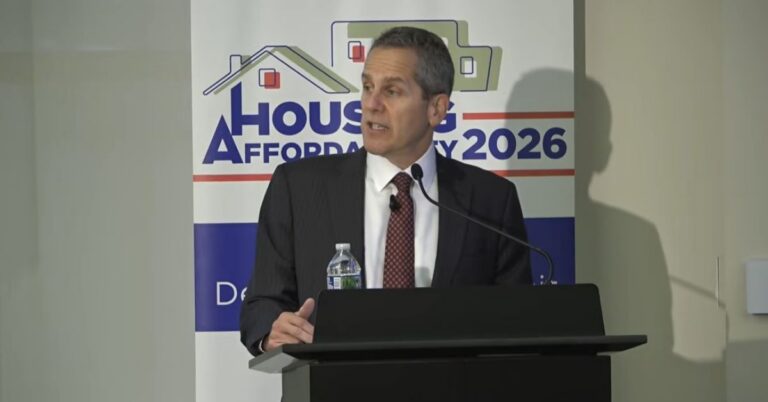
Stephen Miran, a temporary governor who has remained on the Fed’s board while uncertainty over Kevin Warsh’s confirmation process for next Fed chair plays out, dissented in favor of a 0.25% rate reduction.
The FOMC closed out 2025 with three consecutive quarter-point rate cuts. Though there were heightened divisions among committee members by historical standards — with three formal dissents registered in December and two in October — a consensus of policymakers viewed the stalling jobs market as more concerning than stubbornly high inflation.
The tides shifted at the January meeting, with Fed Chair Jerome Powell telling reporters afterward that unemployment had ticked down in December and core inflation less food and energy prices rose at a 3% annual pace that month, which was “pretty much what we had the year before, so on net, no progress.”
Since then, the labor market shed 92,000 jobs in February but core inflation crept up to 3.1% in January, according to the personal consumption expenditures price index.
Complicating matters, the war in Iran has spiked oil prices and other costs impacting consumers, injecting considerable uncertainty into inflation forecasts.
“The FOMC is navigating a narrow corridor where the risks of premature easing are balanced against the structural pressures of a shifting fiscal regime,” Isaac Boltansky, head of public policy at California-based lender Pennymac, observed in commentary emailed to Scotsman Guide.
“While the market often over-rotates on the dot plot or the immediate rate path,” he added, “the more consequential narrative is the Fed’s posture on balance sheet normalization and the long-term neutral rate.”
The “dot plot” referenced by Boltansky refers to a portion of the Fed’s Summary of Economic Projections (SEP) that tracks central bankers’ expectations for future interest rate changes. While only 12 FOMC members vote at the Fed’s eight policy meetings per year, all 19 committee members weigh in on the SEP, which is published four times a year.
In the updated dot plot, seven FOMC members indicated they currently believe there should be no rate cuts at all in 2026. Seven members think one cut of 25 basis points would be appropriate, two think two cuts may be an appropriate stance, two indicated a preference for three cuts and one assessment calls for a full percentage point of easing. One participant now believes a quarter-point rate hike may be appropriate in 2027.
On Monday, The Wall Street Journal reported that President Donald Trump said during a White House meeting that the Fed “should have a special meeting” to cut interest rates “right now” — despite the FOMC’s regularly scheduled meeting kicking off the next day.
Warsh, who made Fed balance sheet reduction a central tenet of his job pitch, will also face pressure from Trump to cut rates if he receives Senate confirmation prior to the central bank’s June meeting.
The divided opinions reflected in the dot plot suggest that Warsh will face a tall task building consensus if he assumes Powell’s seat in June.