Judged just by the headline takeaway from Jerome Powell’s second-to-last policy meeting of his official term as chairman of the Federal Reserve, it was a relatively ho-hum affair. The Fed essentially took no action, voting Wednesday to maintain the benchmark federal funds rate in its current range of 3.5% to 3.75%.
But Powell’s penultimate Federal Open Market Committee (FOMC) meeting came during one of the most tumultuous periods of his eight years as chief U.S. central banker.
Following a year when President Donald Trump’s signature tariff policies dominated economic debates, any discussion of monetary policy now inevitably includes questions about the inflationary impacts of the global oil shock resulting from Trump’s decision to launch airstrikes on Iran.

“Ongoing turmoil in the Middle East has significantly increased uncertainty regarding the current and future state of the economy,” explained Mike Fratantoni, chief economist of the Mortgage Bankers Association, in commentary provided to Scotsman Guide following the FOMC meeting. “The spike in oil prices has the potential to both accelerate inflation and weaken economic growth.”
Fratantoni added that the Fed’s 2.7% median inflation projection for 2026 is an uptick from the previous forecast released in December, and “a growing number of FOMC members now expect no cuts — or at most, one — to the federal funds target this year, likely due to a more negative inflation outlook.”
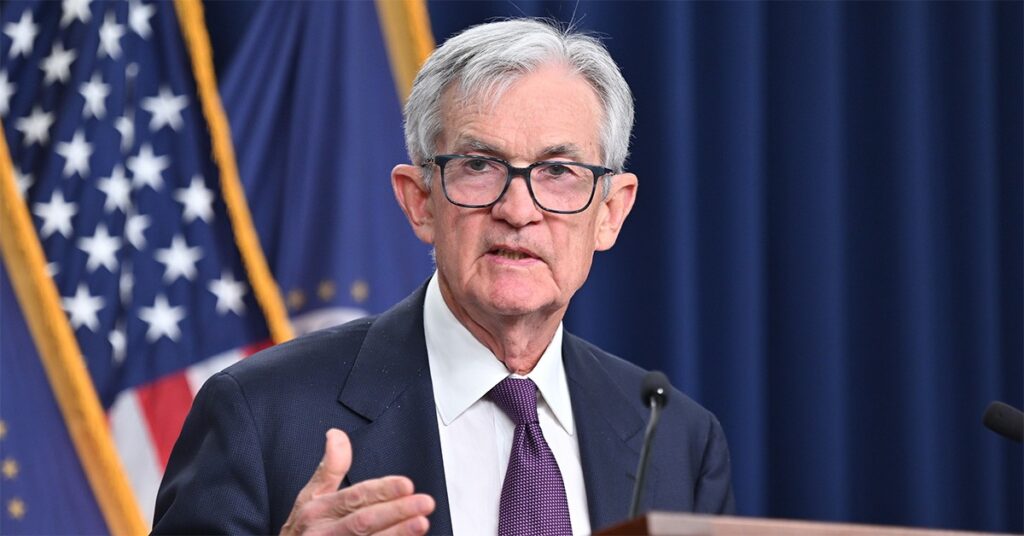
Wearing his customary blue suit and purple tie, Powell stepped to the podium at exactly 2:30 p.m. to address a familiar cadre of reporters from national news outlets. Here are four key takeaways from the press conference — including the possibility that Powell may still oversee at least one more FOMC meeting after his term as chair ends in May.
1. The April FOMC meeting might not be Powell’s last as chair
Looming over the March monetary policy meeting was the ongoing Department of Justice investigation of the Federal Reserve, which concerns Powell’s testimony in June of 2025 before the Senate Banking Committee about cost overruns for a renovation of the Fed’s headquarters.
In a blistering rebuke to U.S. Attorney Jeanine Pirro’s office, which is overseeing the probe, Chief Judge James Boasberg of the U.S. District Court for the District of Columbia ruled there was “essentially zero evidence” that Powell committed a crime during his testimony.
Boasberg also agreed with Powell’s assessment that he was being targeted by the Trump administration, writing in his opinion that “a mountain of evidence suggests that the Government served these subpoenas on the Board to pressure its Chair into voting for lower interest rates or resigning.”
The U.S. attorney’s office has since filed a motion for reconsideration, which prompted Sen. Thom Tillis, R-N.C., to continue his blockade of the Senate confirmation process for Kevin Warsh, Trump’s nominee to replace Powell as Fed chair.
Powell directly addressed the legal controversy in his post-meeting presser.
“If my successor is not confirmed by the end of my term as chair, I would serve as chair pro tem until he is confirmed,” Powell stated. “That is what the law calls for, that’s what we’ve done on several occasions, including involving me, and that’s what we’re going to do in this situation.”
He added, “I have no intention of leaving the board until the investigation is well and truly over, with transparency and finality.”
2. Powell has not decided if he will remain with the Fed after his chair term ends
While Powell’s term as Fed chair technically expires on May 15, his term on the central bank’s Board of Governors runs until Jan. 31, 2028.
Though Fed chairs typically leave the institution altogether when their chairmanship term ends, there is limited precedent for staying on.
In 1948, Marriner Eccles — whom the Fed’s Washington, D.C., headquarters is named after — stayed on the board for three years after stepping down as Fed chair, partially due to prodding from President Harry S. Truman. And in 1978, Arthur Burns remained for about three weeks after his Fed chair term ended.
Powell said he has not decided whether he would stay on the board after his Fed chair successor is installed.
“I will make that decision based on what I think is best for the institution and for the people I serve,” Powell said.
3. The war in Iran is wreaking havoc with the Fed’s economic projections
“Even more than usual, it’s good to take the forecasts with a grain of salt, because it’s subject to just very high levels of uncertainty,” Powell said, referring to the Fed’s quarterly Summary of Economic Projections, which includes the FOMC’s “dot plot” of predicted rate adjustments and forecasts of future gross domestic product, inflation and unemployment rates.
Besides ongoing tariff uncertainty, Powell specifically pointed to the global oil shock stemming from the war in Iran as a challenge for the Fed’s inflation projections.
“The thing that’s really important that we [need to] see this year is progress on inflation through a reduction in goods inflation as the one-time effects on prices from tariffs go through the economy,” Powell said.
He added that the “the question of whether we ‘look through’ the energy inflation doesn’t really arise until we have checked that box. It of course is kind of standard learning that you look through energy shocks, but that’s always been dependent on inflation expectations remaining well anchored.”
Powell also stated that in the near term, “higher energy prices will push up overall inflation, but it is too soon to know the scope and duration of the potential effects on the economy.”
4. Powell does not see ‘stagflation’ as a near-term risk
Stagflation refers to a worst-case combination when rising inflation and high unemployment are accompanied by stagnating economic growth.
While Powell acknowledged the upward risk on inflation and downward risk for employment, he largely dismissed recent observations by economic commentators that the U.S. may be entering a period of stagflation.
“When we use the term ‘stagflation,’ I always have to point out that that was a 1970s term at a time when unemployment was in double figures and inflation was really high and the Misery Index was super high,” Powell said. “And that’s not the case right now.”
He elaborated on that point, saying unemployment is “really close” to longer-run goals and inflation is within one percentage point of target.
“I would reserve the term stagflation for a much more serious set of circumstances,” Powell stated. “What we have is some tension between the goals, and we’re trying to manage our way through it. It’s a very difficult situation, but it’s nothing like what they faced in the 1970s.”