In CommercialCafe’s latest national office report, the specter of artificial intelligence looms large, as do the words “uncertainty” and “flexibility.”
“While acknowledging the recent gains made in New York and San Francisco leasing, the predominant theme in the near and intermediate future is uncertainty,” noted Peter Kolaczynski, director of Yardi Research, in the report. “With this, offering flexible terms in a variety of sizes and options is seemingly the sweet spot.”
Manhattan topped CommercialCafe’s rankings for year-to-date office sales, with nearly $2.9 billion in deals closed. San Francisco placed second at roughly $1.6 billion, followed by Dallas at just over the $1 billion mark and the San Francisco Bay Area just under that threshold.
Overall, what the Yardi Systems-owned platform called a “modest office supply pipeline” saw incremental gains last month to nearly 29.4 million square feet of office space under construction. The national office vacancy rate was 17.6% in April, the company reported, representing a decline of 210 basis points year over year.
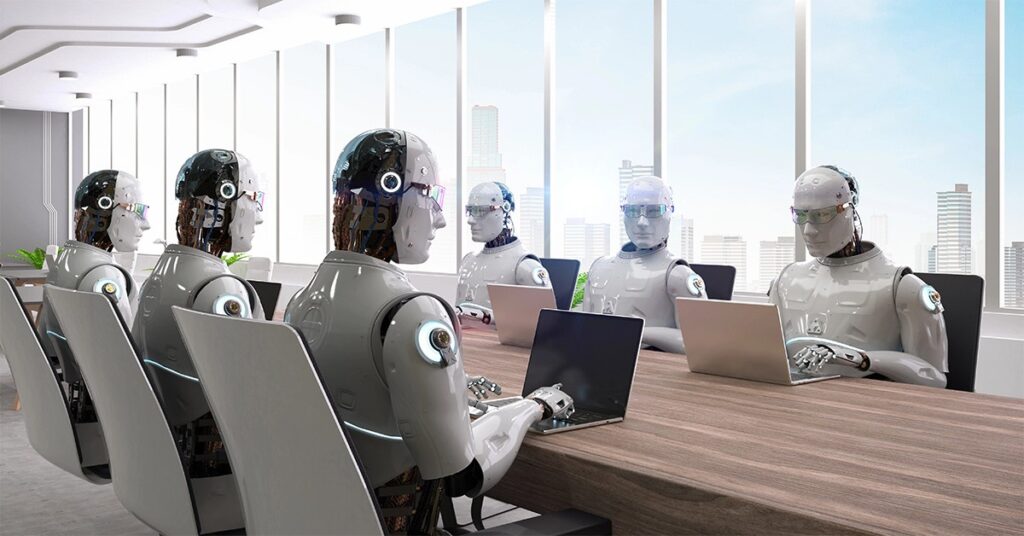
But the CommercialCafe report also flagged heightened uncertainty over the impacts of AI adoption on the office workforce, with promises of productivity gains offset by concerns over displacement of traditional office workers.
A separate analysis released this month by Cushman & Wakefield, which looks at AI’s impact on the commercial real estate (CRE) market, puts the odds of AI-driven, productivity-led expansion at 15%.
“The upside scenario assumes faster diffusion of AI, stronger realized productivity and more effective conversion of efficiency gains into revenue growth and reinvestment,” Cushman & Wakefield wrote. “In these cases, growth emerges not as ‘more of the same’ demand, but through new firms, new occupations and evolving space requirements that favor high-quality, flexible and collaboration-oriented environments.”
The global commercial real estate company placed higher 25% odds on an “AI bust scenario.” Mirroring the dot-com boom and bust of the 1990s, that hypothetical situation sees AI delivering long-run economic gains, “but only after a period of overinvestment, firm failures and financial-market disruption.”
“In this scenario,” the analysis added, “CRE stress emerges through timing and capital-market channels rather than technological failure.”
Cushman & Wakefield sees only a 5% chance of an “AI displacement scenario,” in which “AI substitutes for labor more than expected and revenue growth lags productivity.” But if it came to fruition, that situation would entail “persistently weak office using employment and structurally elevated vacancy throughout the forecast horizon, even in the absence of a recession.”
At a 50% probability, Cushman & Wakefield sees the most likely outcome as AI adoption remaining “incremental and uneven, with firms channeling early productivity gains toward efficiency and margin protection rather than workforce expansion.”
Assuming limited regulatory oversight on AI deployment and power generation, that scenario calls for U.S. gross domestic product stabilizing at a 2.5% annual average growth rate, with the U.S. CRE market seeing “subdued near-term office demand, elevated tenant churn and growing differentiation by asset quality and function rather than systematic decline.”