
Fair housing leaders are cautioning that proposed rule changes by the U.S. Department of Housing and Urban Development (HUD) would weaken safeguards designed to prevent housing and lending discrimination.
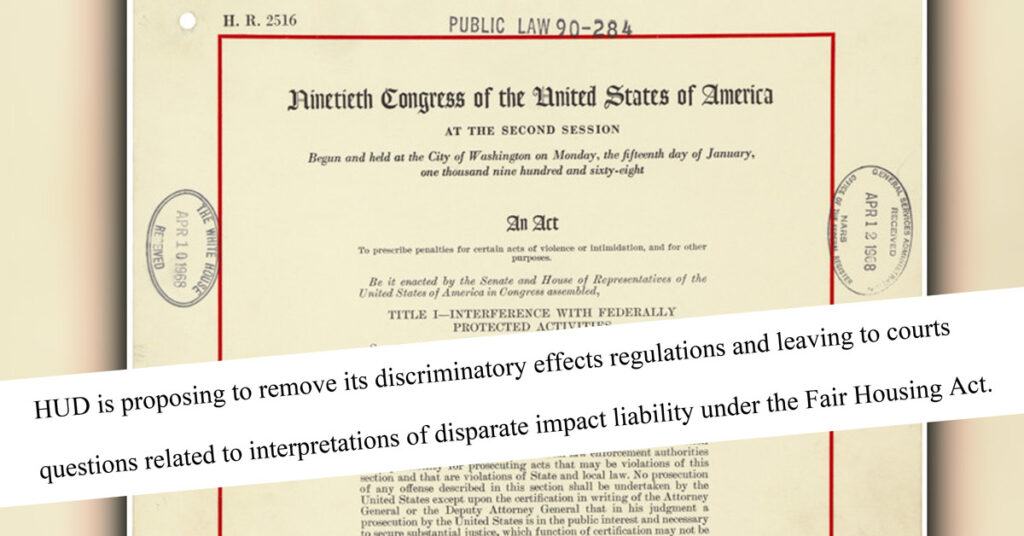
HUD has opened a 30-day window for comments on its proposal “to remove its discriminatory effects regulations,” thus “leaving to courts questions related to interpretations of disparate impact liability under the Fair Housing Act.”
The Fair Housing Act — Title VIII of the Civil Rights Act of 1968 — prohibits discrimination in the sale, rental or financing of dwellings, and in other housing related activities on the basis of race, color, religion, sex, disability, familial status or national origin.

Disparate impact discrimination refers to a seemingly neutral policy or action that results in disproportionate and unjustified negative harm to a group, regardless of intent.
The National Fair Housing Alliance (NFHA) has denounced HUD’s move to roll back disparate impact rules, saying it would weaken fair housing discrimination protections to U.S. residents facing unlawful discrimination.
“The Fair Housing Act was passed, in part, as a tribute to Dr. Martin Luther King Jr., who fought long and hard to remove all forms of discrimination as well as the vestiges of redlining, segregation and other harmful race-based policies from our society,” said Lisa Rice, NFHA’s president and CEO, in a statement. “As the nation prepares to commemorate his birthday, HUD is taking this step to move America further away from his vision of a fair, inclusive society where everyone can thrive.”
Sharon Cornelissen, director of housing at the Consumer Federation of America, told Scotsman Guide that “disparate impact standards have protected consumers against discrimination in housing, credit access and employment for over five decades, and it remains the law, regardless of wishful executive orders.”
She added, “HUD trying to withdraw these regulations, with a short comment period of only 30 days, will make it even harder for consumers to fight unfair practices in housing and to understand their longstanding rights under the Fair Housing Act.”
NFHA believes HUD’s proposal “will make it more difficult for veterans, people with disabilities, low-income households, domestic abuse survivors and rural communities to address systemic housing discrimination and leave them vulnerable during the nation’s fair and affordable housing crisis.”
The group stated the proposal is “just another in a long list of the administration’s efforts to weaken the country’s fair housing enforcement mechanism and amounts to a dereliction of HUD’s responsibilities to enforce the Fair Housing Act.”
Michael Neal, a senior fellow and practice area lead in the Housing Finance Policy Center at the Urban Institute, called access to safe and affordable housing “critical for a stable and prosperous housing market that benefits everyone.”
“Given the history of the country with respect to people of color, weakening protections against rules that, even unintentionally, harm these groups undermines both their ability to successfully access such housing and well-functioning housing and financial markets,” Neal wrote in an email to Scotsman Guide.
David Gonzalez Rice, senior vice president of public policy for the National Low Income Housing Coalition (NLIHC), called the proposed disparate impact rule an “unnecessary, harmful distraction from genuinely addressing our nation’s housing affordability crisis.”
He added that the proposal “disregards how active investigation and enforcement by the federal government can expand affordable housing opportunities,” saying it would create an environment “where providers who are simply trying to comply with the law will now lack clarity about their Fair Housing Act obligations.”
According to HUD’s proposed rule, several factors prompted the reconsideration of its discriminatory effects regulations. President Donald Trump’s executive order titled “Restoring Equality of Opportunity and Meritocracy,” published in April 2025, stated that equal treatment under the law is a “bedrock principle of the United States” which “guarantees equality of opportunity, not outcomes.”
The executive order asserts that disparate impact liability “endangers this foundational principle” by creating a “near insurmountable presumption of discrimination” when there are any differences in outcomes, “even if there is no facially discriminatory policy or practice or discriminatory intent involved, and even if everyone has an equal opportunity to succeed.”
As such, the order established that “it is the policy of the United States to eliminate the use of disparate-impact liability in all contexts to the maximum degree possible to avoid violating the Constitution, Federal civil rights laws, and basic American ideals.”
HUD acknowledged its policy is to provide “not less than sixty days for submission of comments,” though it qualified the abbreviated window by noting it is acceptable to have a shorter window when it offers a reason.
In this case, the proposed rule states: “HUD has thoroughly solicited and reviewed public comments on the relevant topics and issues concerning disparate impact liability under the Fair Housing Act and related proposals for HUD’s discriminatory effects regulations.”
—–
This story has been updated to add comments from the NLIHC.