
Overall construction spending fell in the U.S. over the first 10 months of 2025, government data published this week shows, underscoring the struggles of manufacturers and home builders grappling with high costs and macroeconomic uncertainty.
On Wednesday, the U.S. Census Bureau updated its index of monthly construction spending for October, delayed due to the federal government shutdown, which lasted from Oct. 1 to Nov. 12.
Total construction spending was estimated at a seasonally adjusted annual rate of just under $2.175 trillion, about 0.5% more than the estimated $2.164 trillion in September but roughly 1% below the October 2024 estimate of $2.197 trillion.
Through the first 10 months of 2025, construction spending totaled $1.825 trillion, about 1.4% below the $1.851 trillion seen through the first 10 months of 2024.
Private residential construction spending was 1.3% lower over the year but 1.3% higher over the month in October, registering a seasonally adjusted annual rate of nearly $914 billion and reversing a 1.4% drop in September.
Private nonresidential construction spending was around $737 billion in October, about 0.2% below September’s estimated $738 billion.
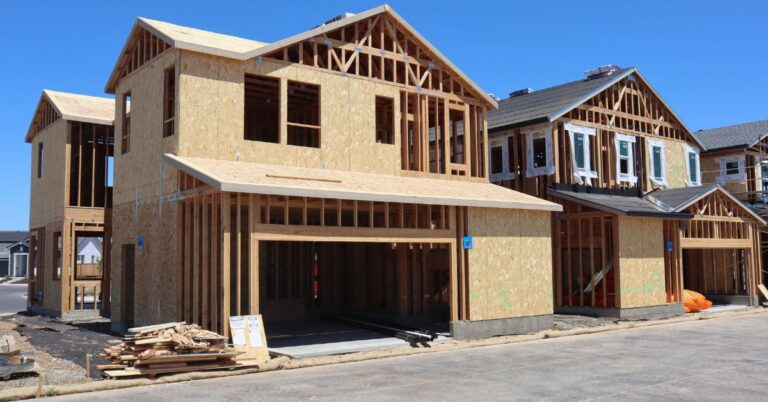
Recently reported figures from the U.S. Department of Housing and Urban Development and Census Bureau showed that U.S. home builders, one segment of the residential construction market, pulled back on the pace of new-home starts in October by 4.6% from the previous month and 7.8% from a year ago.
That pullback was reflected in a 6.1% year-over-year decline in private construction spending for new single-family homes, which declined 1.3% from September. Private spending on new multifamily projects fell 2.8% annually and 0.2% monthly.
High financing costs and uncertainty linked to President Donald Trump’s signature tariff policies have consistently been cited by home builders as undermining confidence in new-home construction.
Cautious buyer behavior has amplified pressure on builders as backlogs of completed homes take longer to sell, requiring increased use of incentives. Until an oversupply of new homes finds better balance, builders have little incentive to break ground on new projects.
The increase in private residential construction spending, occurring amid a decline in spending on new single-family home construction, could be driven by resilient renovation demand.
Similar pressures have hurt nonresidential construction spending in 2025 as manufacturing investment has plummeted, according to Anirban Basu, chief economist of Associated Builders and Contractors, a national construction industry trade association.
“While there are few sources of private nonresidential growth outside of the still surging data center category, much of the recent decline in construction spending is due to a precipitous drop in manufacturing investment,” Basu said in commentary published Wednesday, noting that “manufacturing construction spending has fallen by nearly 10% over the past 12 months.”