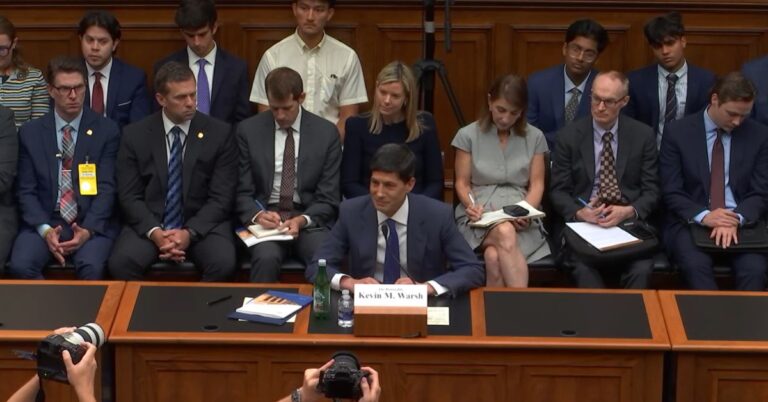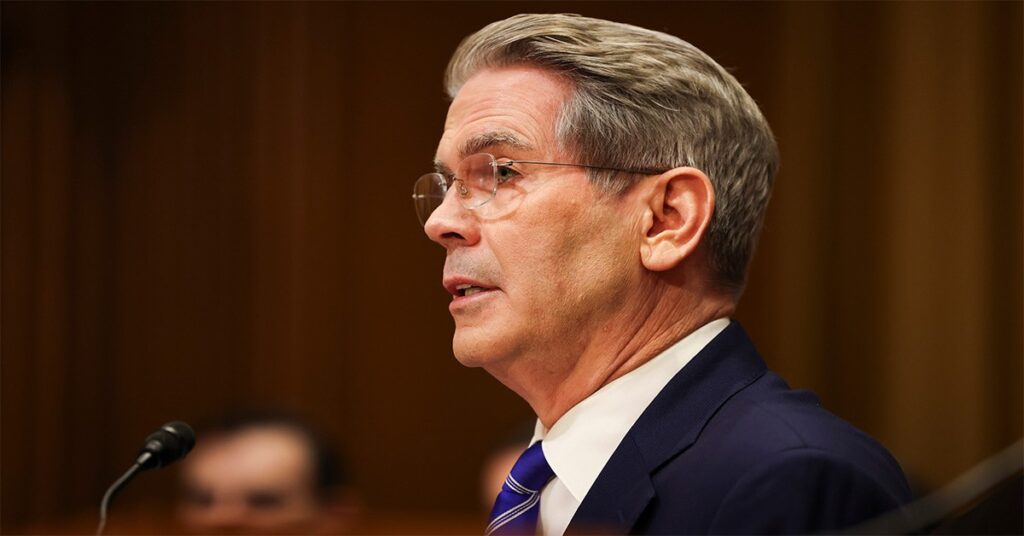
Scott Bessent misstated the Federal Reserve’s dual mandate when responding to the first question Rep. Emanuel Cleaver, D-Mo., asked the secretary of the U.S. Treasury Department as he testified before the House Financial Services Committee on Wednesday.
“What I would like to talk about is your opinion of the dual mandate, of stable prices, maximum employment. I would like to get your philosophy on that issue,” said Cleaver, ranking member of the House Subcommittee on Housing and Insurance, asking if the Fed’s dual mandate was “a mistake.”
“The dual mandate is a very delicate balance between maximizing economic growth while maintaining low levels of inflation,” answered Bessent — substituting the mandate to maintain maximum employment with a mandate to pursue maximum economic growth.

Cleaver did not press him on the distinction or ask if he misspoke, though the distinction and its implications matter for policymakers at the Federal Reserve, who have been duty-bound to that mandate since the Federal Reserve Reform Act of 1977 was enacted.
Labor supply fell largely in line with labor demand in the second half of 2025, keeping the unemployment rate lower than it might otherwise have been but putting the Fed’s dual mandate to maintain stable prices and maximum employment in tension, given that adjustments to the federal funds rate is the main policy tool at the central bank’s disposal.
The jobless rate was 4% to start 2025 and ended the year at 4.4%, a decrease from 4.6% in November. At the same time, government estimates show the economy has netted almost no new jobs in recent months.
With hiring and firing rates stabilizing through the fourth quarter as well, economists have wondered whether maximum employment amid low or negative job growth reflects full employment, casting doubt on whether additional easing may fuel job creation or inflation more directly.
The Federal Open Market Committee voted to leave its benchmark interest rate unchanged in January, citing stabilizing labor trends and “diminishing risks” to both sides of its dual mandate. Fed Chair Jerome Powell highlighted the paradox of low unemployment and low job creation in recent remarks to reporters.
“If demand and supply are in balance, then you could say that’s full employment. At the same time, do we really feel like that’s a maximum employment economy?” asked Powell. “It’s a very challenging and quite unusual situation.”
Typically, rate hikes have a much more direct impact on curtailing spending — helping to broadly reduce demand in the economy and put downward pressure on prices — than rate cuts have on boosting job growth, economists have told Scotsman Guide.
Brightening outlooks for U.S. economic growth in 2026 further underscores how confusing maximum employment with maximum economic growth could risk increasing inflation before it has returned to the Fed’s stated 2% target. Powell said the Fed’s preferred inflation reading showed 3% growth in December, up from 2.8% in November.
Meanwhile, supply-chain inflation has steadily risen in the second half of 2025, which many economists attribute to the inflationary effects of tariffs. Rising prices for wholesalers suggest price hikes on consumer goods are in the pipeline.
After bottoming out at 1.6% annual growth in June, services inflation rose 1.9% on an annual basis in July and August, 2% in September, 2.2% in October and 2.5% in November before topping out at 2.7% last month, its fastest pace of growth in 2025. Once an offset to sticky goods inflation, services inflation is becoming a similar burden on producers.
“So then, you believe, I’m assuming, in the independence of the Federal Reserve?” asked Cleaver of Bessent on Wednesday.
“I believe in the independence of the Federal Reserve, but I also believe in accountability,” Bessent responded, prompting Cleaver to ask Bessent to reconcile independence and accountability.
“We’ve seen these costs overruns at the Fed,” began Bessent, referring to a recently disclosed federal criminal investigation concerning congressional testimony Powell made last summer about cost overruns on an ongoing renovation of the Fed’s headquarters.
Powell alleged the probe was being used as a pretext to target the Fed for setting benchmark interest rates higher than President Donald Trump’s preference. A slew of Powell’s colleagues at the Fed have subsequently vouched for his credibility, emphasizing how attacks on Fed independence risk unraveling hard-won progress on inflation.
“The independence of the Fed is based on its trust with the American people,” Bessent continued, answering Cleaver’s question about the balance between independence and accountability, “and the Federal Reserve lost the trust of the American people when it allowed the greatest inflation of 49 years to ravage — ravage — working people in this country.”