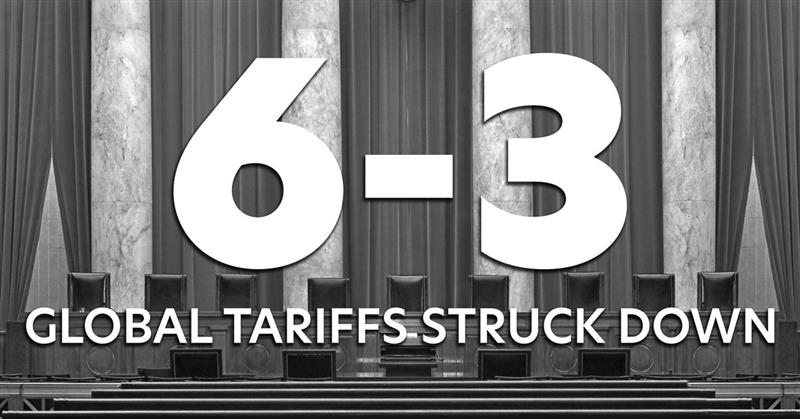
The U.S. Supreme Court has struck down President Donald Trump’s legal justification for unliterally imposing sweeping tariffs on perceived economic rivals and longstanding trading allies alike.
Issued Friday, the blockbuster ruling bears profound implications for the U.S. and global economies, thrown into turmoil after Trump’s signature tariff regime was first implemented last April.
Authored by Chief Justice John Roberts, the 6-3 ruling upholds a lower court’s decision that the president exceeded his executive authority by calling on a law intended for national emergencies to justify his tariff policy absent congressional approval.
The specific law at issue — the International Emergency Economic Powers Act (IEEPA) — was passed by Congress in 1977 and allows a U.S. president to regulate commerce during a national emergency. Trump declared national emergencies related to drug trafficking and trade deficits early in his second term, paving the way for his invocation of the IEEPA.
However, the U.S. Constitution grants the legislative branch, not the executive branch, authority to implement taxes and tariffs. Trump bypassed the need to seek approval from Congress by invoking the IEEPA, which Roberts took issue with in his majority opinion — particularly given the magnitude of tariffs imposed.
By asserting “the extraordinary power to unilaterally impose tariffs of unlimited amount, duration, and scope,” wrote Roberts, Trump had an obligation to “identify clear congressional authorization to exercise it.”
“The question is not, as the Government would have it, whether tariffs can ever be a means of regulating commerce,” he continued. “It is instead whether Congress, when conferring the power to ‘regulate . . . importation,’ gave the President the power to impose tariffs at his sole discretion. And Congress’s pattern of usage is most relevant to answering that question. That pattern is plain: When Congress grants the power to impose tariffs, it does so clearly and with careful constraints. It did neither here.”
Moreover, Roberts noted, no U.S. president before Trump had invoked the IEEPA to impose any tariffs, “let alone tariffs of this magnitude and scope.” The majority opinion concluded, unequivocally: “We hold that IEEPA does not authorize the President to impose tariffs.”
In his dissent statement, Justice Brett Kavanagh maintained that the “power to tariff falls squarely within the President’s wheelhouse.”
Kavanagh added that the majority decision is “not likely to greatly restrict Presidential tariff authority going forward,” but could have “serious practical consequences in the near term.”
“One issue will be refunds. Refunds of billions of dollars would have significant consequences for the U.S. Treasury,” Kavanagh wrote. “The Court says nothing today about whether, and if so how, the Government should go about returning the billions of dollars that it has collected from importers. But that process is likely to be a ‘mess,’ as was acknowledged at oral argument.”
Trump has imposed other additional tariffs under separate laws that were not part of the issues this case considered. The Friday decision reflects a “consolidated” judgment on a handful of cases that the Supreme Court agreed to hear collectively as they raised similar complaints against Trump’s claimed authority under the IEEPA.