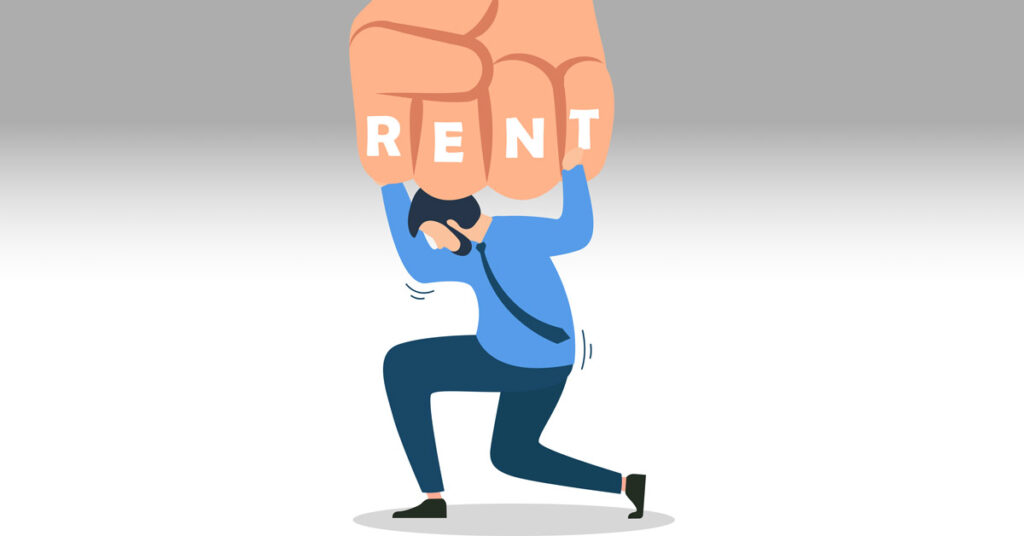
Typical consumers are advised to avoid spending more than 30% of their gross monthly income on housing, be it a mortgage payment or monthly lease.
Those households whose monthly shelter outlay exceeds the 30% spending threshold are labeled “cost burdened” for most data collection purposes.
A persistent housing affordability crisis has sidelined first-time homebuyers and driven housing turnover to multidecade lows. Despite recent softening in U.S. home prices and rents, median home prices exceeded $417,000 in the third quarter of 2025, compared to a median household income of $83,730 in 2024, according to U.S. Census Bureau data.
Median rents nationwide are about 17% higher than pre-pandemic levels, according to listings platform Realtor.com, roughly 4% below their peak in August 2022.
The National Association of Home Builders (NAHB) reports that the ongoing housing affordability crisis disproportionately impacts renter households, however, given that cost-burdened renters outnumber their owner counterparts by two to one.
More than half of all renter households (50.3%; 23.2 million) are burdened by housing costs, while fewer than one-quarter of homeowners (24.3%; 21 million) spend more than 30% of their gross monthly income on housing.
An NAHB analysis of American Community Survey data from 2024 revealed that the share of cost-burdened renters among all renters in the state was highest in Florida (60%), Nevada (57%), California (55%) and Connecticut (53%).
“At the same time, current homeowners, buoyed by significant home equity gains and locked in by below-market mortgage rates, are in a more advantageous financial position to weather the growing affordability crisis,” the report reads.
At least half of the total renter household population are considered cost burdened in Washington, Oregon, Arizona, Colorado, Texas, Louisiana, Georgia, South Carolina, North Carolina, Maryland, New Jersey, New York, Massachusetts and Rhode Island.
The real estate analytics firm Attom says that in more than 34% of U.S. counties it analyzed in the third quarter, home expenses on a median-priced home exceed 43% of typical wages, a benchmark considered “seriously unaffordable.”
The geographic distribution of cost-burdened homeowners in NAHB’s study mirrors that of cost-burdened renters, though the rate of cost-burdened owners is much lower.
California (33%), Florida (31%), Nevada (27%), Colorado (27%) and several Northeastern states with rates between 27% and 30% reported the highest shares of cost-burdened homeowners in 2024.