Every resident in housing funded by the U.S. Department of Housing and Urban Development (HUD) would be required to show proof of citizenship or eligible status, including those in “mixed-status households,” according to a proposed HUD rule announced Feb. 19.
“Under President Trump’s leadership, the days of illegal aliens, ineligibles and fraudsters gaming the system and riding the coattails of American taxpayers are over,” said HUD Secretary Scott Turner in a press release. “HUD’s proposed rule will guarantee that all residents in HUD-funded housing are eligible tenants. We have zero tolerance for pushing aside hardworking U.S. citizens while enabling others to exploit decades-old loopholes.”
According to the press release, the proposed action continues the department’s efforts to execute on President Donald Trump’s executive order from February 2025 titled “Ending Taxpayer Subsidization of Open Borders,” and would close what HUD terms a “roommate loophole” in households with mixed immigration statuses.
Currently, eligible mixed-status families — meaning those with members whose eligibility or ineligibility for HUD housing assistance programs differs based on citizenship or immigration status — can receive housing assistance on a prorated basis, calculated by the percentage of eligible family members. The proposed rule would limit that decreased assistance period to a 30-day window.
Cristy Villalobos-Hauser, a housing policy adviser for UnidosUS, the nation’s largest Latino nonprofit advocacy organization, told Scotsman Guide in an email that the proposed HUD rule is “an attack on mixed-status families.”
Instead of addressing the nation’s housing shortage, Villalobos-Hauser stated, it would evict large numbers of people, the majority of them U.S. citizens, simply because one family member lacks documentation.
“It’s unlawful, costly and will push vulnerable families closer to homelessness while deepening housing insecurity nationwide,” she said. “At UnidosUS, we strongly condemn this proposal and remain committed to protecting immigrant families and their housing stability.”
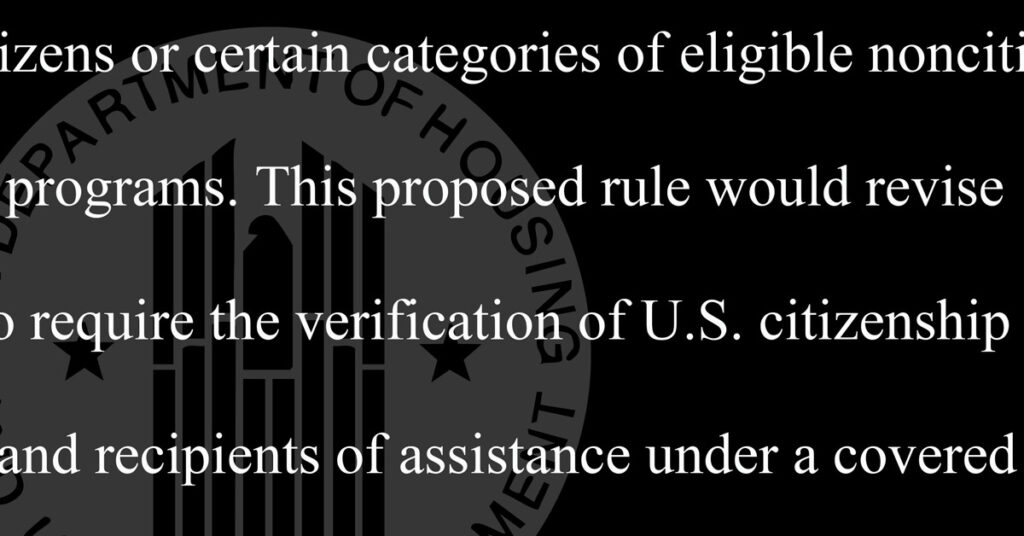
If implemented, the rule would revise Section 214 of the Housing and Community Development Act of 1980. The revision would implement regulations “to require the verification of U.S. citizenship or the eligible immigration status of all applicants and recipients of assistance under a covered program regardless of age.”
A 60-day comment window for the proposal opened on Feb. 20. It closes on April 21.
Scotsman Guide reviewed the 106 responses that had been posted to a government website as of the publication of this article. Eight are in favor of HUD’s proposal, 96 are against and two didn’t have an opinion.
One of the public commenters was Shawna Bowman, executive director of the Chicago-based nonprofit Friendship Community Place, who stated they were also posting on behalf of Neighbors for Affordable Housing in Chicago. They said the proposed rule change “represents a cruel and unnecessary reversal of decades of stable housing policy that has successfully balanced statutory requirements with the fundamental goal of preventing homelessness.”
Bowman added that they believe the proposed HUD policy could have catastrophic impacts on mixed-status families.
“By eliminating the ‘prorated assistance’ model that has been in place for over 30 years, HUD is forcing families into an unconscionable position: they must choose between staying together in homelessness or breaking their families apart to retain a roof over their heads,” Bowman wrote. “This policy ignores the fact that prorated assistance already ensures that no federal subsidy is spent on ineligible individuals.”
Three of the eight respondents who were for the rule change gave their names. The rest were anonymous or used initials. Some stated that the system has failed them or their families.
A commenter identified as “T C” stated: “It doesn’t matter if they have children or spouses because they know they got here illegally and are staying here illegally. Time and family status does not change those facts.”
Many of the responses focused on the emotional aspect of the issue, with many calling it unnecessarily cruel, xenophobic and a threat to exacerbate the U.S. housing crisis.
One commenter, who identified herself as Jamie Ramos of South Jordan, Utah, penned an emotional appeal to HUD to “formally and strongly oppose” the proposed rule. Describing herself as a U.S. citizen and a mother of five, Ramos shared how her family would become homeless as a result of the change.
Ramos stated that her husband holds a category C10 work permit, has a Social Security number and pays taxes, and is in an active immigration court process called Cancellation of Removal, a legal remedy that can potentially overturn a deportation ruling. But under the proposed HUD rule, Ramos stated, “my children will lose their home simply because of their father’s status, despite the fact that our current assistance is already prorated — meaning we receive zero subsidy for my husband.”
The proposed rule opened for comment just one week after another HUD public comment period ended on the Trump administration’s proposal to remove disparate impact discrimination liability protections under the Fair Housing Act of 1968.