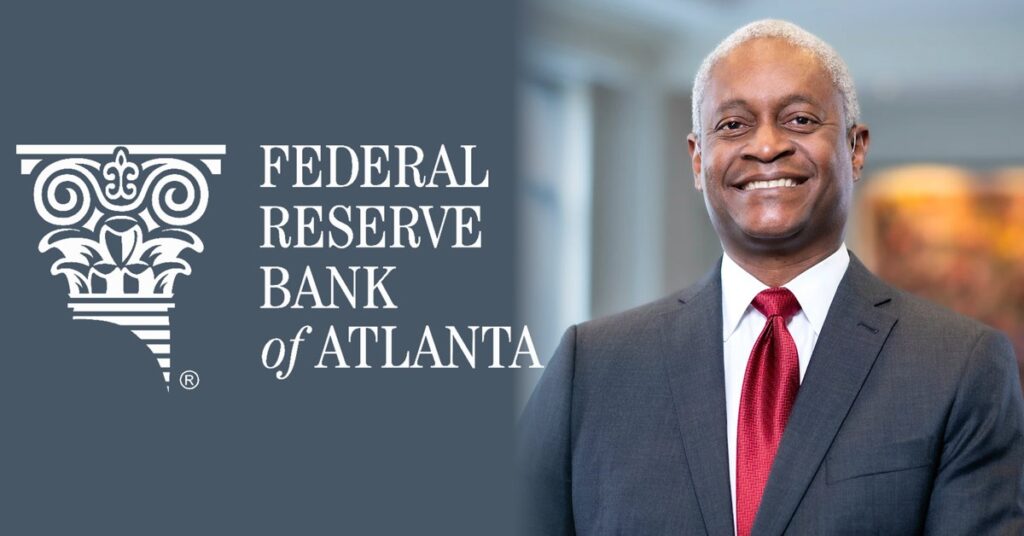
Deep gratitude for his community and a warning about the potency of public assaults on Federal Reserve independence framed farewell remarks published Wednesday by the president and CEO of the Federal Reserve Bank of Atlanta, Raphael Bostic, whose previously announced retirement begins Sunday.
Bostic assumed the role slightly more than eight years ago in 2017, becoming the first Black and first openly gay president of a regional Fed bank, according to his remarks. Turning 60 in June, Bostic would have been eligible to serve until a mandatory retirement age at 65.
“In the past few months, I began to sense that my most valuable work here might be done,” explained Bostic, leading to a recognition that “if I stayed much longer, I risked settling into the role of caretaker. That is not the sort of leader the Bank needs and deserves to continue serving the people of the Sixth Federal Reserve District.”
During his tenure at the Atlanta Fed, Bostic says he prioritized the distribution of decision-making authority and community input.
“Fundamentally, we wanted to move the culture to a place of greater flexibility and more freedom to make decisions from the bottom up,” he said, which required rooting the bank’s work deeper within the regional business community it serves. “I wanted to help ordinary people better understand the Fed and what we do, and also communicate in tangible ways that we are human and serve them.”
‘A major concern’
Bostic’s likely final statement as Atlanta Fed president included a warning about the erosion of central bank independence in the eyes of the U.S. public, made evident to him through interactions with businesses and consumers in his district.
“My travels over the past several months have made clear that the legal and rhetorical battles raging around the central bank right now have caused people across a wide cross-section of our population to begin to doubt the Fed’s independence,” he said. “This is a major concern.”
Fed Chairman Jerome Powell underscored as much at a press conference concluding last month’s monetary policy meeting — the first since he disclosed a federal investigation into himself and the central bank related to Senate testimony he made last year concerning cost overruns for an ongoing renovation of the Fed’s headquarters.
In a defiant rebuttal to the government’s claims, Powell described the investigation as retribution for not heeding President Donald Trump’s wishes to slash interest rates to a level that policymakers at the Fed agree is not appropriate.
“We haven’t lost it,” said Powell of Federal Reserve independence, warning that restoring faith in the Fed’s ability to do its job without political interference, if lost, would be difficult. “I don’t believe we will. I certainly hope we don’t,” he added.
Fed Governor Lisa Cook continues to serve in her role amid an ongoing legal battle over unproven allegations of mortgage fraud. The allegations against Cook were first referred to the U.S. Department of Justice by the director of the Federal Housing Finance Agency, Bill Pulte, who is now under investigation for the manner in which he sourced Cook and prominent Democrats’ records amid his handling of a series of high-profile mortgage fraud referrals last year.
Bostic’s farewell remarks underscore the reality that Fed independence isn’t only won or lost on Capitol Hill and the trading floor of the New York Stock Exchange, but also in the minds of every pensioner who grows increasing reliant on the backstop of their retirement fund. Swaths of the U.S. population have limited or no understanding of how the Fed advances its dual mandate to maintain stable prices and maximum employment, though they may intimately understand rising grocery bills and job anxiety.
“The Federal Reserve’s ability to set monetary policy with a primary focus on the long run has been an important underpinning of the world’s most trusted financial markets and most dynamic economy,” said Bostic. “But that global position is not guaranteed. Safeguarding our special status includes protecting the Fed’s independence.”
Similar to the impartiality of the justice system, the independence of the U.S. central bank is assumed yet still enshrined in law, one of the few government institutions statutorily sidelined from the scrum of elective politics.
An ardent critic of current U.S. monetary policy, Trump and allies across the administration have taken to attacking the consensus-building mechanism at the heart of the Fed’s decisioning process. While acknowledging that dragging the Fed’s reputation through the mud has hit the public’s trust in Fed independence, Bostic sought to remind the public in his statement of why he believes preserving that independence is worthwhile.
“I think it’s important that the public understand what is at stake when the Fed’s independence is at risk,” Bostic stated. “Decades of lived experience, as well as a large body of academic research, makes clear that a nation’s economic outcomes are better when there is an independent central bank. Inflation is lower, economic performance is more robust, and consumers and businesses alike are more confident that long-run investments will be worth making.”