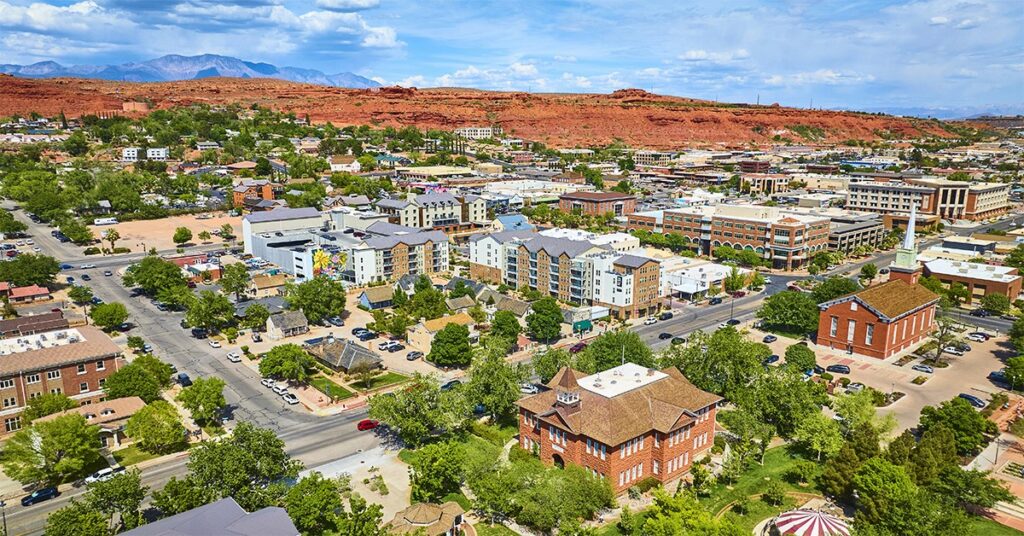
Tucked away in the southwest corner of Utah, St. George is better known as the gateway to Zion National Park than as a commercial real estate juggernaut. But the metropolitan area — with a population of about 200,000 — was named the top spot in the country for overall commercial real estate performance by the National Association of Realtors.
NAR’s newly unveiled commercial real estate demand index gave the St. George metro area a score of 128, the highest in the nation. The Realtor association cites St. George’s strongest office employment growth of any city, along with having one of the fastest-growing populations in the nation. The city, which sits on the border between Arizona and Utah, also scored above average on industrial demand.
St. George wasn’t the only surprise on NAR’s list, which ranked many obscure and smaller metro areas over the nation’s more accepted commercial leaders, such as New York City and Los Angeles. NAR explains that the rankings indicate stronger recent economic momentum relative to other metro areas, rather than more overall commercial real estate activity.

Communities ranking high on NAR’s index include the Arkansas metro area of Fayetteville-Springdale-Rogers and Huntsville, Ala., both of which earned scores of 125. NAR found that Fayetteville showed broad-based growth, ranking first in the nation for retail demand while also scoring above average in office and multifamily demand. Huntsville had one of the strongest multifamily scores in the country and performed well in retail and industrial demand.
Other metros boasting broad-based commercial real estate growth included Ocala, Fla.; Raleigh-Cary, N.C.; Sherman-Denison, Texas; Lakeland-Winter Haven, Fla.; and Grand Forks, N.D.-Minn.
Cooling boomtowns
The NAR index measures local economic conditions in more than 300 metro areas across the U.S. It focuses on four categories: growth in the office sector by tracking professional and business services employment; growth in the industrial sector by tracking manufacturing, transportation and warehousing employment; the retail sector’s expansion by gauging retail and hospitality growth; and the multifamily sector through population growth and net migration.
These four sectors are combined into a single index. A value of 100 represents the average metropolitan area; a score above 100 indicates demand drivers are growing faster than average; and a score below 100 indicates growth is slower than the average community.
When ranked by property type, markets with the strongest growth in professional and business services employment included St. George, Grand Forks and Waco, Texas. Leading the index for industrial demand were Salem, Ore.; Fairbanks, Alaska; and Olympia-Lacey-Tumwater, Wash. Retail strength and multifamily demand was strongest in Huntsville, Ocala and Lakeland-Winter Haven.
The index found that the metropolitan areas that boomed the fastest in recent years have now cooled. These communities, many of which are in the Sun Belt, are still growing, but not as fast.
Austin, Texas, for instance, was the hottest city in the nation in the 2022 NAR index, with a score of 132. Today, Austin is down to 116. That is still very strong, but the gap between Austin and other markets has been closing in recent years as both hiring in professional services and population growth have slowed.
NAR writes that Florida has followed the same pattern, with metros averaging scores of 115 in the 2022 index compared to an average of 110 in the latest index. Naples, one of the Florida cities that boomed the fastest, is down 29 points since 2022 and now measures 95, showing slower commercial growth than average.
Other Florida cities have also fallen down the index, including Miami, which in the past had enjoyed strong international migration. This year, Miami fell 16 points to an index rating of 99, just below average.
Texas and the Carolinas show strength
While Florida communities are seeing slowing demand, metros located in North and South Carolina are generally on the rise. South Carolina is now the strongest state in the index, with its five metro areas averaging 110, which is higher than Florida, Texas and Utah.
North Carolina has also enjoyed greater demand. NAR notes that Raleigh has proven a standout among large metro areas, with its index rating rising from 114 in 2022 to 121 this year. It is “one of the few major markets that is stronger today than it was at the height of the migration boom,” NAR writes.
Texas has remained one of the nation’s strongest areas for commercial real estate, though demand has shifted throughout the state. While Austin has cooled slightly, smaller communities, such as Waco and Wichita Falls, have seen commercial demand increase.
San Francisco, which has been the weakest large market during the past four years, is showing signs of life. It fell to an index reading 87 in 2024, but jumped to 93 in the 2026 edition.
New York City and Washington, D.C., which had shown improvement in recent years, have both moved down the index and rate 96. Boston came in slightly higher at 97. Los Angeles has been mired in the low 90s for the past four years and sits at 91 this year.
Among the major surprises from the index was the stellar showing by Grand Forks, which has jumped 35 points — more than any other metro on the list in the past four years — and now sits at 121. This year’s performance placed Grand Forks among the top 10 metros in the nation. Other cities making unexpected moves included Lake Charles, La., Lexington Park, Md., and Fort Collins, Colo.