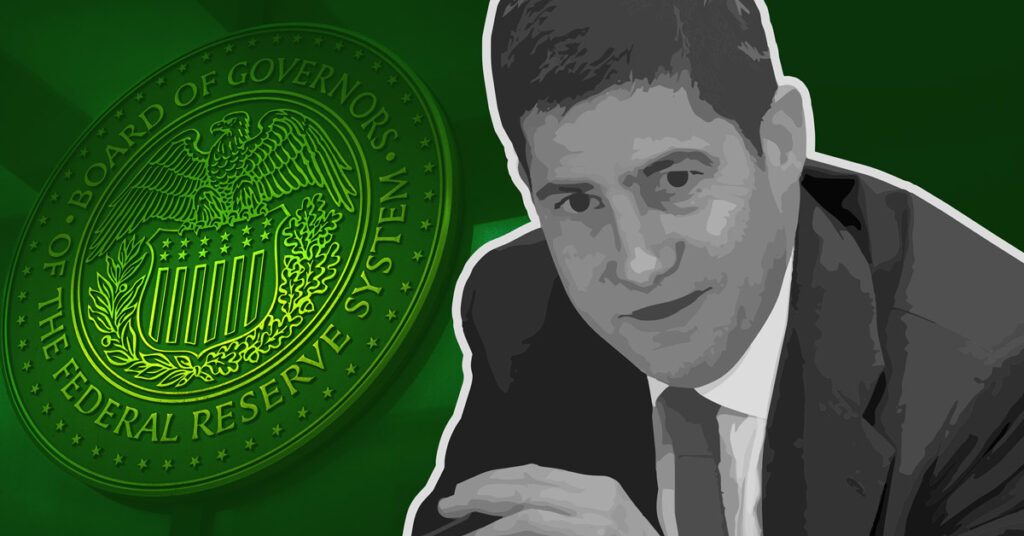
The pick is in. Kevin Warsh will be the next chairman of the Federal Reserve, pending Senate confirmation.
President Donald Trump made the official announcement Friday morning in a post on Truth Social.
“I have known Kevin for a long period of time, and have no doubt that he will go down as one of the GREAT Fed Chairmen, maybe the best,” wrote Trump. “On top of everything else, he is ‘central casting,’ and he will never let you down.”

Warsh, 55, previously sat on the Fed’s board and its 12-member rate-setting committee from 2006 to 2011. A former Morgan Stanley executive, he has a law degree from Harvard University and worked as a staffer on the National Economic Council during the second Bush administration. More recently, he served as a distinguished visiting fellow in economics at Stanford University’s Hoover Institution.
Warsh was considered an early favorite for the Fed chair job when the vetting process began in mid-2025, though his odds fluctuated as the year progressed.
At various junctures, candidates considered for the role included Treasury Secretary Scott Bessent (who ended up directing the interview process), White House economic adviser Kevin Hassett, current Fed Governor Christopher Waller, and BlackRock fixed-income guru Rick Rieder — the latter of whom made a late surge in the online betting odds and was considered the favorite as recently as a week ago.
But Warsh ultimately prevailed, with his candidacy perhaps boosted by the fact that he previously interviewed for the job during Trump’s first term in the Oval Office.
Trump chose Jerome Powell as Fed chair over Warsh in 2017, who was renominated by President Joe Biden in 2021. Powell has since become a frequent punching bag of Trump’s, who believes the benchmark federal funds rate should be far lower than its current 3.5% to 3.75% range.
Powell’s term as Fed chairman is set to expire in May, meaning the first monetary policy meeting Warsh will preside over if he receives Senate confirmation will be in June.
Policy-wise, Warsh’s track record as a Federal Reserve governor would seem to be at odds with Trump’s stated desire for a Fed chair who will cut rates early and often. During his time on the central bank’s board, he gained a reputation as an inflation hawk who favored higher interest rates to curb inflationary pressures.
But Warsh has also been critical of Powell’s policy decisions. In an opinion piece published in The Wall Street Journal in November, Warsh called the Fed’s leadership “broken.” He argued that the central bank’s “bloated balance sheet” should be reduced significantly, with the resulting largesse “redeployed in the form of lower interest rates to support households and small and medium-size businesses.”
Warsh will now face a Senate confirmation process fraught with uncertainty.
Sen. Thom Tillis, R-N.C., a key member of the Senate Banking Committee, has publicly stated that he will oppose the confirmation of any nominee for the impending Fed chair vacancy until a legal matter involving Powell is “fully resolved.”
That matter involves a Department of Justice subpoena Powell received Jan. 9 related to Senate testimony he gave last June about cost overruns for an ongoing renovation of the Fed’s headquarters.
Powell alleged in a video address that he was being targeted by the Trump administration, and that “the threat of criminal charges is a consequence of the Federal Reserve setting interest rates based on our best assessment of what will serve the public, rather than following the preferences of the president.”
The central bank has also been rocked by controversy surrounding a Justice Department probe of Fed Governor Lisa Cook based on unproven allegations of mortgage fraud. The Supreme Court heard oral arguments on that matter on Jan. 21, which Powell has termed “perhaps the most important legal case in the Fed’s 113-year history.”
Assuming his Senate nomination proceeds and he receives a majority of affirmative votes, Warsh will join a monetary policy committee that grew increasingly divided during the latter half of 2025 over whether it should prioritize tackling stubbornly high inflation or a stalling labor market.
He will also be faced with the challenging task of both being a steward of Fed independence and staying in the good graces of the president responsible for handing him the job of a lifetime.