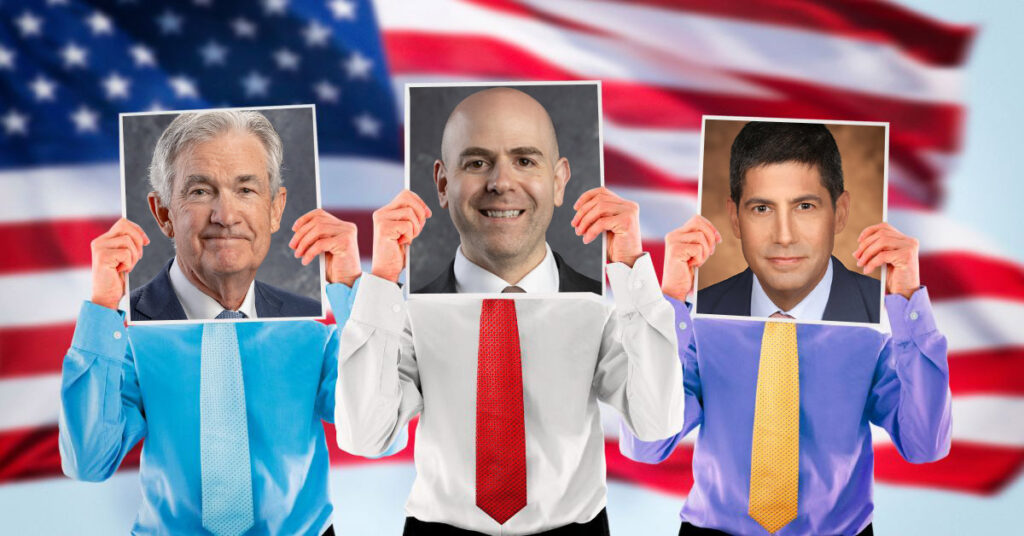
When President Donald Trump nominated Stephen Miran last August to fill a temporary vacancy on the Board of Governors of the Federal Reserve, the president said he intended to name a permanent replacement when the temporary term ended.
That term ended on Jan. 31, when the board seat resigned unexpectedly last fall by Adriana Kugler formally expired. However, no laws mandate Trump to nominate a replacement for Miran or renominate him to a 14-year term with any urgency.
Instead, Miran’s fate largely depends on Jerome Powell, whose term as Fed chair ends in May but whose governorship term ends in 2028, and the pace of Senate confirmation for Kevin Warsh, Trump’s nominee to succeed Powell as Fed chair.

Should Powell relinquish his chairmanship but retain his governorship, Warsh would replace Miran on the board, not Powell. In an interview with CNBC last Friday, Miran — who took a leave of absence as chair of the White House Council of Economic Advisers in order to join the Fed — said he is prepared to remain on the board until such time as a successor is installed.
“At the moment it’s the only one available, so I would assume yeah,” said Miran when asked if Warsh would be taking his seat on the board, pending Senate confirmation. “But I guess we’ll see when the president formally sends the nomination over to the Senate.”
Trump has frequently said whoever he chooses to replace Powell must agree to advance his wishes of substantial interest rate cuts. But observers widely consider Warsh to be more hawkish on inflation than Miran, who has registered formal dissents at all four policy meetings in which he has participated since his swearing in last September.
When the Federal Open Market Committee (FOMC) voted to lower the federal funds rate by 0.25% at three consecutive meetings in September, October and December, Miran dissented thrice in favor of jumbo 0.5% cuts. He dissented in favor of a 0.25% reduction when the FOMC voted for no change to its benchmark borrowing rate last week.
A need for ‘regime change’
A former Fed governor who served from 2006 to 2011, Warsh gained a reputation during that period as a policy hawk, favoring higher interest rates to curb inflation. But Warsh has been critical of Powell’s higher-for-longer rate regime, writing in a November op-ed in The Wall Street Journal that “Americans would have higher pay and greater purchasing power if the Fed got its act together.”
Warsh also said that the Fed has “lost credibility” and is in need of “regime change.”
Powell, who is currently under criminal investigation by the Department of Justice for allegedly making false statement to Congress about cost overruns in an ongoing renovation of the Fed’s headquarters, has not said whether he will resign his governorship in May. He has characterized the investigation against him as political theater, however.
“Public service sometimes requires standing firm in the face of threats,” said Powell in a recent video statement, alleging that he and the central bank were being targeted for not delivering Trump’s desired rate cuts. “I will continue to do the job the Senate confirmed me to do, with integrity and a commitment to serving the American people.”
What Powell perceives as an escalating attack against U.S. central bank independence could backfire for the Trump administration if Powell feels inclined to complete his term as governor to act as a buffer against further assaults on independent monetary policy.
“We haven’t lost it,” said Powell in remarks last week, answering a reporter’s question about the state of Fed independence. “I don’t believe we will. I certainly hope we don’t.”
Where Miran and Warsh align is in their desire to shrink the size of the Federal Reserve’s balance sheet. Miran has argued in recent speeches that regulatory distortion inflates the level of reserves the Fed requires banks to hold at the Fed.
In the same November op-ed, Warsh called the Fed’s balance sheet “bloated,” claiming that the “largesse can be redeployed in the form of lower interest rates to support households and small and medium-size businesses.”
A contentious confirmation process
A former Wall Street banker, Warsh was the only Fed official to argue against the bank’s buying of $600 billion in U.S. Treasury bonds in 2011 to stimulate an economy reeling from the 2008 financial crisis. He resigned from his Fed governorship in early 2011.
Miran confirmed his alignment with Warsh in last week’s interview with CNBC, calling him a “fantastic pick” for Fed chair. Miran underscored their shared ambitions to reduce the Fed’s market footprint while emphasizing that deregulation and balance sheet downsizing are inseparable in pursuit of that goal.
“He’s had a long of history of convincing people about his arguments,” said Miran, “and so I think as a result he’s going to be treated with a lot of respect and people are going to find him very persuasive because, at the end of the day, I think a lot of his views are really right.”
In the wake of grand jury subpoenas being issued against Powell and the Fed, Senate confirmation for Warsh is likely to be a contentious and possibly drawn out affair, which could leave Miran on the Fed’s board for one or more meetings this spring.
Miran’s six-week confirmation process was fast-tracked by Republicans so he would be available to vote at the September FOMC meeting. With a slim majority in the Senate and the likes of Sen. Thom Tillis, R-N.C., vowing not to advance any Fed nominees until proceedings against Powell conclude, Republicans face a tall hurdle ahead for Warsh’s confirmation.
Warsh, who is the son-in-law of billionaire Republican donor and former Trump classmate Ronald Lauder — heir to global cosmetics brand Estee Lauder and reportedly the first person to pitch Trump on buying Greenland, back in 2018 — will likely face Senate questioning on all fronts, from his business dealings to his balance-sheet ambitions to his reflexes if assailed by Trump on social media, should a consensus on rapid rate cuts prove elusive.
Most policymakers at the Fed project one interest rate cut in 2026. Trump wants many. Wall Street has digested the nomination as if Warsh will be the high-interest-rate advocate he proved to be a decade ago, rather than a dovish Fed chair who will push for large cuts.
Sen. Elizabeth Warren, D-Mass., ranking member of the Senate Banking Committee on which Tillis also serves, noted in a separate interview with CNBC last Friday that every Republican she has spoken to since Warsh’s nomination calls Fed independence “crucial.” What remains to be seen, she says, is what version of Warsh will manifest if he’s confirmed as central bank chief.
“My issue is he doesn’t have independent judgment,” said Warren. “He’s a guy who has consistently delivered for the big boys on Wall Street. Wall Street may think that sounds pretty good.”