
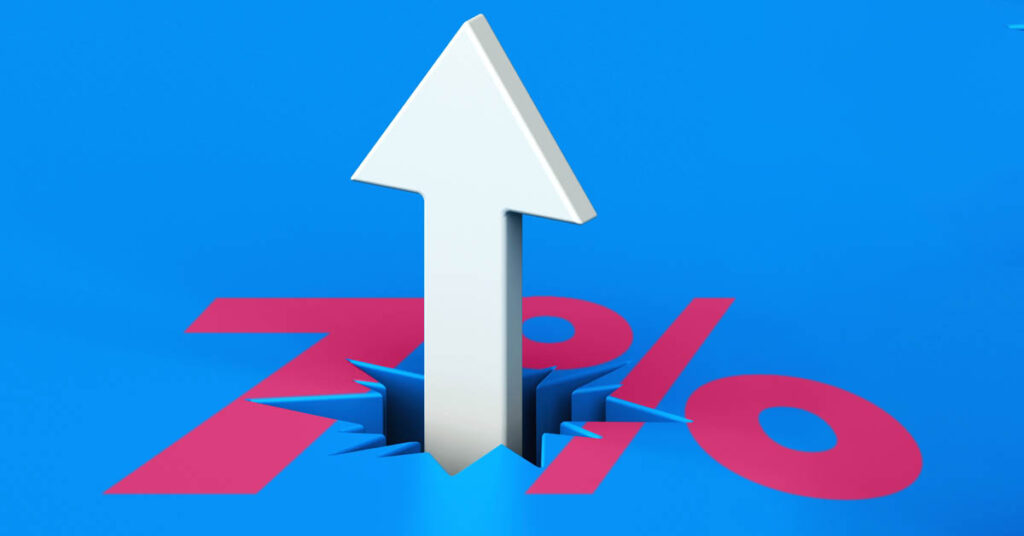
Black Knight’s newest Market Monitor report, derived from originations data gathered through the end of July, was colored by one very crucial development: the growth of mortgage interest rates past the 7% threshold for the first time since November 2022.
“While they moved around a bit in July, there was no escaping the fact that conforming 30-year rates topped 7% in July for the first time since they spiked last fall,” said Andy Walden, Black Knight’s vice president of enterprise research and strategy. “On both a practical and psychological level, that put further downward pressure on mortgage demand.”
This was evident in rate-lock figures, which decreased for a second straight month. Total rate-lock activity fell 7% from June as purchase locks (which made up 88% of all locks in July) dropped 7.4% month over month. The count of purchase locks was down 27% annually and 35% below their pre-pandemic level.
“Purchase loans continue to dominate the origination pipeline,” Walden said, “but current housing market dynamics are just not conducive to boosting homebuyer origination volumes.”
Refinances continue to lag in the high-rate climate, with both cash-out and rate-and-term refis down a respective 60% and 31% year over year. Interest rates hovered in the mid- to high-5% range in July 2022.
The outlook for refinances continues to look grim, per the Market Monitor as only 3% of all homeowners with mortgages have first-lien rates at or above the current level. In a cycle that has been marked by instability, the latest upward bounce of mortgage rates is the newest development in a market with lagging activity and a boil beneath home prices.
“With home prices hitting new peaks across many parts of the country, and no end in sight to the for-sale inventory shortage, the housing market continues to reheat,” Walden said. “It’s worth noting, however, that in a ‘normal’ year, June typically marks the calendar peak of home prices on a non-adjusted basis, so you would normally expect to see a decreasing trend through year’s end and into February. That said, this year, and this market, have been anything but normal.
“Rising rates may be tamping demand for homes at such record-high prices, as evidenced by rate-lock activity, but they’ve still yet to overcome an even greater deficit of supply. As a result, the purchase market is in a stalemate.”
Meanwhile, signs of credit tightening remain highly in focus. Downpayments are up, loan-to-value ratios are down, and credit scores for locked loans are hitting peak levels. The average credit score across purchase locks for primary residences grew to a record high before coming down to remain flat compared to June. Meanwhile, credit scores among locks for conforming and Federal Housing Administration loan products each reached series highs during the same period.