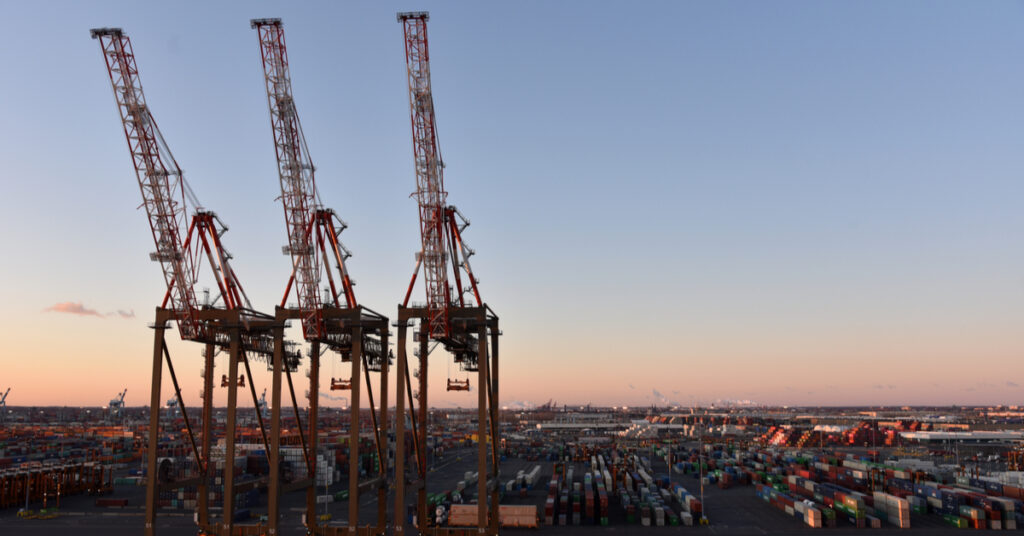
Labor instability at ports on the West Coast have carried over from last year into the opening quarter of 2023, and the ensuing shift from Pacific shipping entry points to Atlantic alternatives poses interesting implications for the industrial real estate sector, according to Marcus & Millichap.
Long-running contract talks between the Pacific Maritime Association, which represents ocean cargo carriers and ports, and the International Longshoreman and Warehouse Union have continued to generate consistent tension, The Wall Street Journal reported in late March. Friction between the two sides were already prompting fears of port shutdowns up and down the West Coast last year, and the stalled negotiations have only heightened simmering anxieties.
As a result, many shipping operations have moved their focus to the East Coast. Last year, the amount of freight throughput in the ports of New York and New Jersey surpassed that of the ports of Los Angeles and Long Beach for the first time in decades. The Port of Los Angeles, in particular, saw throughput decrease by nearly 800,000 twenty-foot equivalent units (TEUs) during the year ending in Q1 2023. Marcus & Millichap noted that monthly throughput has normalized in Los Angeles as initial shutdown fears have subsided and the port remained in business, but ongoing talks between employers and unions have nonetheless kept many retailers shipping via Atlantic and Gulf ports.

The shipping swing from West to East isn’t exactly a new phenomenon. Eastern Seaboard ports have been picking up steam for 20 years. In 2002, some 80% of trans-Pacific cargo entered the country via West Coast ports of entry. Today this figure has dwindled to about 56%, and this migration could amplify even further in the years ahead as trade tensions with China potentially intensify and more manufacturing facilities are nearshored to Latin America.
In some ways, the shift has been a boon for investors, who have saved money via lower entry costs in the Southeast compared to expensive land and assets in the West. Areas near promising ports in the Sun Belt have seen amplified property investment, evidenced by deal volume in markets such as Charleston, South Carolina, hitting new highs in 2022.
And such activity isn’t concentrated near water, with points further inland on the freight relay also benefiting, Marcus & Millichap reported. Atlanta’s warehouse and distribution assets, for example, are receiving ample attention from capital sources outside of Georgia.