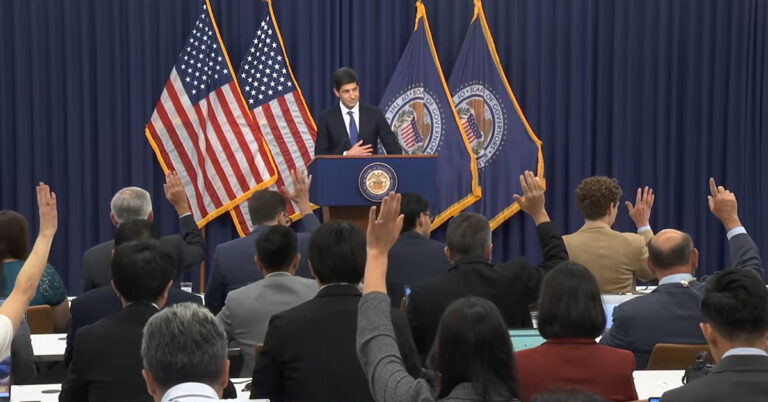
A trio of Federal Reserve officials caused a stir Wednesday when they called out language in the Federal Open Market Committee’s statement on monetary policy and economic conditions.
In an 8-4 vote, the FOMC maintained the federal funds rate at its current level between 3.5% and 3.75%. Fed Governor Stephen Miran, as expected, favored a 0.25% reduction. But in a surprising move, Beth Hammack, Neel Kashkari and Lorie Logan also dissented.
Those regional Fed presidents, who cycled into voting roles on the FOMC in January, all supported the rate hold. But they objected to what they described as an “easing bias” in the policy statement, referring to language that implies the next directional policy move will be a rate cut, not a rate hike.
Though Hammack, Kashkari and Logan have taken hawkish postures in recent public remarks — meaning a monetary stance that prioritizes lower inflation over economic growth — this is the first time they have formally voted against consensus in 2026.
The four committee dissents are the most since 1992 — a sign of increasing divisions at the central bank during a period of heightened economic uncertainty caused by the ongoing war in Iran.
Would removing the easing bias lower mortgage rates?
Treasury bond yields and mortgage rates moved higher following the Fed rate announcement, though that was also due to surging oil prices amid heightened tensions in the Middle East conflict.
But how would markets react if the easing bias were struck from the Fed’s forward-looking policy? Scotsman Guide posed that question to several economists and mortgage leaders, including Doug Duncan, founder of advisory firm Duncanomics and former chief economist at Fannie Mae.
“Dropping the easing bias could bring longer rates down somewhat if the market concluded that the Fed was more serious about getting inflation down,” Duncan says. “It is true the market will have to determine whether the Fed will ‘look through’ the Iran war and energy price rise in its positioning vis-a-vis underlying inflation, which is running at 3%.”
But Joe Panebianco, CEO of AnnieMac Home Mortgage, thinks striking the easing bias from the Fed’s stance could have sent mortgage rates higher, pointing out that short-term U.S. Treasury debt is already pricing in what removing the easing language may have accomplished.
“A removal of the easing bias would suggest that the Fed is comfortable with rates where they are now and might now be balanced between easing and tightening,” Panebianco tells Scotsman Guide.
Mike Vough, who leads corporate strategy for mortgage data platform Optimal Blue, says that even if the easing bias had been removed, rates would likely still be elevated, reinforcing his view that financial markets are “not yet entering a traditional easing cycle, but instead adjusting to a longer period of restrictive, but stable, policy.”
“At current levels, mortgage rates don’t have much room to fall sustainably without a clearer turn in inflation or stabilization of global risk factors,” Vough says.
Jeremy Collett, chief capital markets officer at Rate, believes any move lower in mortgage rates would likely be “very limited” given the relative hawkishness now coalescing at the Fed.
“The committee acknowledged rising geopolitical uncertainty and energy-driven inflation risks, reinforcing that policy patience is no longer a one-way street,” Collett says.
“This doesn’t read as the end of a cycle so much as a transition phase,” he continues, “one where the bar for materially lower rates is significantly higher and increasingly dependent on a clear deterioration in growth or labor conditions that simply isn’t showing up yet.”
‘A more mature phase’
After rising from roughly 6% in February to over 6.5% in late March as the economic impacts of the Iran war flowed through financial markets, average mortgage rates on 30-year fixed-rate loans stabilized between 6.3% and 6.35% through most of April, according to Freddie Mac data.
Net effects on lenders have included a pullback in refinances, though purchase mortgage demand has sustained a rebound from March lows into the end of April.
On Wednesday, following the Fed decision, the 30-year rate jumped 12 basis points to 6.5%, per the Mortgage News Daily Rate Index.
The chief and deputy chief economists at the Mortgage Bankers Association, Mike Fratantoni and Joel Kan, predict 30-year interest rates will range between 6% and 6.5% this year. But they envision rates “leaning towards the upper end of that range if the war with Iran drags on.”
A broader evolution in the market is underway, however, according to Selma Hepp, chief economist at real estate market analytics firm Cotality.
“I wouldn’t characterize this as the end of a mortgage cycle, but rather a transition to a more mature phase,” observes Hepp. “The refinancing-driven, policy-fueled cycle is largely behind us. What lies ahead is a more rate‑constrained environment where affordability, borrower behavior and product innovation matter more than incremental Fed signaling.”
For that reason, she thinks mortgage rates hovering between 6.3% and 6.4% reflects a “balance between moderating domestic growth and persistent upside risks to inflation tied to geopolitical uncertainty, elevated energy prices, federal spending (war included) and ongoing trade and supply-side shocks.”
“As long as those pressures remain, the effective floor for mortgage rates is higher than in prior easing cycles,” says Hepp.
The Cotality economist suggests any meaningful easing in mortgage borrowing costs will require a durable drop in oil prices, a sharp economic slowdown in economic activity to cool inflation, or a generalized risk-off environment to drive U.S. Treasury yields lower.
“Absent those conditions, any further declines are likely to be temporary rather than structural,” she concludes.