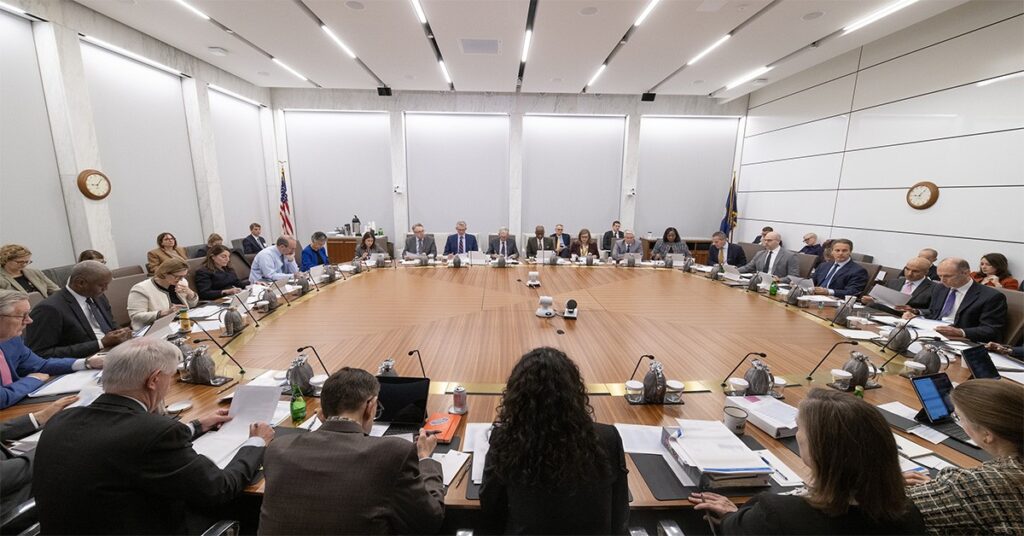
Minutes from the Federal Reserve’s monetary policy meetings are generally long on data, short on drama.
Written in dry prose, with Federal Open Market Committee (FOMC) meeting participants unnamed throughout save for the formal casting of their policy vote, the minutes are nevertheless closely parsed by economists and investors for clues regarding the central bank’s next move.
Though the minutes from the FOMC’s October meeting could hardly be mistaken for the script to a daytime soap, the 21-page document does offer a rare acknowledgement that the Fed’s rate-setting committee is now further away from a broad consensus than at any point in 2025.
“In discussing the near-term course of monetary policy,” the minutes read, “participants expressed strongly differing views about what policy decision would most likely be appropriate at the Committee’s December meeting.”
The formal October vote was 10-2 in favor of a 0.25% reduction to the target range of the benchmark federal funds rate, with most Fed officials prioritizing economic stimulus to support a weakening labor market. Fed Governor Stephen Miran dissented in favor of a 0.5% rate cut, while Kansas City Fed President Jeffrey Schmid voted to leave the target range unchanged.
But the minutes acknowledge a “particularly challenging environment for policy decisions,” with solid economic growth at odds with weak job creation, and the net inflationary impacts of the Trump administration’s tariff policies still uncertain six months in. Add a government shutdown-induced data blackout to the mix, and the minutes suggest a lack of certainty among certain voting members.
“Against this backdrop, many participants were in favor of lowering the target range for the federal funds rate at this meeting, some supported such a decision but could have also supported maintaining the level of the target range, and several were against lowering the target range,” the minutes state.
In the absence of official government inflation data for September, the Fed was forced to estimate personal conception expenditures (PCE) inflation data.
The minutes show the Fed pegged the 12-month change in both overall and core PCE inflation at 2.8% in September. That would be slightly ahead of August’s 2.7% annual pace for headline inflation but below the 2.9% mark for core PCE, which excludes food and energy prices.
On the labor market front, “Participants pointed to recent available indicators, including survey-based measures of job availability, as being consistent with layoffs and hiring having remained low, as well as a labor market that had gradually softened through September and October but had not sharply deteriorated.”
In the weeks following the October FOMC meeting, several Fed officials have indicated their growing uneasiness about cutting rates again in December, including voting members Susan Collins and Austan Goolsbee.
But Fed Governor Christopher Waller — who is among the five finalists to succeed Jerome Powell as Fed chair next year — came out forcefully in favor of a December rate cut during a speech at an economists dinner in London this week.
“I am not worried about inflation accelerating or inflation expectations rising significantly,” Waller said in prepared remarks. “My focus is on the labor market, and after months of weakening, it is unlikely that the September jobs report later this week or any other data in the next few weeks would change my view that another cut is in order.”
The FOMC will reconvene on Dec. 9 and 10 in what is likely to be a policy meeting with more than a hint of drama and rate-cut uncertainty.