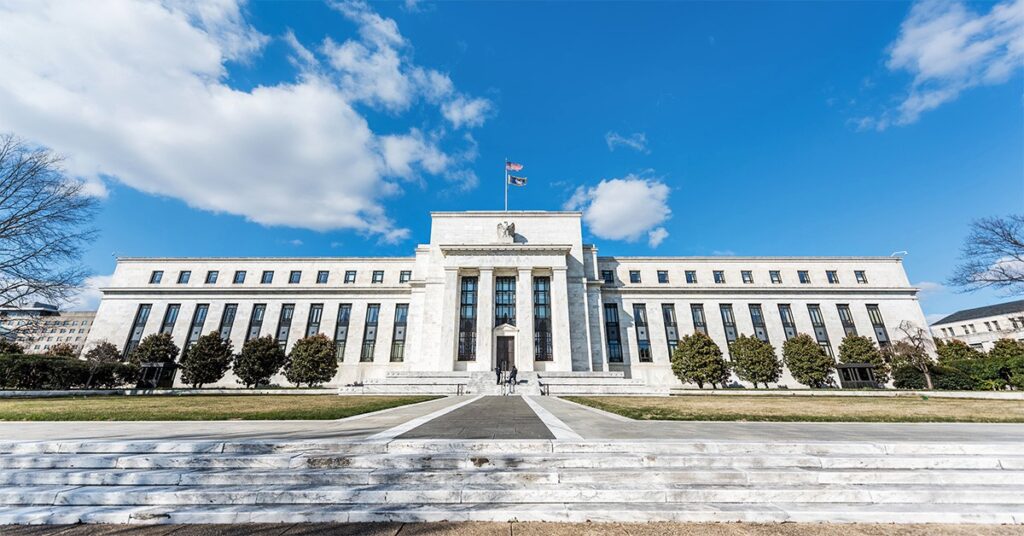
The Federal Reserve’s monetary easing campaign is officially on pause.
Following three consecutive quarter-point rate cuts to conclude 2025, central bank policymakers elected to hold rates steady Wednesday, keeping the benchmark federal funds rate in a range of 3.5% to 3.75%.
The decision reflected inflation readings stuck in a 2.7% to 2.8% range since August and a labor market that remains tepid, but which saw the unemployment rate improve from 4.6% to 4.4% in December.
“Available indicators suggest that economic activity has been expanding at a solid pace,” the Fed rate announcement stated. “Job gains have remained low, and the unemployment rate has shown some signs of stabilization. Inflation remains somewhat elevated.”
Dissenters on the Federal Open Market Committee (FOMC) included Fed Governor Stephen Miran, whose temporary term is set to expire at the end of the month. He voted for a 0.25% rate cut.
Fed Governor Christopher Waller, one of the finalists for next Fed chair, also voted for a quarter-point cut. Miran’s call for just a 25-basis-point cut is notable, as he voted for a jumbo half-point cut at the previous three meetings.
The rate-cut pause was widely anticipated. On Tuesday, speculative interest-rate contracts tracked by CME FedWatch put the odds around 97% that the Fed would stand pat. By Wednesday morning, those odds jumped to 99.4%.
The smart money now thinks the FOMC will wait until June to cut rates again. Fed Chairman Jerome Powell’s press conference, scheduled for 2:30 p.m. EST today, will be closely parsed for clues into that timeline.
Charles Goodwin, head of bridge and debt-service coverage ratio lending for Kiavi, noted in commentary shared with Scotsman Guide prior to the rate announcement that markets tend to react more strongly to changes in labor market expectations as opposed to inflation outlooks. He added that investors should pay attention to Powell’s presser for mentions of Fed balance sheet policy.
“Any hint that they will slow the runoff of mortgage-backed securities (MBS) would be a win for mortgage spreads,” Goodwin commented. “Overall, though, markets will generally be looking past this meeting towards later in the year, when Jerome Powell’s term as Fed chair is up.”
Prelude to the rate-cut pause
The Fed typically slashes rates to stimulate the economy and boost the labor market, with rate hikes generally coming during periods of heightened inflation.
Last January, the Fed also hit the pause button on a year-end rate-cut push. It then held rates steady for the next four meetings before cutting again in September.
Last year’s lengthy pause was largely due to uncertainty over the potential inflationary impacts of President Donald Trump’s tariff policies, which were unveiled to global trading partners on April 2.
Tariff-driven inflation ended up being less pervasive in 2025 than many economists had feared, though the personal consumption expenditures (PCE) price index — the Fed’s preferred inflation gauge — stood at a 2.8% annual gain in November, which is well above the central bank’s stated 2% target.
The consumer price index, another widely tracked inflation measure, posted a 2.7% reading in December.
The easing campaign that began in September was driven by a significant slowdown in the labor market during the summer months, which coincided with a dramatic downward revision of 258,000 jobs to May’s and June’s payroll growth figures — the largest amendment since 1968.
But the federal government shutdown that ran from Oct. 1 to Nov. 12 created a data blackout that left the Fed without key economic reports during its final two meetings of the year.
A consensus of policymakers still voted for rate cuts during the October and December meetings, though divisions emerged.
Kansas City Fed President Jeffrey Schmid voted to hold rates steady at consecutive meetings. He was joined by Chicago Fed President Austan Goolsbee in December, who said in a subsequent interview that he was “uncomfortable front-loading too many rate cuts and assuming that what we’ve seen in inflation will be transitory.”
Schmid and Goolsbee have since cycled off the 12-member voting contingent of the FOMC. But new members Beth Hammack of Cleveland, Lorie Logan of Dallas and Neel Kashkari of Minneapolis have publicly cited inflation concerns and expressed caution about future rate cuts, suggesting a more hawkish bent to the committee in 2026.
However, Powell’s term as Fed chair expires in May, and Trump has made it known that he won’t tolerate a successor unwilling to sign on to his low-rate playbook, a signal that the committee’s policy doves may find their voices amplified as the year progresses.