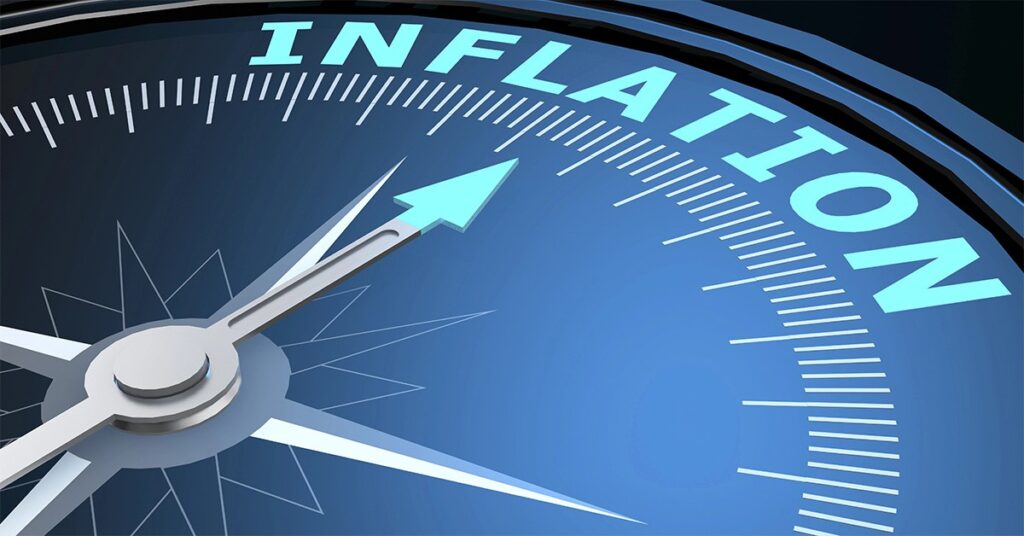
Unlike many Americans these days, Stephen Miran isn’t too worried about inflation.
“I think very gradually over time” many experts have “been moving in my direction,” Miran said during an appearance at Boston University’s Questrom School of Business this week, according to Reuters. He added that he believes the impacts of tariffs on the U.S. economy have been “quite muted.”
Miran, whose temporary term on the Federal Reserve’s board and its 12-member rate-setting committee technically expired on Jan. 31, recently resigned from his economic advisory post at the White House but has remained on the central bank’s board amid ongoing uncertainty about whose board seat Kevin Warsh would assume if he’s confirmed as the next Fed chair.
Miran claimed during the Boston University talk that the primary tariff burden does not lie with U.S. companies — and by extension, U.S. consumers — as many economists have maintained.
“It looks like a U.S. entity is bearing the burden, but it’s actually just the U.S. subsidiary of a foreign company,” Miran said, according to Reuters.
A study released Feb. 6 by the Tax Foundation appears to undercut Miran’s argument. According to the nonprofit think tank, Trump administration tariff policies amounted to an average cost increase of $1,000 per U.S. household in 2025, with that figure expected to increase to $1,300 in 2026.
“The Trump tariffs are the largest U.S. tax increase as a percent of GDP (0.54% for 2026) since 1993,” the Tax Foundation report stated.
Tariffs have consistently been cited as an area of concern in consumer sentiment surveys published since President Donald Trump’s Liberation Day tariff announcement in April 2025.
“Concerns about the erosion of personal finances from high prices and elevated risk of job loss continue to be widespread,” said Joanna Hsu, director of Surveys of Consumers at the University of Michigan, in a statement released with the university’s latest survey results last week.
Several of Miran’s colleagues on the central bank’s Federal Open Market Committee (FOMC) have addressed tariffs and their potential inflationary impacts in recent public remarks.
In a Feb. 4 speech at the Economic Club of Miami, Fed Governor Lisa Cook stated that recent inflation estimates showed the personal consumption expenditures (PCE) price index rose 2.9% for the 12 months ending in December, well above the Fed’s 2% target. Core PCE, which excludes the volatile food and energy categories, was estimated to be 3% at the end of last year, she said.
“Those readings indicate that progress on inflation essentially stalled in 2025,” Cook lamented.
Cook, who voted with the consensus at the Fed’s January policy meeting to hold interest rates steady, attributed the lack of progress in the inflation fight to an uptick in core goods prices, which “primarily reflects an increase in tariffs last year on a wide variety of imported products.”
Philip Jefferson, who serves as vice chair of the Fed’s Board of Governors, also attributed the stall in the disinflationary process as being “mainly because of tariffs on some goods.” But he said during a speech last week at the Brookings Institution that he expects the disinflationary process to resume this year “once increased tariffs pass through more fully to prices.”
Fed Governor Christopher Waller, who joined Miran in voting for a 0.25% reduction to the benchmark federal funds rate in January, argued in his formal dissent statement that the “labor market remains weak.”
While acknowledging that “inflation is elevated from tariff effects,” Waller believes that “appropriate monetary policy is to ‘look through’ these effects as long as inflation expectations are anchored, which they are.”
“With total inflation excluding tariff effects close to our target at just slightly above 2% and a weak labor market, the policy rate should be closer to neutral,” Waller added, “which the median FOMC participant estimates is 3%, and not where we are — 50 to 75 basis points above 3%.”
Waller was one of the four finalists to succeed Jerome Powell as Fed chair when his term expires in May. Warsh, who was tapped by Trump for the role on Jan. 30, earned a reputation as an inflation hawk during his previous stint with the U.S. central bank from 2006 to 2011. But more recently he has called for significantly reducing the Fed’s balance sheet, with the resulting largesse “redeployed in the form of lower interest rates to support households and small and medium-size businesses.”