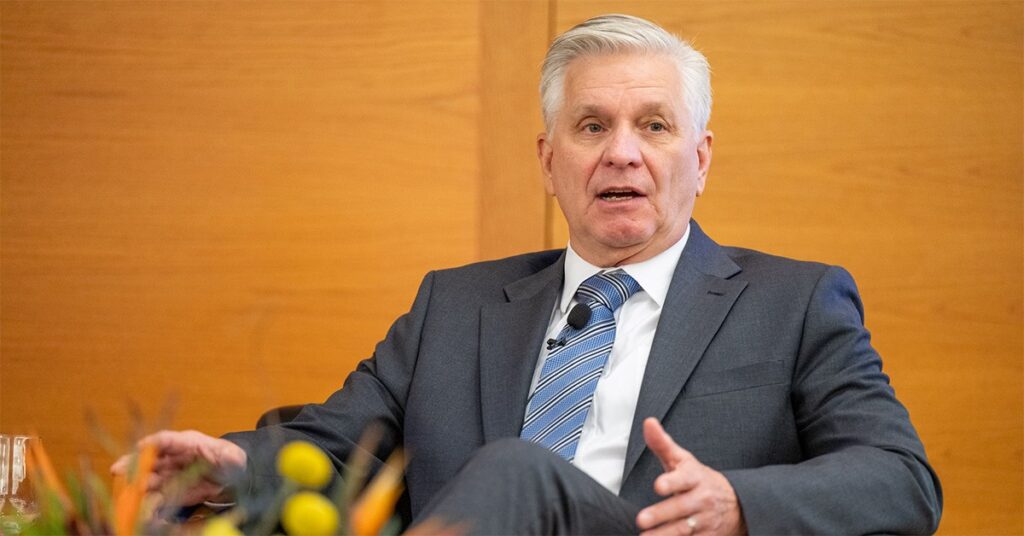
On Wednesday morning, ahead of an afternoon interview with President Donald Trump, Federal Reserve Governor Christopher Waller — dark horse candidate to replace Jerome Powell as chairman of the U.S. central bank when Powell’s term concludes in May — explained his projections for multiple interest rate cuts in 2026.
More than 300 miles away, possibly breakfasting at 1600 Pennsylvania Ave., the president may have been watching. Waller spoke at a summit for business executives, Trump’s ilk, hosted by Yale University.
“We’re close to zero job growth. That’s not a healthy labor market,” said Waller, responding to a question from CNBC’s Steve Liesman about shutdown-delayed October and November employment figures released Tuesday. Employers added about 64,000 jobs last month, but the unemployment rate rose to 4.6%.
“I’ve talked to home builders,” said Waller at one point. “The reason people aren’t buying homes is because they’re worried about losing their jobs.”
Many of those in attendance lead the largest companies in the U.S. and the world, like Delta Air Lines, IBM, Target, TD Bank and Goldman Sachs. The conversation functioned something like a pre-interview to Waller’s afternoon appointment with the president as he weighed in on employment, inflation and AI trends shaping his outlook for monetary policy in 2026.
The room of less than 100 attendees was split 78% to 22% between business leaders and non-business leaders, according to anonymous live polling conducted during the event.
Jobs, inflation and impact of AI
Anthony Scaramucci, founder of investment firm Skybridge Capital who served as White House communications director for 10 days in 2017 during Trump’s first term, asked a question.
So did Bob Diamond, former CEO of banking giant Barclays, who subsequently founded and is CEO of Atlas Merchant Capital, an investment firm backing non-agency mortgage lender AD Mortgage.
One poll asked attendees to say whether they were in a state of hiring, firing or maintaining their current workforce levels. About one-third said they were hiring, while 18% said they were firing and 48% said they were in maintenance mode.
The virtual raise of hands supported Waller’s self-described conversations with business executives across the U.S. He noted that while he hasn’t heard talk of big expansion plans among business leaders, he also hasn’t seen “a dramatic decline of the labor market going off a cliff.”
“AI, AI, AI, AI — that is all I have heard since the summer,” Waller said at one point, referring to business leaders’ reasoning for why job creation has stagnated in recent months.
Powell noted during a press conference following last week’s decision to cut rates by a quarter-point for the third consecutive meeting that AI’s impact on declining demand for workers was “not a big part of the story yet,” despite companies citing artificial intelligence in announcements of layoffs and hiring freezes. “It’s certainly not showing up in layoffs yet,” said Powell.
Asked on Wednesday morning to what extent he believes Trump’s signature tariff policies are responsible for job losses, Waller responded, “I don’t have any direct evidence of that.” He also addressed concerns of sticky inflation, and the impact of tariffs on prices in 2026.
“Inflation I’m not particularly worried about,” said Waller, adding that he has “colleagues that are very concerned that inflation’s going to get stuck.” Inflation may remain stickier for longer as tariffs continue to pass through to consumers, he said, but he believes tariffs will be a one-time price effect, not a driver of persistent increases in inflation.
CEOs voice support for Waller
Waller said he would “absolutely” emphasize the importance of central bank independence in his interview with Trump, while acknowledging that any president can have a say on interest rates when coordinating economic responses during times of crisis, like a pandemic.
“There are other channels for that kind of communication,” said Waller. “The Fed chair and the Treasury secretary have breakfast every two weeks.”
Trump has signaled support for two front-runners in the race to replace Powell, the director of the National Economic Council and close Trump adviser, Kevin Hassett, and former Fed Governor Kevin Warsh, who served in that capacity from 2006 to 2011.
One live poll asked attendees their preference for next Fed chair, between Waller, Hassett and Warsh. Lowering his head to avoid seeing the result, Waller would have been pleased to see 81% of responses in his favor, compared to 6% for Hassett and 12% for Warsh.
A follow-up question asked attendees who they thought Trump would actually pick as the next Fed chair. Waller garnered 36% of responses, followed by 35% for Hassett and 28% for Warsh.
Waller has been bullish on rate cuts since July, when the Federal Open Market Committee voted to hold rates steady. He and fellow Trump nominee to the Fed’s Board of Governors, Michelle Bowman, cast the committee’s only dissenting votes at the July meeting, favoring a quarter-point cut.
An exceptionally weak July jobs report published in early August, which led the president to claim it had been “manipulated for political purposes,” leading to his firing of the commissioner of the Bureau of Labor Statistics, retroactively affirmed Waller’s stance.
“That data came in and said, ‘Look, that guy was right,” Waller said on Wednesday morning.