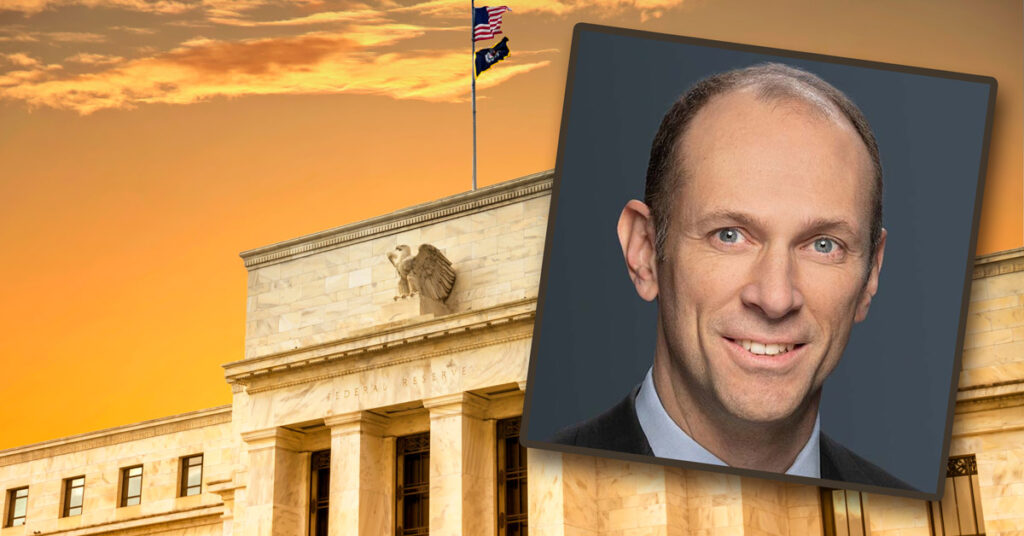
Austan Goolsbee isn’t one to mince words. So when the Chicago Fed president was asked to explain his decision to buck consensus and vote against a rate cut this week, he said he was “uncomfortable front-loading too many rate cuts and assuming that what we’ve seen in inflation will be transitory.”
That said, the Federal Reserve official mentioned during a CNBC interview Friday that he’s “pretty optimistic that for 2026 rates will be able to be a fair bit lower than they are today.”
Goolsbee was one of three members of the Federal Open Market Committee (FOMC) to vote against a quarter-point reduction to the benchmark lending rate at the committee’s December meeting. The others were Kansas City Fed President Jeffrey Schmid, who also voted for a rate-cut pause, and temporary Fed Governor Stephen Miran, who favored a jumbo half-point cut.
The Chicago Fed president, who is set to rotate off the FOMC in 2026, parted ways with most voting members who judged that a rate cut was necessary to provide stimulus for a sagging labor market.
“Most of the measures of the job market have been pretty stable,” Goolsbee told CNBC. “The chance that things in the job market would fall apart rapidly within one to two months before we would visit this again feel relatively low.”
In a separate statement released Friday, Goolsbee noted, “While I voted to lower rates at the September and October meetings, I believe we should have waited to get more data, especially about inflation, before lowering rates further.”
He added that “before the data went silent” due to the 43-day federal government shutdown, “there were some concerning [inflation] readings.”
Schmid, in a statement of his own issued Friday, elaborated on his second consecutive dissent.
“Inflation remains too high, the economy shows continued momentum and the labor market — though cooling — remains largely in balance,” Schmid wrote.
Noting that he has continued to hear anecdotal accounts of inflation concerns while traveling within his Federal Reserve district, Schmid said that “with inflation pressures still evident, my preference would be to keep monetary policy modestly restrictive.”
Miran has not commented publicly on his latest dissent, though he has been the central bank’s strongest advocate for monetary easing since taking office in September.
The minutes from Miran’s inaugural meeting describe his rationale for a jumbo rate cut as being dictated by his view of “further softening in the labor market over the first half of the year and underlying inflation that in his view was meaningfully closer to 2% than was apparent in the data.”