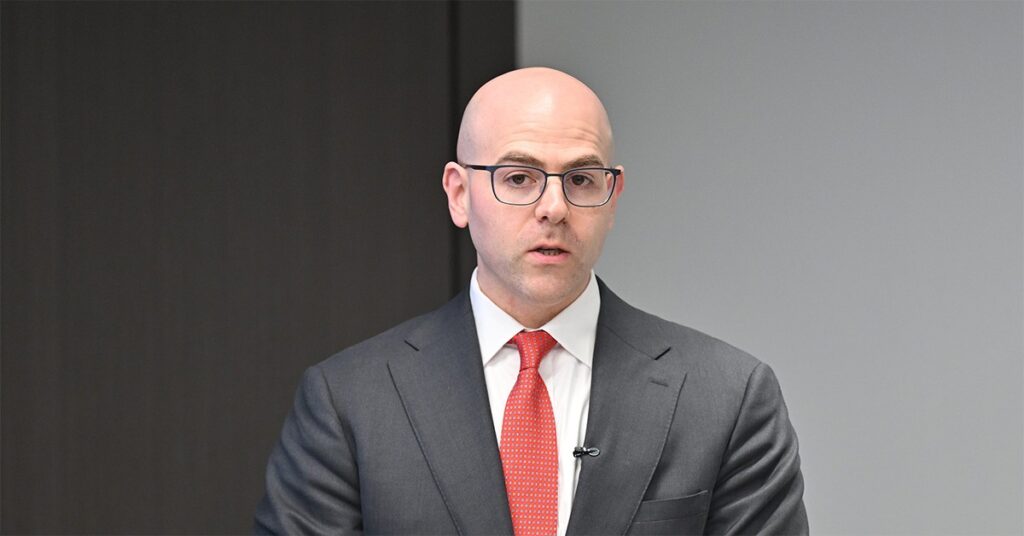
Calling Stephen Miran “one of the sharpest economic minds” shaping monetary policy conversation in Washington, D.C., Kimberly Guilfoyle, U.S. ambassador to Greece, welcomed the Federal Reserve governor to share prepared remarks at the Delphi Economic Forum in Athens on Wednesday.
Speaking on the implications of deregulation for monetary policy and supply-side production, Miran expounded on remarks he made in November at a Bank Policy Institute event in Washington, D.C., concerning an “often underappreciated overlap.”
He repeated on Wednesday his belief that “short shrift” has been given to regulation when judging economic outlooks, reinforcing the need for central bankers to consider the broad range of regulatory factors that impinge on the transmission of monetary policy.
Calling it “a story that probably generates a lot of clicks,” Miran also rebuffed concerns voiced by central bankers of some of the United States’ staunchest allies about escalating attacks against the Federal Reserve, which they say threatens the standing of the U.S. dollar and dollar-denominated assets like U.S. Treasurys.
Miran addresses Powell criminal probe
The setting for Miran’s remarks reinforced parallels he drew between an economic turnaround in Greece fueled by deregulation and accommodative monetary policy at the European Central Bank (ECB), and that which the Trump administration — along with numerous domestic industries — perceive the U.S. as desperately needing.
“Greece and the ECB has lit the path and shown us the way,” said Miran.
He tempered his complimentary tone, however, in a fireside chat following his speech, when asked about grand jury subpoenas issued to the U.S. central bank and its chairman, Jerome Powell, by the Department of Justice last Friday. The Fed chair claimed in a rare video statement that the probe over construction cost overruns at the Federal Reserve headquarters is being used by President Donald Trump as a pretext to attack the central bank over monetary policy disagreements.
Alexis Papahelas, executive director of Kathimerini, a political and financial newspaper published daily from Athens, asked Miran for a response to a letter criticizing the probe and expressing solidarity with Powell, which was signed by central bankers from a dozen countries including England, Switzerland, Sweden and Australia.
“I don’t think it’s appropriate for central bankers to get involved in non-monetary policy issues in their own country, and I think it’s even less appropriate in other countries, that’s all I’ll say,” Miran responded.
“That doesn’t worry you, that these are some of the major allies of the U.S. where this criticism is coming from?” Papahelas pressed.
Miran responded that it didn’t, adding, “What other people say is what other people say.”
Papahelas linked the international community’s perception of eroding independence at the U.S. central bank to broader questions about the standing of the U.S. dollar.
“I think that’s a story that probably generates a lot of clicks, but I don’t think it’s a story that has a lot of meat on its bones,” responded Miran, adding that “the use of the dollar internationally has been fantastic.”
Miran, whose term in a temporary governor seat vacated by Adriana Kugler last August expires at the end of January, has argued in the past that the introduction and expansion of stablecoins will reinforce the role of U.S. dollars in global trade networks.
“A lot of people say the standing of the dollar was derived by the institutional integrity in the U.S.,” Papahelas remarked. “They claim that the standing of the dollar is going to be sort of demoted, let’s say, because of changes in those institutions. What’s your response to that?”
“The logic follows if you believe the premise, but the premise is absurd,” responded Miran. “At the end of the day, the institutions in the United States are very, very strong, and what matters at the end of the day is if policy is good or bad and capital flows ultimately follow economic growth, they ultimately follow the returns on capital.”
Deregulation an ‘infinite tax’ on supply
“Regulations can have far larger consequences for the supply side than, for example, taxes, because they amount to outright prohibitions and thus function as infinite taxes,” said Miran, at one point turning his attention to the U.S. home building industry, which frequently cites local and federal regulations that can add as much as $20,000 to new-home prices.
“The barriers to building a house have become so burdensome that many builders exit entire markets, leaving numerous large metro areas without desperately needed supply,” he said, insisting that regulations often disincentivize new entrants to various markets.
“In many jurisdictions, they’d have to learn how to measure carbon emissions, decipher labor regulations, pass various inspections at various stages and pay other fixed costs,” said Miran, as it concerns potential entrants to the new construction market.
Miran cited the Trump administration’s deregulatory push, which included an executive order signed by the president last January titled “Unleashing Prosperity Through Deregulation,” which requires that 10 regulations be revoked for every one regulation adopted.
Based on the pace of regulatory culling in 2025, he said, “I estimate that if this pace continues, 30% of the regulatory restrictions in the code of federal regulations will be eliminated by 2030, though this may prove to be an underestimate.”
Beyond home building, he pointed to distortions in the traditional banking sector that have fueled the rise of private credit markets following the 2008 financial crisis.
“It only became profitable to make a lot of those loans outside of the banking sector,” said Miran. “I think a lot of growth in that sector has been a result of regulatory arbitrage.”
Returning annual inflation to target
The Federal Reserve’s efforts at fulfilling its dual mandate to maximize employment and maintain price stability have entered 2026 on a collision course with President Trump’s preference to dictate monetary policy from 1600 Pennsylvania Avenue.
Miran said inflation is heading in the right direction, noting disinflation trends concentrated in the services sector, such as market rents that have been rising at around 1% for the past two years.
“In recent quarters, monetary policy has been tighter than it should have been,” he expressed, confirming that he stands by his December forecast for 150 basis points of interest rate cuts in 2026.
Supporting this view, Miran said he believes the neutral rate at which monetary policy neither stimulates nor impedes economic output has fallen because of declining labor supply from Trump administration immigration policies, increased productivity across economic sectors, and projections from the Congressional Budget Office of $4 trillion in tariff revenue over the next decade that Miran says will shrink federal spending deficits.
He said he does not believe that Trump’s signature tariff policy has contributed to elevated goods inflation, which has remained stubbornly higher for central banks around the world.
Papahelas asked Miran to explain that position.
“To me it’s an open question. I don’t have an easy answer to that,” Miran said, listing a series of pandemic-fueled market distortions. He cited roughly a decade of increasing use of export controls in the tech sector and critical minerals sectors.
Amid myriad disruptions to international trade, Miran said it was an “easy, facile and lazy conclusion” to blame sticky goods inflation on tariffs alone. Then again, he could be wrong.
“If I end up being right about shelter [inflation], and wrong about goods [inflation], that means we’re really going to undershoot our inflation target,” he said.