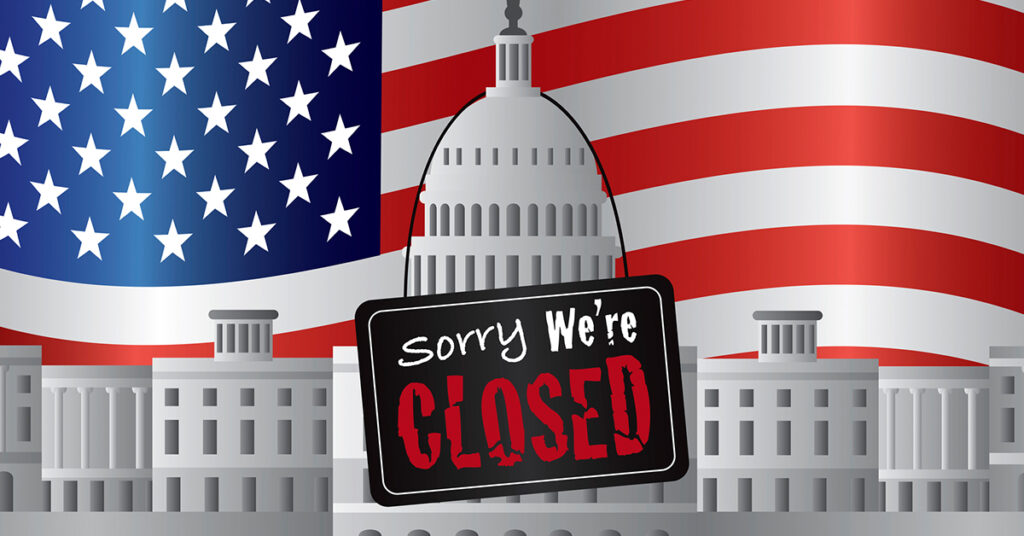
The partial federal government shutdown entered its third day on Monday, bringing with it a familiar headache for the mortgage industry: a potential suspension of the National Flood Insurance Program (NFIP) and disruptions to the Department of Housing and Urban Development (HUD).
Hopes for a swift resolution dimmed as House Speaker Mike Johnson, R-La., indicated Sunday there would be “no quick House vote” to restore funding, signaling potential delays for closings on properties requiring flood coverage.
The funding lapse, which began Saturday, was triggered by an impasse over the Department of Homeland Security (DHS) budget. While the shutdown is limited in scope — roughly half of the federal government remains funded through September — the expiration of DHS funding has immediate consequences for the housing market.
The lapse in DHS appropriations forces the Federal Emergency Management Agency (FEMA) to pause the issuance and renewal of NFIP policies — a fact industry participants like the National Association of Home Builders (NAHB) have flagged as an “immediate concern.”
This means that borrowers attempting to close on homes in designated Special Flood Hazard Areas cannot obtain the federally backed flood insurance required by law to secure a mortgage. Similar lapses in the past, including during the record-breaking 43-day shutdown in October and November, resulted in thousands of delayed or canceled transactions.
The political gridlock stems from a fierce debate over immigration enforcement. The shutdown was precipitated by Democratic demands for reform following the shooting deaths of two U.S. citizens, Alex Pretti and Renee Good, by federal agents in Minneapolis earlier in January. Democrats have insisted that any funding bill for DHS include new oversight measures, such as a code of conduct for agents and mandatory identification requirements.
While the Senate passed legislation on Friday to fund DHS at current levels for two weeks to allow for negotiations, the measure requires House approval. On Sunday, Speaker Johnson dampened expectations for that approval, blaming the impasse on Democratic demands regarding Immigration and Customs Enforcement (ICE) in an interview with Fox News.
Johnson explicitly stated there would be no immediate vote to end the partial closure, suggesting the standoff could drag on.
Beyond the flood insurance freeze, the shutdown affects the Department of Transportation, the Pentagon and the State Department. However, the Department of Agriculture remains funded, meaning nutrition programs like SNAP are unaffected, unlike previous shutdowns where food assistance was threatened.
An email auto-reply received by Scotsman Guide from a HUD official on Monday stated that “most HUD programs have been temporarily interrupted, and most HUD employees have been told they cannot work.”
They added, “I will not be able to check this email account during the lapse of appropriations.”
An analysis published Monday by the National Association of Realtors noted that HUD will operate under a government shutdown contingency plan for the time being, with some housing programs running at reduced capacity and others facing serious disruption.
For example, the Federal Housing Administration will still have the ability to endorse single-family mortgages and will maintain FHA loan servicing functions, according to NAR. But certain loan programs will be paused, including FHA-backed reverse mortgages, Title I Property Improvement Loans and the Section 184 Indian Home Loan Guarantee Program.