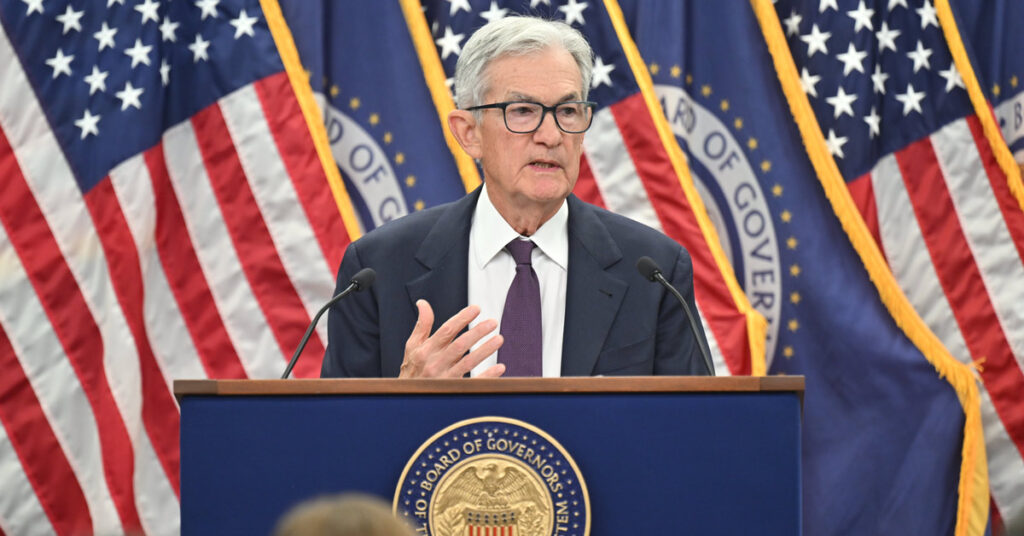
That the first four reporters to question Jerome Powell would ask him about the political maelstrom rocking the U.S. central bank was to be expected. That the reticent chairman of the Federal Reserve would decline to stick his foot in his mouth was also no surprise.
The Federal Open Market Committee (FOMC) voted on Wednesday to keep the federal funds rate at its current range of 3.5% to 3.75%, a widely anticipated move following 0.75% in total reductions to the Fed’s benchmark borrowing rate over its final three meetings of 2025.
“The U.S. economy expanded at a solid pace last year and comes into 2026 on firm footing,” said Powell at a post-meeting press conference. Amid overall healthy economic indicators, though, he specifically called out activity in the housing sector as “weak.”
The Fed chair noted that outlooks for U.S. economic output had “clearly improved” since the Fed’s last meeting in early December, adding that the unemployment had declined from 4.6% in November to 4.4% last month. Consumer spending continued to prove more resilient than expected while fixed business investment continued to expand, he said, supporting the rate-cut pause.
“There was broad support on the committee for holding today,” said Powell, though two FOMC members registered formal dissents. Stephen Miran, whose temporary Fed governor term is set to expire at the end of the month, voted for a 0.25% rate cut, as did Fed Governor Christopher Waller, one of the finalists to replace Powell as Fed chair.
Powell cast doubt that stubborn inflation would lead to a near-term rate hike.
“It isn’t in anybody’s base case that the next move will be a rate hike,” he said. “That’s not where people’s expectations are right now.”
But Powell demurred when asked about risks to U.S. dollar legitimacy and the chances that he will remain at the U.S. central bank as a governor when his chairmanship term concludes in May. He also declined to comment about a recently launched federal criminal investigation into Powell, which is connected to congressional testimony he gave last summer regarding cost overruns for renovations to the Federal Reserve’s headquarters.
“We don’t talk about the dollar or what moves it around,” he said, noting currency concerns are fully under the purview of the U.S. Treasury Department. “They have their bailiwick.”
“That case is perhaps the most important legal case in the Fed’s 113-year history.”
Powell did clarify, however, why he chose to attend a recent emergency Supreme Court hearing concerning Fed Governor Lisa Cook and whether she should be allowed to remain in office while a case involving unproven allegations of mortgage fraud proceeds. U.S. Treasury Secretary Scott Bessent has criticized Powell for “trying to put his thumb on the scale,” calling his attendance a “real mistake.”
“That case is perhaps the most important legal case in the Fed’s 113-year history, and as I thought about it, I thought it might be hard to explain why I didn’t attend,” said Powell. “I thought it was an appropriate thing and I did it.”
On the health of U.S. central bank independence, Powell struck an optimistic tone, pointing to the fact that all advanced, Western economies have an “institutional arrangement” to not have elected officials control the setting of monetary policy. He warned that faith in Fed independence, once lost, would be difficult to regain.
“We haven’t lost it,” said Powell. “I don’t believe we will. I certainly hope we don’t.”
The Fed has a dual mandate to maintain stable prices and maximum employment. Since early 2025, each side of the dual mandate has been in tension as the annual pace of inflation has remained above the Fed’s stated 2% target and job creation has weakened.
Speaking more directly to Wednesday’s decision to leave the fed funds rate unchanged, Powell underscored how upside risks to inflation and downside risks to employment have diminished in recent months, moving closer into balance, though tension still exists.
“I’m not making a judgment about how one of them is more at risk than the other,” he noted, “just that the risks to both have diminished.” He said survey and market data show short-term inflation expectations “have come way down,” while longer-term inflation expectations “have been solid,” reflecting confidence the Fed will return inflation to 2%.
That being said, Powell said an internal assessment of the personal consumption expenditures (PCE) index, the Fed’s preferred measure of consumer inflation, showed annual PCE inflation rising to 2.9% in December, up from 2.8% in November. Core PCE inflation excluding food and energy prices rose to 3%, Powell noted, up from 2.8% in November.
Powell attributed the majority of the rise to goods inflation boosted by the impact of tariffs, which are expected to peter out sometime in “the middle quarters” of 2026.
“We had 3% core PCE inflation over the 12 months ending in December, and that’s pretty much what we had the year before, so on net, no progress,” he said. “But the story behind that is modestly positive in that, most of the overshoot was in goods prices, which we think is related to tariffs, and ultimately we think those will not result in inflation as opposed to a one-time price increase.”
With only two FOMC meetings remaining over which Powell will preside before his chairmanship term ends in May, one of the last questions the head of the U.S. central bank answered concerned what advice he had to offer his eventual replacement.
“Stay out of elected politics,” he urged. “Don’t get pulled into elected politics. Don’t do it.”
He then turned his thoughts to his central bank colleagues, with whom he has worked since joining the Fed’s board in 2012: “I will tell whoever it is — you’re about to meet the most qualified group of people you not only have ever worked with, [but that] you will ever work with.”