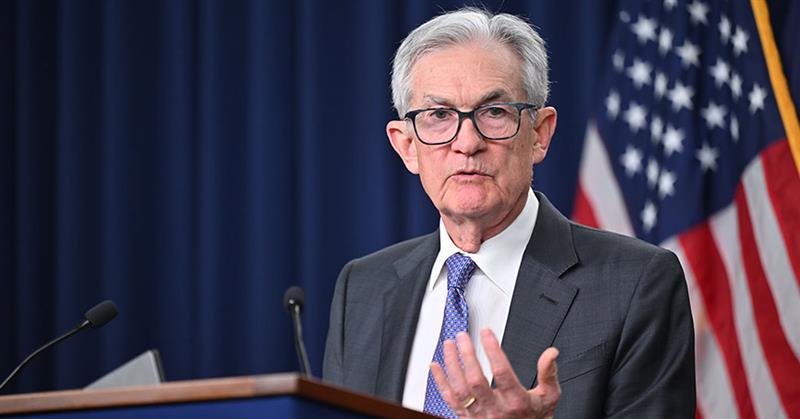
Over the course of 2025, President Donald Trump and his allies across the public and private sectors have exerted enormous pressure on the chairman of the Federal Reserve, Jerome Powell, to dramatically lower interest rates.
Repeated jabs from the most powerful politician in the world have included threats of Powell’s termination and schoolyard taunts on social media, where the top central banker of the world’s most powerful economy has been dunce-capped by Trump as a “major loser.”
Trump resumed his attacks on Wednesday following a decision by the Federal Open Market Committee (FOMC) to cut the federal funds rate by 0.25% at its third consecutive meeting. The president referred to Powell as “a stiff” and said the central bank should have “at least doubled” its December rate cut, according to CNBC.
In recent weeks, the president has teased Powell’s replacement, suggesting a reveal will likely come “early next year,” despite Powell’s tenure not ending until May 2026.
Kevin Hassett, director of the National Economic Council and a close adviser to Trump, is widely expected to assume the top job at the Federal Reserve come spring. Trump is also reportedly interviewing former Fed Governor Kevin Warsh this week as part of a final vetting process.
Powell will head into the final three policy meetings scheduled before his term ends next year as something of a lame-duck chairman. On Wednesday, however, financial markets the world over hung to his every word.
“What do you want your legacy to be?” one reporter asked, acknowledging the light at the end of the tunnel of Powell’s turn at the podium.
“I really want to turn this job over to whoever replaces me with the economy in really good shape,” Powell replied, ducking a follow-up question about whether he plans to remain on the Fed’s Board of Governors after his chairmanship term ends, something no previous Fed chair has ever done.
Is there a chance for improved affordability in the housing market next year, another reporter inquired?
“The housing market faces some really significant challenges,” he responded, citing persistent lock-in effects and a structural housing shortage that lowering short-term borrowing costs does little to solve. “We’re a ways away from that changing.”
Deepening divisions
The Fed’s decision to cut the overnight lending rate for banks by a quarter-point at the December meeting means the fed funds rate is now 175 basis points lower than it was in September 2024. That is “within a broad range of estimates of neutral,” according to Powell, referring to the theoretical threshold where benchmark rates are neither restrictive nor accommodative to economic growth.
In conjunction with the December rate decision, the Fed also released its quarterly Summary of Economic Projections, which indicated a median fed funds rate projection of 3.4% for 2026. That would entail only one rate cut for all of next year, which flies in the face of Trump’s interest-rate wishes and recent remarks by Hassett that there is “plenty of room” to cut rates.
Wednesday’s decision produced three formal dissents and four “soft dissents,” reflecting growing divisions among central bank officials, foreshadowing the challenges whoever replaces Powell will face in martialing consensus.
Fed Governor Stephan Miran, whose temporary term as a replacement for former central banker Adriana Kugler ends Jan. 31, voted for a jumbo 0.5% reduction, as he did at meetings in September and October.
Kansas City Fed President Jeffrey Schmid voted to keep rates unchanged, as he did in October, joined by Chicago Fed President Austan Goolsbee, who had expressed increasingly hawkish views in public comments on inflation since the last Fed meeting.
The central bank carries out a dual mandate to maintain stable prices and maximize employment. Job creation and hiring have weakened considerably in 2025, while various measures of inflation have settled near 3%, above the Fed’s stated 2% target.
Since their prior meeting in late October, as many as five voting members of the FOMC had publicly expressed opposition to a December rate cut, citing inflation concerns. Four had voiced support for additional easing, expressing fears of a labor downturn.
Wednesday’s decision occurred with key government reports on inflation and employment still missing due to the six-week government shutdown lasting from Oct. 1 to Nov. 12, prompting one reporter to ask why the FOMC did not wait until January’s meeting to cut.
Powell cited a steadily rising unemployment rate that hit 4.4% in September, up 0.3% from June. Inflation readings are in the low-2% range, he said, when subtracting “one-time price hikes” of Trump’s signature tariff policies.
“It doesn’t feel like a hot economy,” said Powell.
Official estimates showing average job creation of around 40,000 positions in recent months may be up to 60,000 jobs too high, according to Powell, citing internal projections, resulting in negative job growth of around 20,000 jobs.
With consumers’ economic outlooks historically bleak, another reporter asked about the sustainability of the “resilient consumer spending” Powell cited, as the economic fortunes of upper- and lower-income earners diverge in the so-called K-shaped economy.
“It’s clearly a thing,” said Powell, acknowledging the divergence and calling it a “good question” about the sustainability of the trend.
“We hear loud and clear how people are experiencing really high costs,” he added.