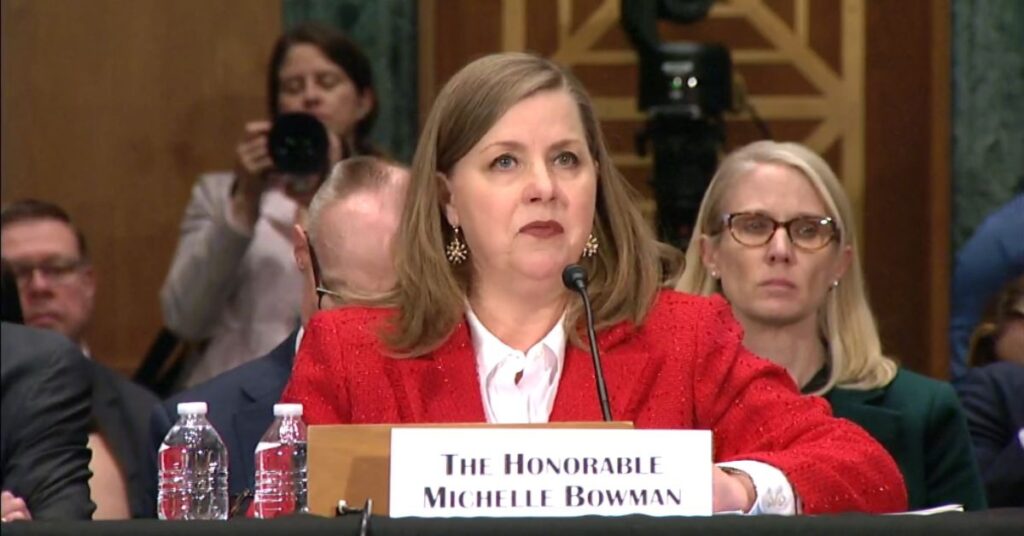
The most powerful federal banking regulators testified in Washington, D.C., on Thursday to provide the Senate Committee on Banking, Housing, and Urban Affairs with updates on their overhaul of banking regulation.
“We’re refocusing our supervision in a laser focus on material financial risks,” said Michelle Bowman, a governor at the Federal Reserve who was nominated to vice chair for supervision of the U.S. central bank by President Donald Trump and confirmed to that role last June.
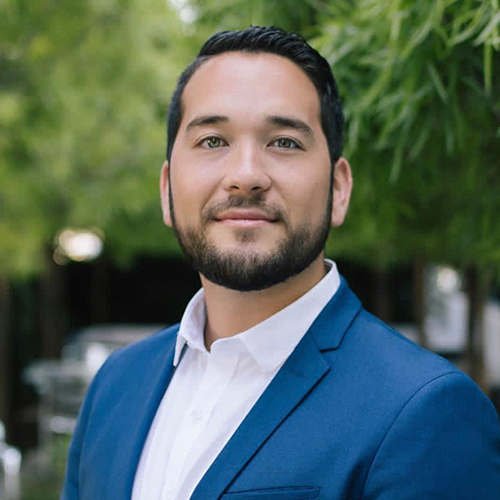
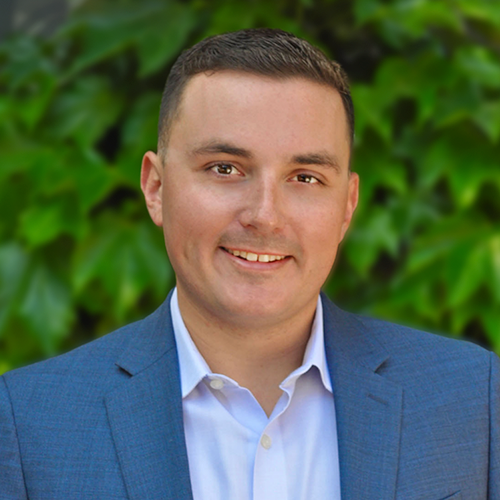
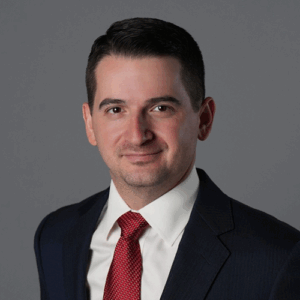
The president has made bank deregulation a top priority in his second term, citing perverse incentives and market distortions born of overregulation in the wake of the 2008 financial crisis. Providing testimony alongside Bowman was Travis Hill, chair of the Federal Deposit Insurance Corp. (FDIC), and Jonathan Gould, comptroller of the Office of the Comptroller of the Currency (OCC).
During more than two hours of questioning, the prudential regulators tasked with ensuring the safety and soundness of the U.S. banking sector explained their efforts to minimize the government’s regulatory footprint while rebuffing concerns of inappropriate political interference amid shifting regulatory priorities.
Tailoring risks to tailored reforms
Early in Thursday’s hearing, Sen. Jack Reed, D-R.I., referenced a proposed exemption for nationally chartered banks from paying interest to mortgage borrowers whose servicing escrow balances they manage. State regulators have lambasted the proposal, claiming the OCC seeks to trample on states’ preemption authorities to help “enrich national banks off the backs of consumers.”
Laws in almost one-quarter of U.S. states discourage banks from inflating escrow account balances as a source of interest-free funding by requiring entities that hold escrows to pay homeowners a small amount of interest.
When asked by Reed if the OCC would conduct a study on the cost to consumers from such a change, Gould explained his agency is focused on ensuring “the general principle that states do not have the ability to regulate national banks,” which he described as “inconsistent with the whole reason for the OCC.”
Reed persisted in asking whether the OCC has estimated the cost of the proposed change to consumers. On net, he said, banks would make money as consumers lost money.
“The level and degree of state interference in creating nationwide mortgage markets will actually interfere with the availability and the cost of mortgages going forward,” replied Gould, “so we’re very intent on ensuring there is a nationwide mortgage market.”
Questions of mortgage and housing affordability amid efforts to deregulate the banking sector featured heavily in Thursday’s hearing, particularly for Bowman.
“Homeownership is the equity position we really want in America,” said Sen. Tim Scott, R-S.C., chair of the Senate Banking Committee, highlighting the upper chamber’s signature housing reform bill that awaits reconciliation with a parallel bill widely supported in the House of Representatives.
“We all are very aware of the fact that the average age for first-time homebuyers is at 40 years old,” said Scott, “and that is devastating to so many Americans.” Economists across the mortgage and housing industries disagree on the typical age of first-time homebuyers, putting it in a range between 30 and 40 years old last year.
Acknowledging impacts of a housing supply shortage on affordability, Scott asked Bowman what the Federal Reserve is doing to facilitate community banks’ return to mortgage lending. Sen. Thom Tillis, R-N.C., asked Bowman about the drivers of a shift toward nonbank dominance in mortgage lending and how traditional banks could find their footing.
Reiterating remarks made at an industry event last week, Bowman attributed the shift in market share to the “reweighting” of mortgage-related collateral following the 2008 financial crisis. She said that revised bank capital rules have ultimately “pushed a lot of activity outside of the banking system and outside the regulatory perimeter.”
Earlier this week, eight financial trade associations sent a joint letter to the prudential regulators testifying Thursday, outlining specific steps regulators could take that would earn the housing finance industry’s support. The letter suggests reducing the capital treatment for mortgage servicing rights from 250% to 100%, while lowering the risk weight for warehouse credit lines relied upon by nonbank lenders to 50%.
Sen. Pete Ricketts, R-Neb., asked FDIC Chairman Hill how much weight should be given to the impact that current capital rules, specifically, have on smaller insured institutions to compete or retain mortgage servicing.
“I think it’s a major factor, and as a result, it’s something that the banking agencies have been looking very closely at,” responded Hill. “That’s something we plan to include as part of our capital proposals next month.”
“There are other areas that need to be addressed as well,” said Bowman on Thursday, mentioning Consumer Financial Protection Bureau regulations that put “large fines on banks for making mistakes on mortgage applications.” She advocated shifting the supervisory approach to one that eyes compliance in a “broad manner and wholistically.”
The erosion of Fed independence
Efforts to tailor and shift bank supervision priorities under Bowman’s leadership of the Fed’s regulatory apparatus have come under fire recently amid allegations she has sidelined examiners at the behest of executives at supervised banks.
As previously reported by Scotsman Guide, Sen. Elizabeth Warren, D-Mass., ranking member of the Senate Banking Committee, sent a letter endorsed by five other Democratic committee members to Bowman last week, asking why some examiners “have interpreted her policies to mean they should refrain from being tough on the banks they oversee.”
But Bowman only faced light questioning on the allegations, first reported by The Wall Street Journal in January.
Sen. Cynthia Lummis, R-Wyo., characterized the Journal’s report as having shown that Bowman “disciplined Federal Reserve bank examiners after they engaged in unprofessional conduct.” Lummis referenced the reporting and asked Bowman whether as head of the Fed’s division of supervision and regulation it is “literally her job to ensure that bank examiners do their job in a professional and fair way under the law.”
“Yes,” said Bowman, prompting Lummis to note her approval of Bowman’s recognition “that not even bank examiners should be above the law.”
The Journal’s reporting suggests that Bowman’s alleged disciplining of examiners was prompted by the personal requests of banking executives at supervised institutions, not unprofessional behavior. The Journal has not replied to a request for comment on the accuracy of Lummis’ characterization of their reporting.
Declining to address ongoing investigations into fellow Fed governors Lisa Cook and Jerome Powell, Bowman committed elsewhere in her testimony to the importance of preserving Fed independence, sustained assaults on which have been a feature of the second Trump administration. The president has demanded interest rates be much lower.
Not all Fed officials agree on to the extent Fed independence is under direct threat, it should be noted. Trump’s most recent nominee to the Fed’s board, Stephen Miran, said “the premise is absurd” during an economic summit in Greece last month. Meanwhile, the outgoing president and CEO of the Federal Reserve Bank of Atlanta, Raphael Bostic, said in a statement Wednesday that he has observed softening public trust in Fed independence.
Many current members of the Fed’s rate-setting committee, however, are united in what they see as escalating political interference at the U.S. central bank.
“I can assure you that I think the independence of the Federal Reserve is of utmost importance, but along with that independence comes the responsibility for accountability and transparency,” said Bowman in response to a question from Sen. Andy Kim, D-Calif., about her views on the importance of Fed independence.
Sen. Angela Alsobrooks, D-Md., broadened concerns about Fed independence to include the data produced and distributed by its many staff economists.
Kevin Hassett, director of the White House National Economic Council — and formerly a strong contender for next Fed chair — said researchers at the New York Fed should be “disciplined” for their recent research showing that U.S. businesses and consumers, not foreign exporters, had paid most of Trump’s signature import duties through the end of last year. Hassett has subsequently walked back his remarks about disciplining researchers.
“I’m very concerned about the presidents’ advisers interfering in the Fed’s work and hiding economic data from the American people,” said Alsobrooks. “Do you have any reason to dispute the Fed’s report concluding that tariff price increases are being passed down to consumers?”
“I’m not familiar with the report that you’re referring to,” responded Bowman, “but there have been a number of reports that come to different conclusions about many different subjects, including this one.”