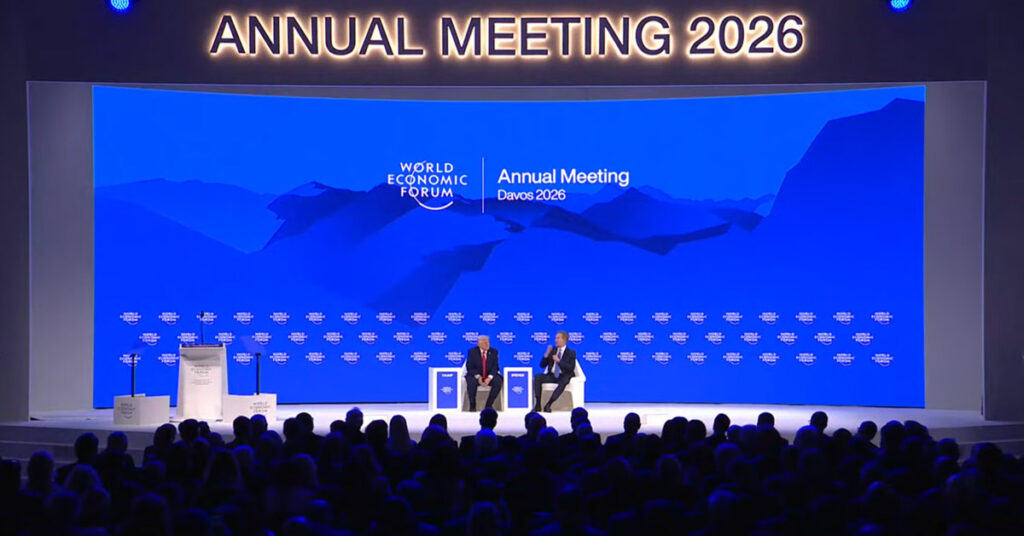
No new proposals to address U.S. homebuyer affordability were announced by President Donald Trump in a nearly 80-minute speech delivered Wednesday at the World Economic Forum in Davos, Switzerland. That matters because Trump said he would.
Instead, his remarks ricocheted between familiar grievances of the U.S. president. Those included the perceived ingratitude of U.S. military and economic allies and former U.S. President Joe Biden’s use of an “autopen” for signing official documents. Also discussed were bird deaths caused by windmills, the human toll of war, data centers, tariffs, Venezuela, energy security and the 2020 presidential election Trump lost, but which on Wednesday he again claimed was stolen from him.
The president had nothing new to say on housing, either, reiterating a proposal for Fannie Mae and Freddie Mac to purchase $200 billion in mortgage-backed securities (MBS) to subsidize mortgage rates.
No additional details emerged on implementing those MBS purchases, such as the pace and timeline for purchases or how preserving that function of the government-sponsored enterprises may conflict with efforts to release the pair from federal conservatorship.
Trump repeated his plan to restrict sales of single-family homes to “large institutional investors,” a proposal that was formalized in an executive order Trump signed on Tuesday before traveling to Europe, but which housing economists broadly agree will do little to move the needle on housing affordability.
The first step in implementing that executive order directs U.S. Treasury Secretary Scott Bessent to develop definitions of “large institutional investor” and “single-family home.” Congress would likely be needed to pass legislation instituting such restrictions, which Trump called for from U.S. lawmakers while at the podium in Davos on Wednesday.
“I can crush the hell out of the [housing] market,” said Trump, expressing what he could do to help prospective homebuyers access the market. But he won’t, Trump said, because he feels “very protective of the people who already own a house” and does not want to risk hurting home values for those consumers.
It matters that Trump fired blanks in Davos because the U.S. housing sector — from builders to bankers to borrowers — has been counting on the president following through on Day 1 promises to address years of stagnation born of pandemic-era distortions.
“Homeownership has always been a symbol of health and vigor of American society,” the president said on Wednesday. “America will not become a nation of renters.”
But a full 12 months into his second term, it is unclear if Trump or his economic advisers have more robust solutions to support such strong pronouncements. The president’s focus on foreign policy has thus far masked a dearth of domestic policy solutions for helping average consumers afford housing and the necessities.
Trump did inform world leaders on Wednesday, however, that the U.S. “won’t use force” to acquire Greenland, though he doubled down on his position that U.S. ownership of the territory must occur “for national and international security” — despite the rising security threat that European nations see the U.S. posing itself.
With a trade war — or hot war — between NATO allies on their minds, investors around the world have signaled a desire to trim exposure to U.S. debt markets. Though once unthinkable, perhaps, the headline risk for affordability in mortgage lending may increasingly be President Trump.
“All the U.S. is looking for is a place called Greenland,” said Trump, adding that he seeks “immediate negotiations” with Denmark on the issue. “You can say ‘yes’ and we will be very appreciative. Or you can say ‘no,’ and we will remember.”
In the absence of any broader proposals to address housing affordability in the U.S., the verbal commitment to not invade Greenland — a longstanding U.S. ally and an autonomous territory of Denmark, a fellow NATO member — carries important implications for mortgage financing, specifically.
Mortgage rates are benchmarked to yields on 10-year U.S. Treasury bonds, which spiked this week following Trump’s threat to impose tariffs on European nations that do not support U.S. annexation of Greenland.
Investor sentiment impacts mortgage rates more directly than the short-term rate cuts that the president has been clamoring for from the Federal Reserve. Anything causing risk premiums to spike on longer-dated U.S. debt pushes up mortgage rates, too.
Though Trump appeared to take an invasion of Greenland off the table, the threat of tariffs and associated trade tensions remain in place. Yields on 10-year Treasurys opened Wednesday around 4.28% and remained near that level as of noon Eastern Standard Time, supported by a global bond sell-off hitting Japan and the U.S.