Your Mortgage Clients Own Businesses. Who Is Handling Their SBA Loans?
A Scotsman Guide featured sponsor
How mortgage brokers add SBA lending as a second revenue stream without a new license or a new hire, with free training from the Lords of Lending team at Leader Bank.
I think most mortgage brokers are walking past their best deal every week and do not know it.
Here is what I mean. Look at your closed loans from the last two years and count the borrowers who own a business. A dentist. A trucking company. A restaurant group. A contractor with eight trucks. You already know their income, their credit, their tax returns, and you have their trust, because you got them into a house. What you probably do not know is that a fair number of them are going to borrow money for that business in the next few years, and that loan is often larger than the mortgage you closed for them.
That loan is very often an SBA 7(a) loan. The 7(a) is the Small Business Administration’s main loan program. A bank makes the loan, and the SBA guarantees a large share of it, which is what lets a bank lend up to $5 million to a small company for things a conventional lender would pass on: buying a building the business will occupy, buying another business, buying equipment, or refinancing expensive debt. Terms run up to 25 years on real estate and 10 years on most everything else.
The problem, from where I sit, is who originates them. Right now, that borrower finds an SBA lender by searching online or by asking their CPA. You are not in that conversation, and you should be, because you are the one they already trust with their finances. They are likely to consider you a trusted source for an SBA loan referral.

“I think most mortgage brokers are walking past their best deal every week and do not know it.”
Shane Pierson
VP SBA National Sales Manager,
Lords of Lending team at Leader Bank

What a Referral Actually Looks Like
I want to be precise here, because the word “referral” gets used loosely.
You do not need a new license. SBA commercial loans are not mortgage loans, so your state mortgage license does not apply, and no separate license is required to refer a business borrower to a bank. You do not need to hire anyone. You are not underwriting, not packaging, not closing. You are introducing a client you already know to a lending team and staying in the loop.
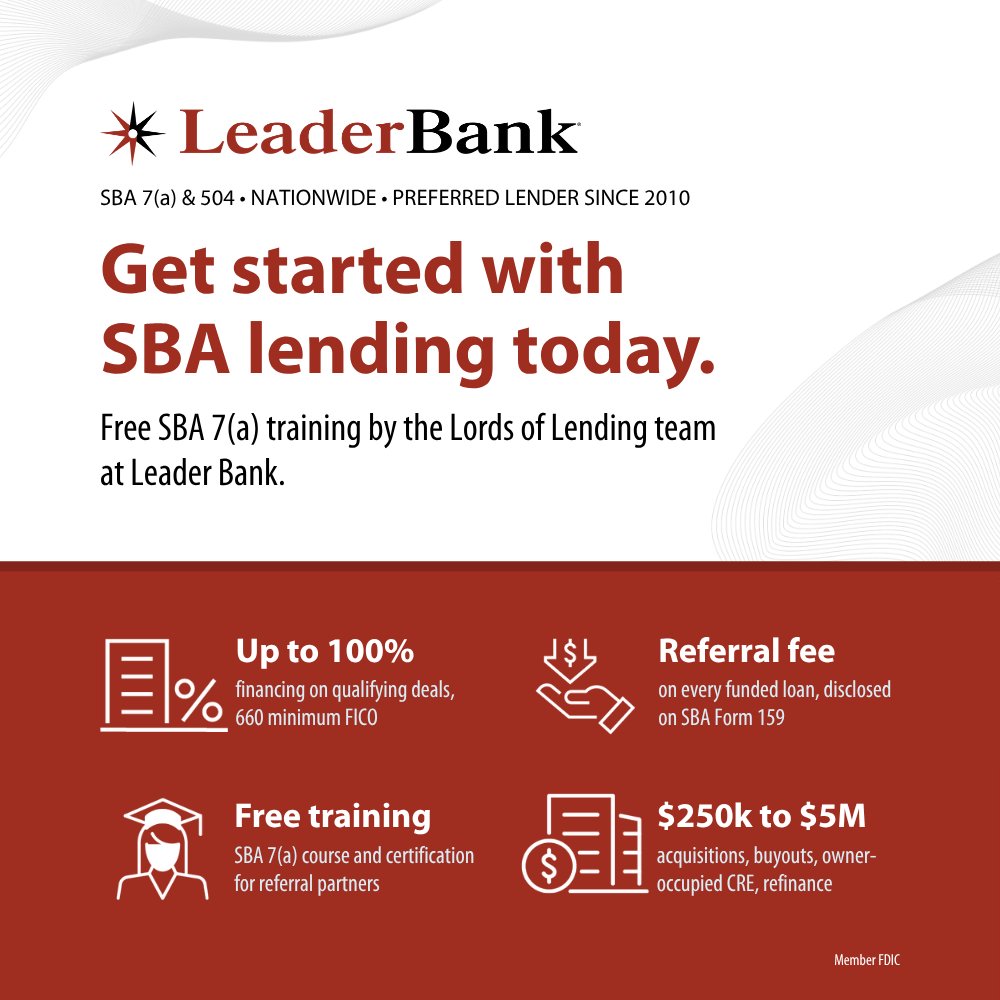
If you are a referral partner, the Bank pays you a referral fee when the loan is funded. The SBA requires that fee to be disclosed on a form called the SBA Form 159, signed by the borrower, the lender and you, so everyone sees exactly what was paid and by whom. I like that rule. It means the fee is out in the open, and it means the borrower is never paying you on the side.
From there, our team at Leader Bank takes the file. We are the Lords of Lending, the Bank’s nationwide SBA 7(a) and 504 lending team, and Leader Bank has been an SBA Preferred Lender since 2010. Preferred Lender status means Leader Bank has delegated authority from the SBA to make its own credit decisions on these loans, which is the difference between a 60-day answer and a two-week one. We structure the deal, build the credit file, underwrite it, and close it.
Why the Training Matters More Than the Fee
The fee is not the real value, and I would rather say so.
The brokers who make real money on SBA referrals are not the ones who send us a name and a phone number. They are the ones who can sit with a business owner and spot the deal: this owner rents and should own, this owner is buying out a partner, this owner has $400,000 of merchant cash advance debt at a rate that is eating the business alive. Spotting issues early is most of the job.
That is what our training is for. The Lords of Lending Academy is a free, structured SBA 7(a) course built by the people who actually fund the loans. It covers eligibility, deal structure, how a business acquisition gets financed when the buyer does not have all the cash, what documents a lender needs and why, and how to talk to a business owner about financing without sounding like a banker. There is a certification at the end, and there is ongoing support from our team after that.
It is free for accepted referral partners. There is no subscription and nothing to renew. We do it because a trained partner sends us deals we can close, and a partner who sends us deals we can close is worth a great deal more to the Bank than a course fee would be.
Next Steps
Pull up your closed-loan list. Flag every borrower who owns a business. That list is your SBA pipeline, and it is sitting in your CRM already.
Then go to learn.lordsoflending.com and apply for a referral partnership. Tell us a little about your book of business. If it’s a fit, you get access to the academy, a direct line to our team, and a referral agreement from Leader Bank that spells out how you are paid.
Your clients are going to borrow for their businesses whether you are involved or not. You have the opportunity to strengthen that client relationship by referring your client to an experienced, efficient and effective SBA lender.

Leader Bank, Member FDIC, has been an SBA Preferred Lender since 2010 and lends nationwide through the Lords of Lending, its dedicated SBA 7(a) and 504 team. The team funds owner-occupied real estate, business acquisitions, equipment and refinances from $250,000 to $5 million, pays referral fees to brokers on funded loans, and runs a free SBA training academy for referral partners. Learn more at learn.lordsoflending.com.