In the game of Federal Reserve musical chairs, there’s now one too few for Stephen Miran.
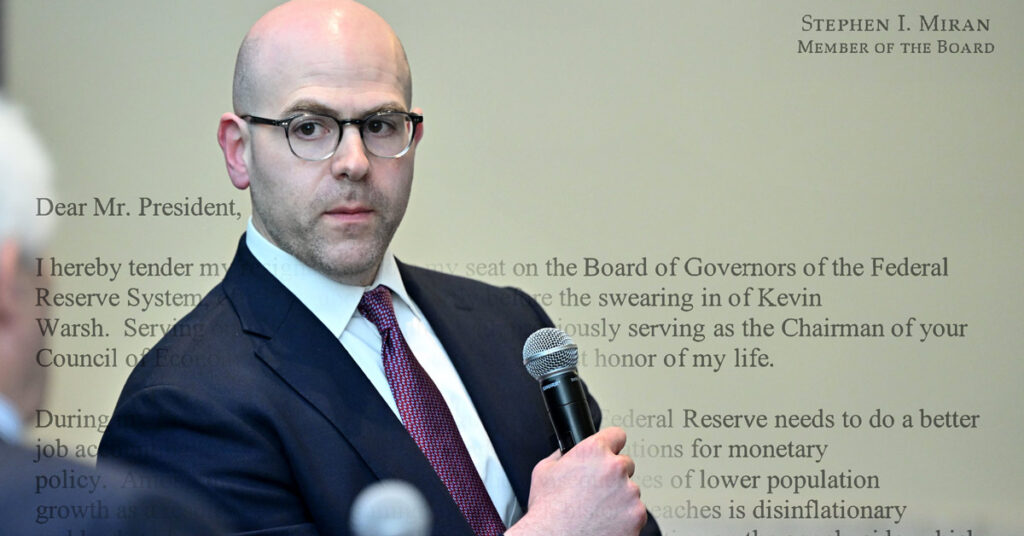
Tendering his resignation from the U.S. central bank on Thursday, Miran expressed optimism about his replacement as Fed governor, Kevin Warsh, who was also confirmed as Fed chairman on Wednesday.
“Going forward, I am excited about changes Chairman-designate Kevin Warsh and the Federal Reserve may make in areas such as communications policy, balance sheet policy, and keeping the Federal Reserve to its narrow mandate and out of hot-button political and cultural issues,” said Miran in his letter to President Donald Trump.

Nominated by Trump last summer to fill a temporary vacancy on the central bank’s governing board, Miran outlasted the January expiration date on the role he assumed on Sept. 16, which had been vacated by ex-governor Adriana Kugler following an ethics probe.
However, Miran’s inevitable departure was sealed when Fed Chair Jerome Powell announced in late April that he would retain his governorship position after his term as chair ends on Friday.
Powell’s governor term expires in 2028, though he intends to step down once he is confident that a Department of Justice probe into a costly renovation of the Fed’s headquarters is fully resolved.
Theoretically, Miran could be renominated to serve on the Federal Reserve Board when Powell departs. Trump recently threatened to fire Powell if he did not resign as governor when his chair term ends.
“Serving on the Board, together with previously serving as the Chairman of your Council of Economic Advisers, has been the highest honor of my life,” wrote Miran, addressing Trump. Miran had taken an unorthodox leave of absence from his White House job while serving as a Fed governor, but eventually resigned that post in February.
During his short tenure at the Fed, Miran voted at six Federal Open Market Committee (FOMC) meetings, each time dissenting with the consensus view.
As policymakers lowered the federal funds rate by 0.25% in the last three meetings of 2025, for example, Miran advocated for jumbo 0.5% reductions. When the FOMC held rates unchanged in January, March and April of this year, he dissented in favor of quarter-point cuts.
Miran’s stance on interest rates and the Fed’s balance sheet strategy reflected his assessment that “often underappreciated” overlaps between regulatory and monetary policy following the 2008 financial crisis have established an environment of regulatory dominance, distorting financial markets and effective monetary policy transmission.
In particular, Miran has said the Fed should strive for “the smallest footprint it can manage” to limit distortions in the provision of credit that can be fueled by large-scale asset purchases.
“While I have no bias against nonbank financial companies, credit allocation should be driven by market forces, not regulatory arbitrage,” Miran said in November at an economics event in Washington, D.C.
He took that message on the road to Greece in January, where he rejected concerns voiced by fellow colleagues at the Fed that criminal probes into Powell and the Fed undermined U.S. central bank independence.
“Regulations can have far larger consequences for the supply side than, for example, taxes, because they amount to outright prohibitions and thus function as infinite taxes,” Miran said at the Delphi Economic Forum in Athens, citing regulatory burdens to home building pushing builders to “exit entire markets, leaving numerous large metro areas without desperately needed supply.”
In Thursday’s resignation letter, Miran underscored his efforts to advance the Trump administration’s deregulatory efforts, which included setting the table for Warsh to pursue his own stated ambitions for balance sheet reduction.
“Laying out paths by which the balance sheet can be reduced, thereby shrinking the Federal Reserve’s role in the financial system, was a major workstream for me this spring,” Miran wrote.