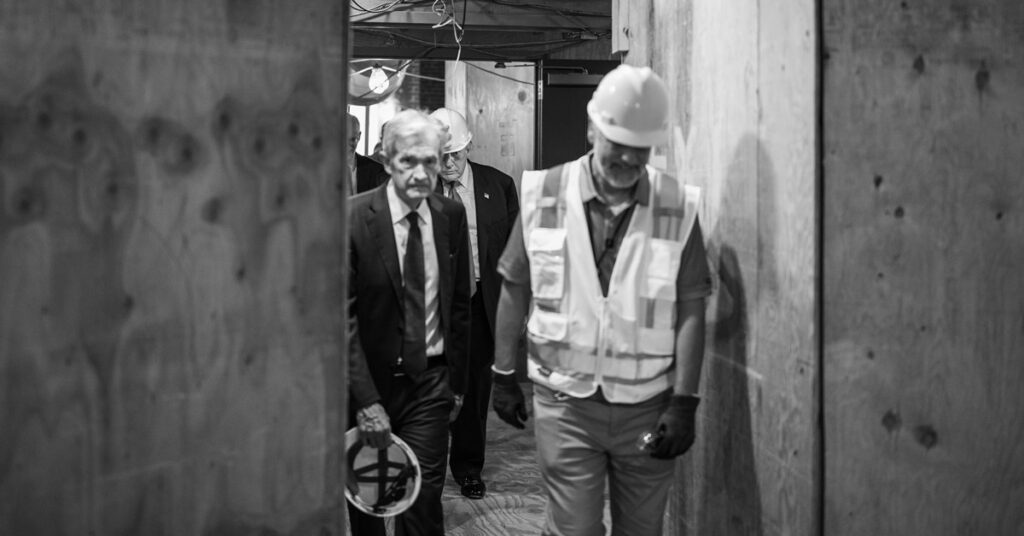
The Federal Reserve’s internal watchdog says neither criminal nor administrative misconduct led to costly delays and budget overruns as part of an ongoing renovation of the Fed’s headquarters.
But deep oversight failures and deficiencies in project management, such as the lack of a formal framework for monitoring the renovation’s progress, were extensively documented in a 120-page report unveiled by the Fed’s Office of Inspector General (OIG) on Wednesday.
“For example, rather than establish a project cost ceiling and manage to it, the Board increased the project’s budget as costs escalated, thereby creating a pay-as-you-go approach,” said the OIG. “An additional governance concern was the limited requirement for senior leadership to review key decisions affecting budget or scope.”
Over the past roughly six years of the project’s duration, however, operational ineptitude and not criminal wrongdoing were found to be the driver of cost overruns that have ballooned from an approved construction budget of $921 million in early 2020 to more than $2 billion as of the end of 2024.
“At no point during our evaluation did we find reasonable grounds to believe that a violation of federal criminal law had occurred requiring a referral to the U.S. Attorney General in accordance with the Inspector General Act,” the report concluded.
Former Fed Chairman Jerome Powell — who has remained on the central bank’s Board of Governors since May after being succeeded as chair by Kevin Warsh — was subpoenaed by the U.S. Department of Justice in January over allegations he had lied under oath while testifying about the cost overruns before the Senate Banking Committee in June 2025.
Powell disclosed the subpoenas in a video address, alleging that the threats of a criminal indictment were a consequence of the Fed “setting interest rates based on our best assessment of what will serve the public, rather than following the preferences of the president.”
A federal judge agreed with Powell, quashing the subpoenas in March while ruling that they lacked “proper purpose.”
Jeanine Pirro, U.S. attorney for the District of Columbia, ultimately closed the investigation into Powell, but vowed to reopen the matter pending the outcome of the OIG’s internal audit “should the facts warrant doing so.”
That internal audit, spearheaded by Inspector General Michael Horowitz, found the facts do not warrant reopening the investigation.
“While our report outlines numerous deficiencies in the management of the renovation project, resulting in our recommended corrective actions, we did not find reasonable grounds to believe that a violation of federal criminal law had occurred and did not identify violations of Board policy warranting an administrative misconduct finding,” the OIG said.
In a statement provided to Scotsman Guide on Wednesday, a spokesperson for Pirro’s office noted that it “has just received the Federal Reserve OIG report and is in the process of reviewing the 121-page report.”
OIG recommendations
The corrective actions recommended by the OIG are numerous and exhaustive, from creating a “project cost and schedule success metric” that will guide the Fed toward final completion of the renovations to exercising the audit clauses in awarded contracts to actually validate the costs it has incurred.
The report also noted that the board failed to implement previous recommendations that the OIG had made following previous Fed renovation projects that also had delays and cost overruns.
The report drew some distinctions, however, between institutional failures and underlying drivers of cost increases over the multiyear project. Inflation, for example, spiked during the COVID-19 pandemic, exacerbated by global supply chain issues that led to delays and higher costs. Challenging site conditions, such as asbestos remediation, also contributed.
But limited subcontractor bidding and significant design changes and modifications that disrupted construction schedules exacerbated the impact of market-specific factors ostensibly outside the Fed’s control.
“I am determined that all of the recommendations in your report be carried out in a systematic way that drives the work forward and keeps the parties accountable,” Warsh stated in the board’s official response, included as an appendix to the audit findings.
The OIG said it will follow up with the board quarterly to ensure that the recommendations it made are being fully addressed.