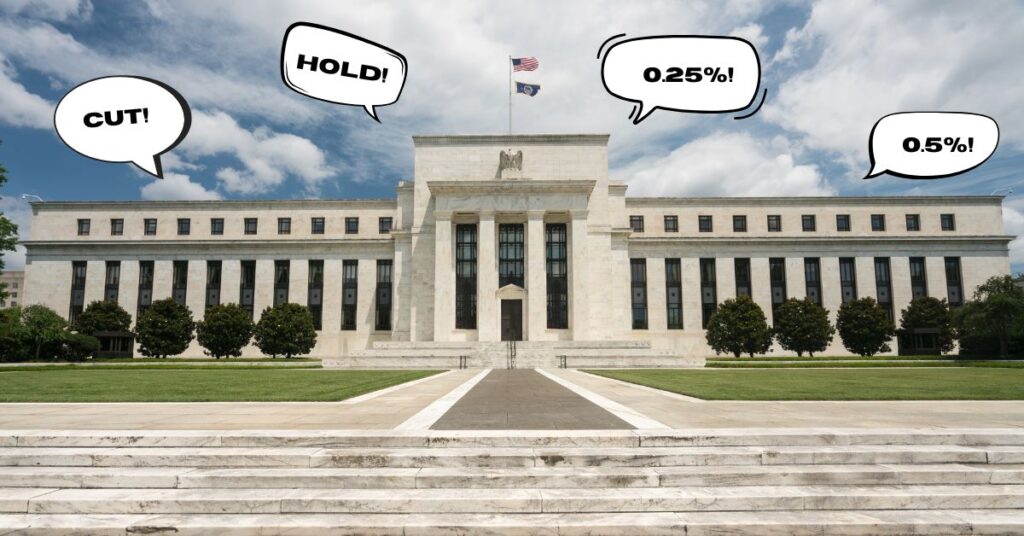
Last Wednesday, the Federal Reserve lowered its benchmark borrowing rate by 0.25% for its third consecutive meeting.
That decision — which generated three formal dissents, the most of any interest-rate decision in the past six years — reflected the economic consensus of 12 voting members on the Federal Open Market Committee (FOMC) that sets interest-rate policy.
At the press conference concluding last week’s two-day FOMC meeting, Fed Chair Jerome Powell remarked to reporters that lowering the federal funds rate to a range of 3.5% to 3.75% renders it “certainly not strongly restrictive.”
In public remarks made since then, a slew of U.S. central bankers involved in last week’s vote have sought to extract their personal policy views from the FOMC’s groupthink. The Fed has a dual mandate to maintain maximum employment and stable prices.
In a Monday post on LinkedIn, Boston Fed President Susan Collins called her vote in support of the 25-basis-point reduction “a close call,” adding that “scenarios with a notable further rise in inflation seem somewhat less likely.”
“While my analysis in November had leaned towards holding policy steady, by the December meeting, available information suggested the balance of risks had shifted a bit,” Collins wrote.
The Fed has signaled it is approaching a rate-cut pause, having lowered the fed funds rate by 1.75% since September 2024. The quarterly “dot plot” released in conjunction with last week’s decision only showed one quarter-point reduction penciled in for 2026.
“It was important to me,” Collins continued, “that the forward guidance in the Committee’s statement now echoes language in the December 2024 statement, which preceded a pause in cutting rates.”
Several shutdown-delayed government reports on employment and inflation that had yet to be published ahead of last week’s FOMC meeting are due to be published this week, throwing policymakers’ third consecutive cut into even greater focus.
Speaking Monday at a New Jersey Bankers Association event, New York Fed President John Williams provided a centrist take, echoing Powell’s frequent refrain.
“Monetary policy is well positioned as we head into 2026,” said Williams in his prepared remarks, noting that signature Trump administration tariff policies have not impacted prices as much as he expected. He forecasts inflation of 2.5% in 2026 and 2% in 2027.
He further echoed Powell in underscoring the stability of the cooling labor market while noting that projections for economic growth in 2026 have improved and the unemployment rate is likely to fall after peaking at 4.5% this year.
“The labor market is clearly cooling,” he explained, “an ongoing, gradual process, without signs of a sharp rise in layoffs or other indications of rapid deterioration.”
Chicago Fed President Austan Goolsbee, who voted to hold rates steady along with Kansas City Fed President Jeffrey Schmid, called himself “uncomfortable front-loading too many rate cuts” in a CNBC interview last Friday.
“Most of the measures of the job market have been pretty stable,” Goolsbee said. “The chance that things in the job market would fall apart rapidly within one to two months before we would visit this again feel relatively low.”
The unemployment rate ticked up to 4.4% in September, the latest month for which official government data is available.
Fed Governor Stephen Miran, whose December dissent and vote for a jumbo 0.5% reduction mirrored earlier votes at FOMC meetings in September and October, said current policy conditions are more restrictive than headline figures suggest.
“Keeping policy unnecessarily tight because of an imbalance from 2022 or because of artifacts of the statistical measurement process will lead to job losses,” he said, speaking at an event at Columbia University on Monday.
Miran said consumer prices “are now once again stable, albeit at higher levels,” acknowledging the affordability challenges many U.S. households have faced since inflation surged during the COVID-19 pandemic.