

Recent data from Cotality indicates homebuyers continue to relocate across state lines, but the rate of movement has slowed compared to previous years.
There has been a decrease in the share of out-of-state loan applications, yet migration from high-cost states to more affordable regions persists. Out-of-state home loan applications, which surged to 18% during the pandemic, have retreated to 15% in 2025.
What’s driving this change? Pandemic-induced remote work policies opened the door for workers in various sectors to live where they pleased, but now buyers are proceeding cautiously, confronted by rising housing costs, affordability challenges surrounding flexible housing expenses (such as insurance and property taxes), tougher lending standards and general economic uncertainty.

Who’s moving out?
States like California, New York and Massachusetts continue to lose more residents than they gain. California tops the list for net out-migration in 2025, followed closely by New York and Massachusetts.
Still, the pace of departures has cooled compared to previous years. For example, the out-in ratio for California dropped to 4.6 in 2025 from 5.6 in 2021. High housing prices, property tax burdens, climate risks and quality of life concerns remain the strongest drivers of out-migration.
Who’s moving in?
On the flip side, more affordable states have attracted new residents. South Carolina, Florida and Texas lead the pack for in-migration in 2025, followed by Georgia, Nevada and Tennessee. For years, Florida and Texas were the go-to choices, but South Carolina has taken the top spot since 2024.
Although these states continue to attract out-of-state homebuyers, the rate of in-migration has slowed from previous years. For instance, Florida’s in-out ratio declined from 2.5 in 2021 to 1.5 in 2025.
Interstate flows
An analysis of interstate migration patterns from 2024 to 2025 indicates that Florida, Texas and the Carolinas remain popular destinations for new residents, whereas higher-cost states like California and New York continue to experience net homebuyer outflows.
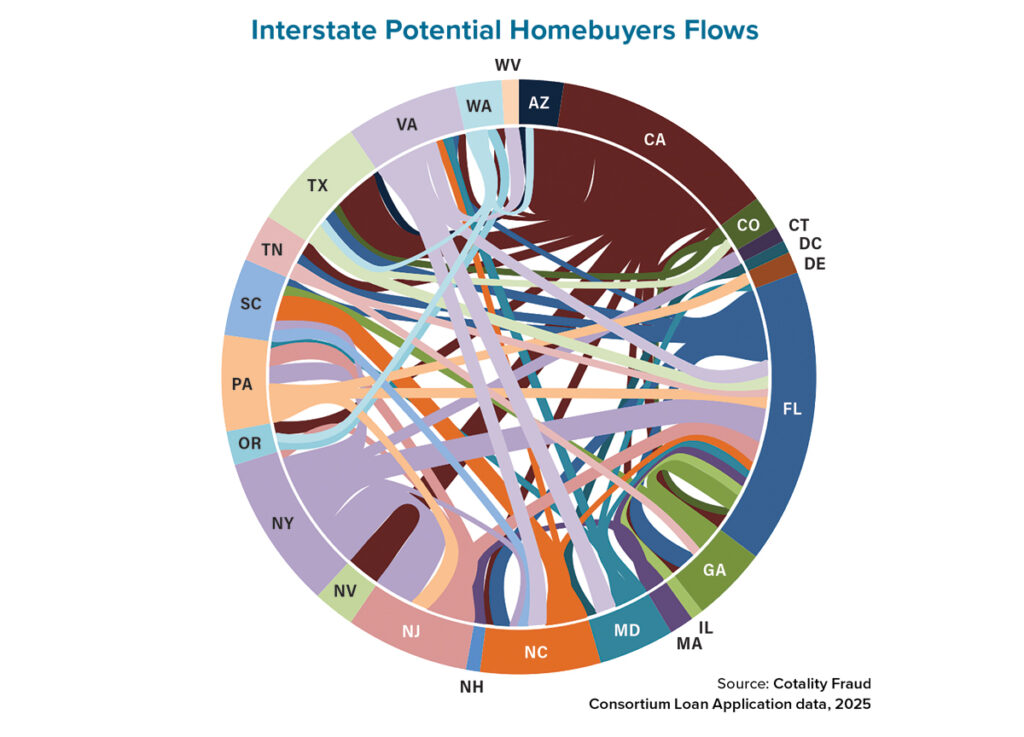
The above graphic presents a chord diagram tracking the interstate migration of potential homebuyers in the states with higher numbers of moves from January 2024 to August 2025. Each chord represents migration between states, with colors matching the state of origin.
Higher-cost states, such as California and New York, saw applicants migrating to more affordable neighboring states. For example, California experienced a net loss of potential homebuyers to Texas, Nevada and Arizona. Similarly, New York lost a good share of its potential homebuyers to affordable neighboring states New Jersey and Pennsylvania, in addition to sunny Florida.
While Florida attracted some applicants from high-cost areas such as New York, New Jersey and California, Floridians themselves migrated to nearby states in response to rising home prices and increasing property insurance costs. Similarly, South Carolina has drawn homebuyers from adjacent states, including those with lower housing costs, due to its affordability, low property tax rates and temperate climate.
The bigger picture
Americans are still chasing affordability and a better lifestyle in the Sun Belt, but the frenzy of pandemic-era moves is tapering off.
High homeownership costs and the “lock-in effect” — where homeowners hesitate to give up low mortgage rates — are keeping many people from making a move. In short, the great migration isn’t over — it’s just recalibrating and evolving.