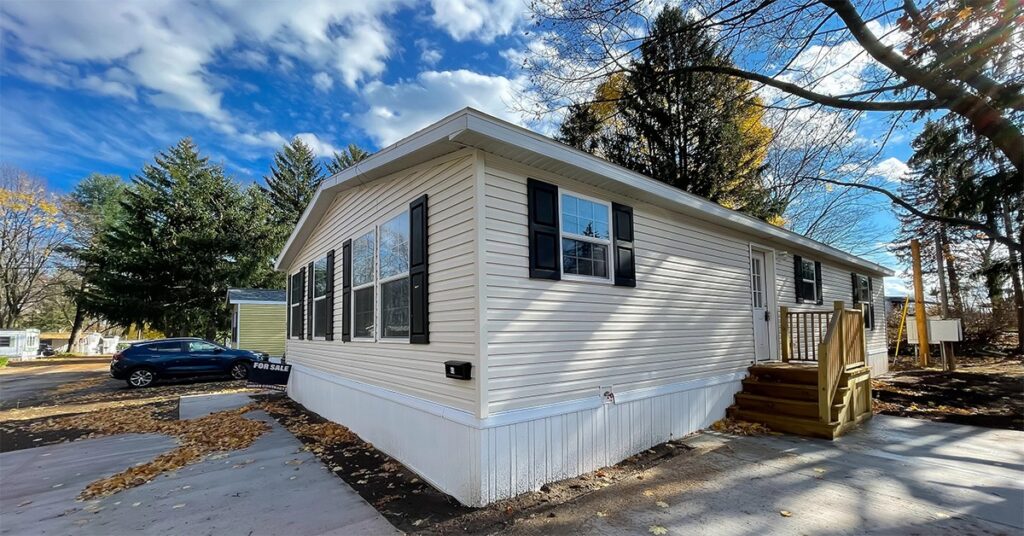
Makers of manufactured housing may have cheered the passage of the 21st Century ROAD to Housing Act this past July, but there remain many barriers to expanding the relatively cheap housing alternative.
The new law calls for the removal of the permanent steel chassis requirement, allowing qualifying manufactured homes to more closely resemble site-built housing and potentially reduce production costs, according to a new report by Marcus & Millichap.
Provisions in the housing bill also require the Federal Housing Administration and the Department of Housing and Urban Development (HUD) to improve access to mortgage financing for manufactured homes and to encourage localities to loosen zoning restrictions on manufactured housing, long the ugly duckling of the housing sector.

Those changes ultimately “reflect a growing recognition among policymakers that manufactured housing could play a larger role in expanding attainable homeownership opportunities amid a persistent national housing shortage,” writes Marcus & Millichap.
However, numerous challenges still must be overcome — not the least of which is that the scope and timing of the required changes remain uncertain. Some of the proposed changes will take time as government regulators grind through the available policy options.
HUD, for instance, which has seen its staff dramatically reduced due to federal workforce reductions, is responsible for implementing most of the new requirements and must undertake extensive rulemaking and administrative actions. Marcus & Millichap assesses that those actions will be undertaken with a staff 27% smaller than it was just one year ago.
Another potential barrier is that many of the policy changes affecting manufactured housing would involve modifying state and local regulations, where adoption may vary. Local zoning restrictions are seen as a crucial problem, with many communities wanting to limit the locations of manufactured housing communities (MHCs).
Financing issues also continue to limit affordability. While manufactured housing is generally cheaper than traditional site-built housing, Marcus & Millichap writes that many buyers — especially tenants who place their homes on rented land in MHCs — rely on home-only loans with borrowing costs far above conventional mortgages.
In some instances, mortgage interest rates on those loans can range up to 12%. The high interest rates have the greatest impact on low-income families, the main buyers of manufactured housing. Until federal reforms are adopted, access to affordable financing will remain a problem.
But demand remains strong. Limited new expansion in recent years has kept national vacancy rates at around 5% in MHCs. Rent growth of 6.2% was recorded so far in 2026, down from a 7.9% increase posted last year. One sign of the strong demand is that several markets have recorded inventory growth as well as above-average rent gains.
Another sign of strength is that sales involving MHCs have remained steady. Transactions in the first eight months of 2026 have already surpassed the annual totals for both 2023 and 2024 but were below the high level reached in 2025. This may be due to the ongoing economic uncertainty and the current high interest rate environment.
Age-restricted communities are also seeing limited new developments, stable vacancy rates and strong rent growth. In Florida, Arizona and California, where there are large numbers of age-restricted properties, aging populations continue to support long-term tenant demand, despite in-migration to many Sun Belt markets beginning to slow.