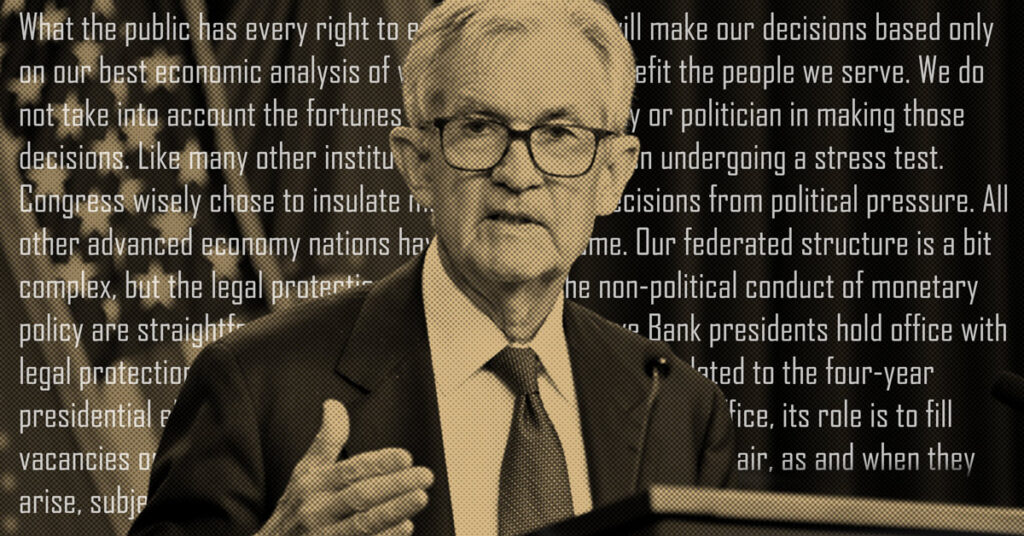
Federal Reserve Governor Jerome Powell cautioned against the removal of U.S. central bank officials on the basis of policy differences while delivering prepared remarks over the weekend in an award acceptance speech.
“If any administration finds a way to remove Fed officials over policy differences, then future administrations will do so as well,” cautioned Powell in his first public remarks since Kevin Warsh succeeded him as Fed chair in late May.
“The public would lose faith that the central bank will make decisions based only on what’s best for all Americans,” continued Powell, speaking in Minneapolis after receiving the John F. Kennedy Profile in Courage Award. The annual recognition is bestowed by the JFK Library Foundation to honor the life and legacy of the 35th president of the U.S., who was assassinated in 1963 when Powell was in fifth grade.

The selection committee broke with custom, however, in granting the recognition — ordinarily reserved for elected officials — upon Powell. He served two successive four-year terms as Fed chair following nominations by Presidents Donald Trump and Joe Biden.
Powell’s remarks follow the Fed’s Office of Inspector General announcing last week that it was reviewing the process by which the 12 regional Fed bank presidents are nominated and reappointed to five-year terms. The internal watchdog said it seeks to determine whether the process for nominating and reappointing regional Fed presidents “aligns with relevant Federal Reserve Administrative Manual requirements and leading practices.”
A ‘priceless asset’
In Sunday’s speech, Powell underscored the historic role of the U.S. as standard-bearer of global democratic norms, the durability of public institutions in the U.S., and the “priceless asset” of the Fed’s credibility in stewarding the nation’s economy. He pontificated but did not linger on any particular stresses impacting consumers, businesses or the financial system.
That made his remarks about preserving the independence of the 12 regional Federal Reserve banks all the more notable.
“When a new administration takes office, its role is to fill vacancies on the Board of Governors, and for chair and vice chair, as and when they arise, subject in all cases to Senate confirmation,” explained Powell. “Administrations play no role in the selection or oversight of the 12 Reserve Bank presidents.”
Instead, the Fed’s seven-member board approves the appointments of regional Fed presidents, five of whom rotate onto the Federal Open Market Committee that votes on interest rate adjustments. Regional Fed presidents are nominated by the regional banks’ outside directors representing those areas’ business communities.
Eleven of the 12 regional presidents were unanimously reappointed in February. Turning 60 years old this month, Atlanta Fed President Raphael Bostic announced last November that he would not be seeking another term, despite remaining eligible to serve until a mandatory retirement age of 65.
“My travels over the past several months have made clear that the legal and rhetorical battles raging around the central bank right now have caused people across a wide cross-section of our population to begin to doubt the Fed’s independence,” said Bostic in late February, delivering final remarks as a regional president. “This is a major concern.”
Broadsides by the Trump administration and a criminal investigation that Powell publicly framed as a political assault against the independence of U.S. monetary policy ultimately led the former chair to retain his seat on the Board of Governors after Warsh succeeded him as chair.
Announcing that decision in late April, Powell also cited an ongoing Supreme Court case concerning Trump’s attempted firing of Fed Governor Lisa Cook over unproven allegations of mortgage fraud as justification for staying on the board until a time “to be determined.”
But as the Fed’s Office of Inspector General reviews the handling of cost overruns associated with a renovation of the central bank headquarters — which also formed the legal basis for the Trump administration’s criminal inquiries into Powell — it is also embarking on a review of regional presidents that opens a door for political interference.
“Like many other institutions, the Fed has been undergoing a stress test,” Powell said on Sunday, without referencing any test in particular.