Russell Vought, the outgoing acting director of the Consumer Financial Protection Bureau (CFPB), defended his 17-month record of reining in the agency’s enforcement apparatus during Senate testimony on Thursday, his first appearance before the upper chamber since taking over the bureau last February.
During his tenure, Vought has championed an overhaul at the CFPB that has included so-called “humility pledges” read by examiners before bank examinations, as he confirmed Thursday, and a massive realignment of supervisory and enforcement priorities that aligns with his personal view that the CFPB should not exist.
“You’re in favor of getting rid of the CFPB, right? You’d like to get rid of it entirely?” asked Chris Van Hollen, D-Md., on Thursday morning.

“Yes,” replied Vought, who has opened no new enforcement actions over the past year and a half.
Describing the CFPB in his opening remarks as “weaponized” under the Biden administration, Vought said the bureau — created by the 2010 Dodd-Frank Act following the 2008 financial crisis — has “imposed huge costs on the American people” including “reduced product offerings” and “higher borrowing costs.”
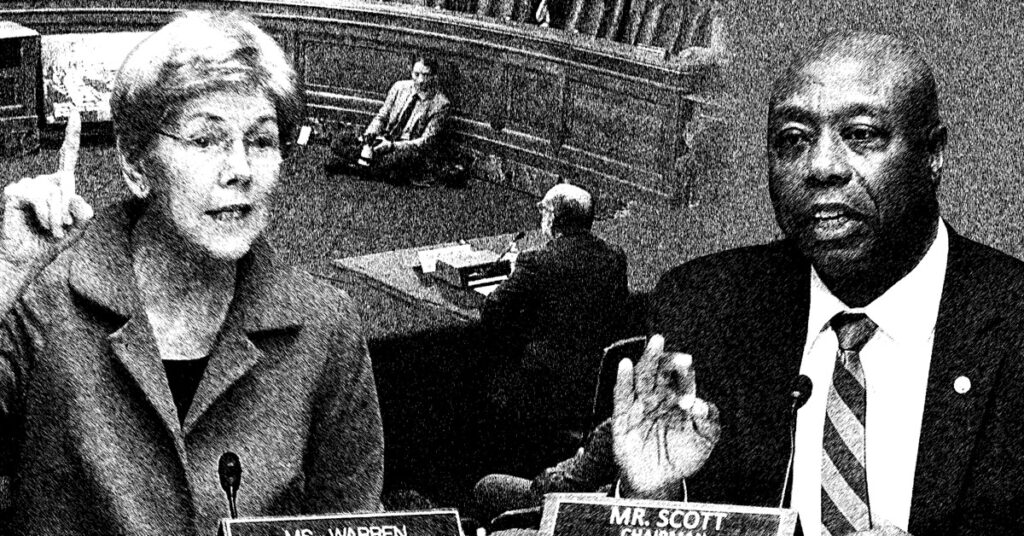
Contesting those claims, Elizabeth Warren, D-Mass., the ranking member of the Senate Committee on Banking, Housing, and Urban Affairs before which Vought was testifying, said CFPB enforcement has returned $21 billion to “cheated” consumers, while accusing Vought of enabling companies to unwind approved settlements.
“How many of the enforcement actions and investigations that you dropped were against companies that have donated to President Trump?” asked Warren, citing “40-plus” companies including Apple, Bank of America, Capital One, Walmart, Meta and JPMorgan Chase that have had CFPB actions dropped under the second Trump administration.
“I have no idea because I never look at such things,” Vought replied, who will continue to serve as head of the White House Office of Management and Budget after his interim leadership at the CFPB ends on August 1. President Donald Trump has nominated Brian Johnson, a former deputy director of the bureau during his first term, to succeed Vought.
Other Democratic members of the housing and banking committee also challenged Vought on a series of controversial actions Vought has taken at the CFPB.
“What is your obsessive concern about CDFIs?” asked Mark Warner, D-Va., referring to community development financial institutions, which have statutorily mandated access to funds at the U.S. Treasury Department to expand credit in underserved communities.
CDFIs enjoy strong bipartisan support in Congress, as evidenced by a pair of letters sent to the Treasury Department and CFPB last fall — one signed by powerful housing and banking industry groups, the other signed by more than 100 Republican lawmakers — urging Vought and the Trump administration to cease efforts to defund CDFIs.
“My concern, and we have had a dim view of this program as an administration, but there’s tons of examples, and I can go through them,” responded Vought, “where in the last administration they were incredibly woke, and we have concerns with that.” He also voiced concerns about CDFIs not having to comply with ability-to-repay mortgage lending rules.
Citing comments made by Vought about his desire for federal government employees to be “traumatically affected” by large-scale staffing cuts undertaken by the Department of Government Efficiency last year, Warner demanded that Vought assign himself a grade on “how much trauma” he has brought to federal workers.
At first Vought disputed the premise of Warner’s question, offering to clarify his previous comments, but under repeated questioning stated, “We’ve done an excellent job of running the CFPB.” Vought has aggressively sought to downsize, if not eliminate, the bureau, but several federal court rulings have stymied those efforts.
Angela Alsobrooks, D-Md., whose state has roughly 160,000 federal government employees, also zeroed in on Vought’s stated desire to traumatize federal workers, describing his efforts to do so as White House budget chief as “evil.”
Republican senators on the committee largely applauded Vought’s downsizing efforts, which have included rescinding controversial rules issued under Biden-era CFPB director Rohit Chopra. Critics accuse Chopra of violating required rulemaking processes in issuing new rules and guidance, as well as enforcement overreach.
“When the CFPB writes a rule like these, who ends up paying the cost?” asked Pete Ricketts, R-Okla., who serves on the Subcommittee on Financial Institutions and Consumer Protection.
“Consumers pay the cost with higher amounts of spending, and sometimes the product doesn’t get put on the market,” replied Vought.
“What should Congress learn about, over the last several years, the risk of giving one unelected director so much unchecked authority?” asked Katie Britt, R-Ala.
“Well, I would say senator, that the biggest issue is not the one director as much as it is not being subject to the appropriations process,” Vought answered, calling the manner in which the CFPB is funded through the Federal Reserve as its “main defect” for depriving Congress the ability to ask bureau directors to justify their running of the agency.
“What changes have you made to the bureau’s enforcement approach to ensure enforcement is focused on clear violations rather than novel legal theories or political priorities?” asked Britt, who also sits on the Senate Appropriations Committee, citing the lack of regulatory and enforcement certainty critics say Chopra’s approach created.
“We’ve been very clear with our priorities. We’ve stated those priorities,” Vought replied. “We’ve taken a lot of steps to cancel enforcements that were done on novel legal theories that we didn’t have the statute to do, and we’ve focused on identifiable victims, actual consumer harm that’s material and measurable.”
Thursday’s appearance was Vought’s second consecutive day of testifying, after he spent three hours Wednesday before the House Committee on Financial Services.