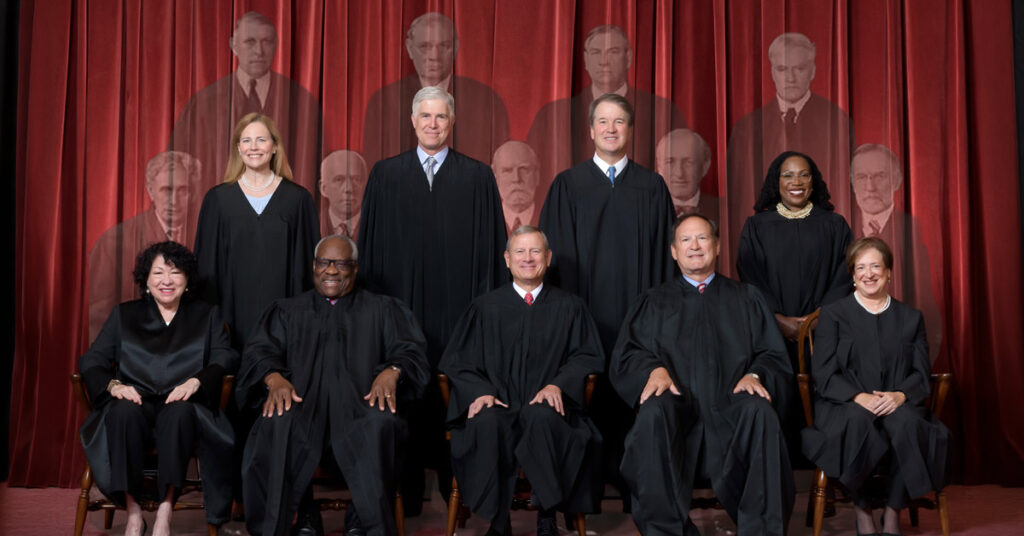
The Supreme Court ruled Monday that U.S. presidents have the authority to remove members of independent federal agencies without cause, overturning 91 years of legal precedent.
In a 6-3 decision, the court decided that President Donald Trump’s removal of Rebecca Slaughter, a Democratic member of the Federal Trade Commission (FTC), was lawful, despite no reason being given for her termination.
“Although it is up to the Senate to decide whether to confirm those with whom the President would prefer to work, neither Congress nor the courts may saddle him with those with whom he cannot work,” wrote Chief Justice John Roberts, who italicized those words in his majority opinion. The court’s three liberal justices dissented.

The FTC, a powerful federal agency that investigates and enforces consumer protection laws while issuing rules and opinions that standardize trade and business practices, was traditionally a five-member panel required by Congress to be bipartisan.
Overriding that statutory requirement, the Supreme Court ruling represents a major expansion of presidential power over independent agencies. It also throws into question the removal protections extended to members of other independent federal agencies like the Securities and Exchange Commission (SEC), the Equal Employment Opportunity Commission and the Merit Systems Protection Board.
The court’s conservative majority ultimately ruled that presidents should have the ability to choose and remove delegates of executive branch authority.
“Subordinates who exercise the President’s power are subject to removal by him,” added Roberts. “Then, and only then, can they remain accountable to the President, and the President to the people.”
Removal protections afforded under the 1935 Supreme Court precedent known as Humphrey’s Executor, which shielded independent federal workers like Slaughter, have been waning for years.
In 2020, during Trump’s first term, the Supreme Court ruled that the director of the Consumer Financial Protection Bureau could be removed without cause due to the CFPB’s single-director (as opposed to multimember) structure. In 2019, the court had also ruled that Federal Housing Finance Agency directors could be fired at will.
“Today’s decision negates Congress’ efforts to make federal agencies operate in an expert and bipartisan manner and instead ensures that they will be political footballs to be kicked around by the current and future presidents,” Richard Cordray, who served as the first director of the CFPB from 2012 through 2017, told Scotsman Guide.
Cordray resigned as head of the financial watchdog agency in November 2017, saying that Trump and White House budget chief Mick Mulvaney worked to undermine him and the bureau.
Potential mortgage impacts
Monday’s ruling in Trump v. Slaughter effectively overturns the Humphrey’s precedent for good. For highly regulated industries like mortgage finance, the decision introduces a range of uncertainties.
“This now affects the National Credit Union Association, FTC and SEC, regarding agencies most relevant to mortgage,” said Mark McArdle, head of public policy and regulatory affairs at lender-servicer Newrez.
Former assistant director of mortgage markets at the CFPB from 2017 to early 2025, McArdle thinks mortgage companies and credit unions will likely have to prepare for more dramatic regulatory shifts when presidential administrations change, potentially reinforcing the “rulemaking by enforcement” paradigm for which the CFPB has long been criticized.
“It will make those agencies more subject to political will and potentially big swings every four years, adding to regulatory uncertainty,” said McArdle, citing “increased lookback regulatory risk as each new regime can scrutinize what went before.”
Jonathan Kolodziej, a partner at financial services law firm Bradley Arant Boult Cummings, believes the impact of eliminating removal protections for members of independent federal agencies may be more muted, at least in the near term.
“I actually don’t think the overturning of Humphrey’s Executor will have any immediate impact on the mortgage industry,” said Kolodziej, who advises mortgage companies on compliance with state and federal consumer financial laws.
The FTC and SEC, while relevant to mortgage compliance in the statutes they enforce and oversee, “are not significant players in day-to-day mortgage regulation or oversight,” he added in emailed remarks to Scotsman Guide.
“It certainly is the final blow to what seems to have previously been the chipping away of Humphrey’s Executor over the years,” said Kolodziej. “But most of the regulators with jurisdiction over the mortgage industry, like the CFPB and FHFA, have already been subject to the president’s removal power in other cases.”