Rising foreclosure auction volume in 2026 is being driven largely by recent vintage loans with little or no equity. This shift in the mix of distressed loans, combined with a sluggish retail housing market in many parts of the country, is changing the loss severity calculus for mortgage servicers and government policymakers, prompting lower pricing at foreclosure and bank-owned auctions.
The good news is that in a transparent marketplace, these pricing adjustments are helping spur more demand and competition from auction buyers. That is helping the market find equilibrium and minimize loss severity for servicers and government agencies.
Foreclosure auction volume in the second quarter of 2026 increased 23% from a year ago, matching a six-year high from the previous quarter, according to the latest “Auction Market Dispatch” report from Auction.com. Foreclosure auction volume has now increased on an annual basis for six consecutive quarters and is 34% below its pre-pandemic level in the first quarter of 2020.

Forty-five percent of foreclosure auction volume during the second quarter of 2026 came from mortgages originated in 2022 or later, with volume for that loan set increasing 104% from a year ago. Among recent vintage volume, 44% was from loans insured by the Federal Housing Administration, but a substantial 33% came from loans backed by Fannie Mae and Freddie Mac.
The growing share of foreclosure auction volume from recent vintage loans is significant because these loans tend to have relatively little borrower equity. The lower equity profile of these loans is also associated with a higher roll rate from scheduled to completed foreclosure auction, likely because homeowners have less means and motivation to avoid foreclosure. During the second quarter, the roll rate for post-2021 vintages was 30.6% versus the overall rate of 25.2%.
The lower equity profile also means less demand from foreclosure auction buyers when the credit bid is set at the total debt owed. If the debt owed approaches or exceeds the property’s estimated value, prospective buyers have little margin for profit or unexpected costs.
Loans originated in 2022 or later that were brought to foreclosure auction during the second quarter had an average debt-to-value ratio of 97.5%, compared to an 83.4% ratio for all vintages combined. The debt-to-value ratio was much lower for earlier vintage buckets. For example, it was 66.4% for loans originated between 2015 and 2019, which accounted for about 16% of all foreclosure auction volume during the quarter.
For older vintages, setting the credit bid at total debt still leaves sufficient margin for potential buyers, helping attract auction attention. That is not the case for recent vintage loans.
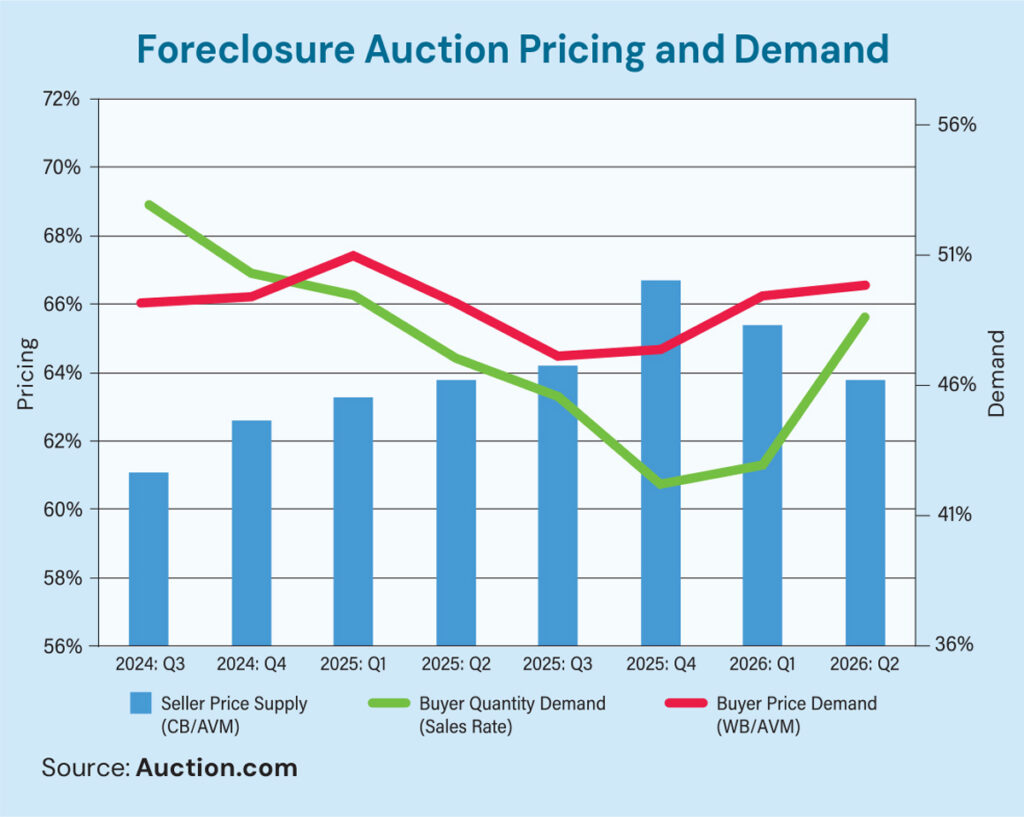
In the second quarter, the average credit bid-to-value ratio for post-2021 vintage loans was 70.1%, compared with 64.4% for all loan vintages. The higher pricing left less potential margin for auction buyers. Not surprisingly, the auction sales rate — a proxy for buyer demand — was significantly lower for post-2021 vintages, at 41.1% compared to 48.9% for all vintages.
The good news is that pricing on these recent vintages seems to be moving toward a more market-clearing level as servicers and policymakers adjust to the evolving landscape. At the same time, the first-quarter sales rate was only 32.8%, compared with 41.1% in the second quarter, as the higher pricing likely discouraged more potential auction buyers.
Another positive for loss severity is that in the second quarter, lower pricing did not result in a corresponding drop-off in what winning bidders were willing to pay relative to market value.
Despite the nearly five-point drop in pricing for loans originated in 2022 or later between the first and second quarters, the average winning bid-to-value ratio declined only 1.3 percentage points, from 70.9% to 69.6%. That appears to be a favorable trade-off, considering the spike in sales rate from 32.8% to 41.1%. The results suggest that transparent, competitive auctions can help balance buyer demand with loss severity.