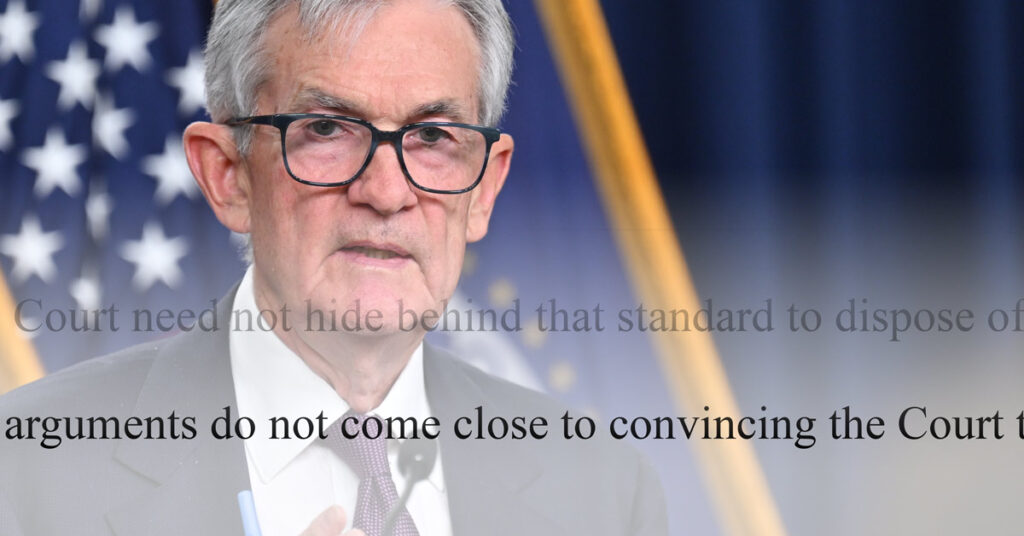
A federal judge denied the U.S. government’s attempt to reinstate grand jury subpoenas directed against the Board of Governors of the Federal Reserve System and Fed Chair Jerome Powell.
Chief U.S. District Judge James Boasberg, of the District of Colombia, ruled the government had failed to provide new evidence or point to any material error to justify reviving what the court previously deemed an improper criminal investigation targeting Powell.
The opinion could set up an appeal that would delay President Donald Trump’s efforts to see Kevin Warsh installed as the next Fed chair.

In the six-page memorandum of opinion, the court firmly rejected the government’s motion to reconsider its March 13 ruling that originally quashed the subpoena efforts — an effort the Federal Reserve opposed.
Boasberg maintained that the government lacked a good-faith basis to suspect a crime, and he concluded that the obligation for reconsideration of his prior ruling that the Powell probe had not been met.
“The Government’s arguments do not come close to convincing the Court that a different outcome is warranted,” the judge wrote in the opinion. He re-affirmed his position that the “dominant purpose” of the subpoenas was not a legitimate investigation, but rather an effort to pressure Powell to lower interest rates or resign.
He faulted the government for failing to argue otherwise, concluding the administration’s legal case “ignores the fact its total lack of a good faith-basis to suspect a crime is relevant” to establishing its argument to reinstate the subpoenas.
The government “spent all of one sentence” to make this case, Boasberg stated, adding: “nothing in the Motion for Reconsideration changes the Court’s view of the appropriate legal framework, most of which the Government does not even contest.”
The legal clash comes amid ongoing political pressure on the central bank — a dynamic closely watched by the mortgage and real estate industries, whose markets are highly sensitive to the Fed’s interest rate policy.
In its motion for reconsideration, the government argued that the court had applied an incorrect legal standard, asserting that prosecutors are not required to produce evidence of a crime before issuing a grand-jury subpoena to discover new information. The court acknowledged that the initial bar for issuing a subpoena is indeed low, but emphasized that a second, separate standard limits that power: a subpoena’s dominant purpose cannot be improper.
The government issued the subpoenas under the stated auspices of investigating whether Chairman Powell lied to Congress and looking into suspected fraud related to Federal Reserve building renovations. However, resolving whether the investigation was legitimate required the court to examine the strength of the government’s claims. According to the ruling, the government failed to back up its assertions, with Judge Boasberg writing that it presented “no evidence whatsoever of fraud.”
Instead, the court’s decision highlighted a sequence of events pointing to an improper motive fueled by executive branch pressure. The ruling noted that President Trump had spent years attacking Powell and suggesting he be investigated. The judge pointed out that after the investigation was opened, the President reportedly berated a gathering of U.S. Attorneys for not aggressively prosecuting his opponents. The U.S. Attorney’s Office served the subpoenas on the Board the very next day.
The government attempted to argue that because the subpoenas were directed at the Board rather than Powell directly — with one not even mentioning him by name — they could not have been meant to pressure him. Judge Boasberg dismissed this argument entirely. The judge noted that one subpoena specifically sought records regarding Powell’s congressional testimony, while the other sought records on building renovations whose high costs the President had repeatedly tried to blame on the Fed Chair.
“No matter whom the subpoenas were addressed to, then, it was clear whom they sought dirt on: Powell,” Boasberg wrote.
The Trump administration’s pursuit of the Powell probe has drawn bipartisan backlash, including from Sen. Thom Tillis (R., N.C.), who has said he will hold up Warsh’s nomination process until the administration concludes its Powell investigation.