
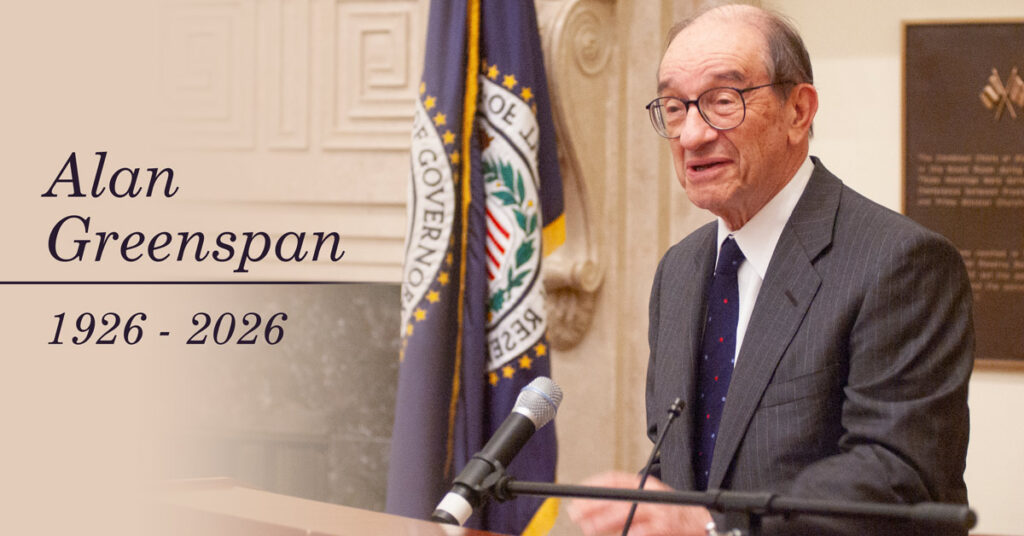
Alan Greenspan, the long-serving Federal Reserve chair from 1987 to 2006, died Monday from complications linked to Parkinson’s disease, according to a family statement. He was 100 years old.
Head of the U.S. central bank for more than 18 years under four consecutive presidents, Greenspan was first appointed to the role by President Ronald Reagan and led the U.S. economy through two decades of expansion fueled by rapid globalization and technological innovation.
“It’s just a sad day for the Fed,” said Fed Governor Christopher Waller, noting Greenspan’s passing in welcoming remarks while kicking off a New York Fed conference on Monday.

Serving under Presidents Reagan, George H. W. Bush, Bill Clinton and George W. Bush, Greenspan was the second-longest-serving chair in Fed history. He was a strong proponent of banking deregulation as an advocate of private companies’ ability to police themselves.
Concerning monetary policy, Greenspan is widely credited with sustaining a long era of low inflation amid strong economic growth, while steering markets through a range of geopolitical upheavals, from the collapse of the Soviet Union in the 1990s to the Sept. 11, 2001, terrorist attacks and subsequent U.S. invasion of Iraq.
In a statement noting “deep sadness” over his passing, the Federal Reserve reflected on Greenspan’s legacy as central bank chairman.
“Under his leadership, the Federal Reserve achieved a sustained era of price stability that supported economic growth and helped anchor the public’s confidence in the institution,” the Fed stated. “He brought rigorous analytical discipline to monetary policymaking and helped establish the credibility that remains one of the Federal Reserve’s most important assets.”
Succeeded by Fed chairs Ben Bernanke, Janet Yellen, Jerome Powell and, just recently, Kevin Warsh, Greenspan pioneered a more interventionist Fed that was willing to protect financial markets during downturns, effecting a policy that became known as the “Greenspan put.”
But the dot-com crash of the early 2000s became an enduring stain on Greenspan’s legacy, when many early internet-based companies collapsed, leading to widespread job and investment losses.
The inherent risks of Greenspan’s laissez-faire regulatory approach also became apparent during the 2008 financial crisis, when ultra-low interest rates set during the tail end of his central bank tenure led to a housing bubble and subsequent crash, exacerbated by predatory subprime lending.
“More than 30 years of deregulation and reliance on self-regulation by financial institutions, championed by former Federal Reserve chairman Alan Greenspan and others, supported by successive administrations and Congresses, and actively pushed by the powerful financial industry at every turn, had stripped away key safeguards, which could have helped avoid catastrophe,” read a bipartisan report published in 2011 by the Financial Crisis Inquiry Commission, assembled by Congress to identify drivers of the crisis.
Current Fed Governor Michael Barr has warned that a similar historical pattern is emerging as the Trump administration pursues an aggressive banking deregulation agenda, including the gutting of the Consumer Financial Protection Bureau and weakening of other financial guardrails implemented after the 2008 crisis.
Doug Duncan, former chief economist at Fannie Mae from 2009 to 2025, called Greenspan’s “unique insights into the damage inflation does to businesses and households” a perspective that “he alone among modern central bankers held due to his experience as a private business forecaster early in his career.”
Greenspan famously said during a Federal Open Market Committee meeting in 1996 that the appropriate level for inflation was 0% — if measured correctly. By 2012, Greenspan’s successor, Ben Bernanke, had formally made the Fed’s inflation target 2% on an annualized basis.
“The irony of his reputation being sullied by his trust in markets and the resulting Great Financial Crisis is that none of the rest of the huge financial market regulatory apparatus detected the oncoming crisis either and the apparatus grew in spite of its failure,” said Duncan, reflecting on Greenspan’s policy impact in remarks shared with Scotsman Guide.
Assessing Greenspan’s “enduring legacy,” current New York Fed President John Williams released a statement praising his “dedication to the institution, the field of economics and public service,” which he believes “continues to inspire generations of central bankers.”
Donald Kohn, who served as vice chair of the Fed from 2006 to 2010, shared a personal anecdote in commentary published Monday by the Brookings Institution.
“We were reminiscing during a recent visit at his home, and Alan summed it up with, ‘We had fun, didn’t we, Don,’” Kohn wrote. “Yes, Alan, we had fun — maybe as only a couple of policy nerds would define that word. And his ‘fun’ enriched policymaking and economic analysis in the U.S. and around the world.”